
New BEV Brands
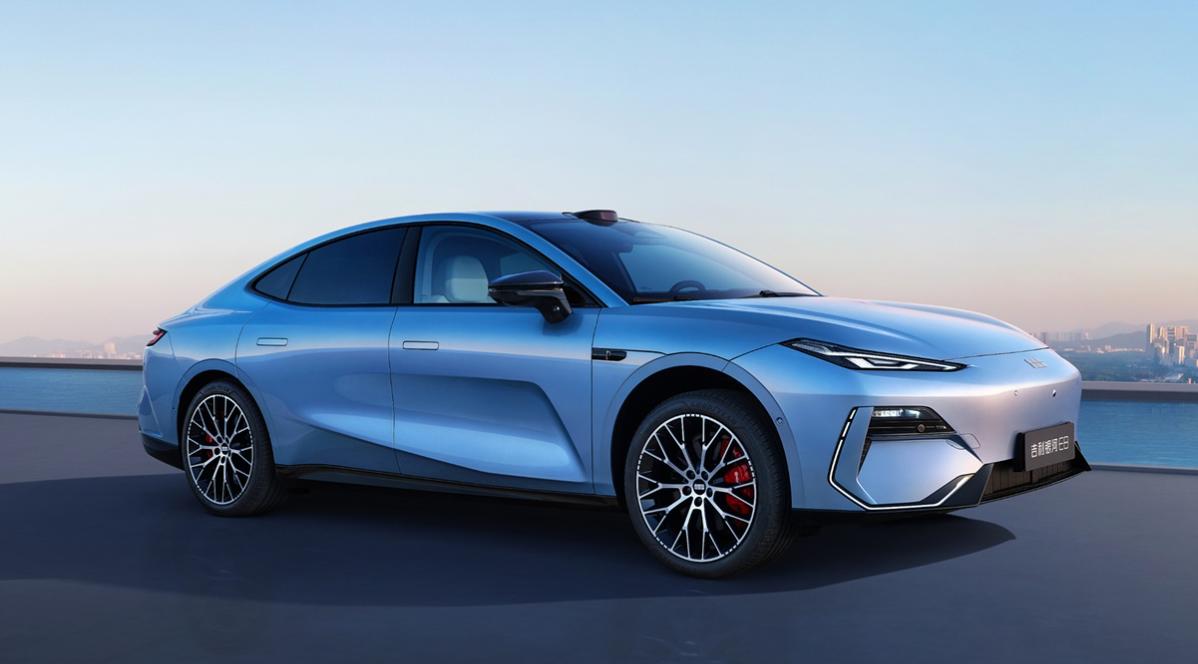
Geely Galaxy E8 – Exterieur
(Mit freundlicher Genehmigung/Courtesy of Geely Auto [Homepage])
Management Summary
Elon Musk’s success with Tesla has triggered a profound transformation in the automotive industry, resulting in the emergence of numerous BEV-Start-ups, new BEV brands, and BEV joint venture.
In this article, we provide an overview of the most important new BEV and NEV brands that have been created in recent years, primarily by established combustion engine manufacturers.
Almost all of the new brands originate from China. Brand awareness among Chinese consumers is not yet as pronounced as in the Western hemisphere, so the potential for new brands is fundamentally higher than in Europe or the US.
The new brands are being created by both state-owned carmakers such as Changan and Dongfeng and private manufacturers such as the Geely Group and Great Wall Motors. However, companies from outside the industry are also seeking new business opportunities in the automotive market, such as smartphone manufacturer Xiaomi and real estate giant Evergrande.
The absolute shooting star is Galaxy, a new NEV brand from private company Geely Automobile Holdings. With around 1,420,000 units sold, Galaxy already surpassed the million mark in 2025.
The emerging BEV brands include those that sold more than 100,000 vehicles in 2025:
- With 412,000 vehicles sold, the group is led by Xiaomi, a tech company known for its smartphones.
- With 333,000 units sold Deepal, a NEV brand owned by state-owned automaker Changan, follows.
- GAC Aion sold 286,000 vehicles, a NEV brand owned by state-owned GAC Group.
- Zeekr, a BEV brand owned by private company Geely Automobile Holdings, follows with 214,100 units sold.
- Arcfox sold 163,000 vehicles, a BEV brand owned by state-owned BAIC Group.
- With around 150,000 vehicles sold, the NEV brand Voyah from state-owned carmaker Dongfeng brings up the rear in this group.
The stagnating BEV brands include those that sold fewer than 100,000 vehicles in 2025:
- ORA leads this group with around 90,000 vehicles; the brand was founded by the private company Great Wall Motors.
- Polestar, a joint brand of Volvo and Geely, follows with just over 60,000 units.
- Bringing up the rear is the SERES brand of the Seres Group of the same name, which sold an estimated 50,000 units.
Due to fierce competition in the Chinese BEV market, some new brands have failed already:
- Rising Auto was a new BEV brand from SAIC Motors, originally based on the British vehicle manufacturer Rover. Due to very low sales figures, Rising Auto is no longer operated as an independent brand, but continues as a model series.
- Evergrande New Energy Auto was a new division of the Chinese real estate company Evergrande, but BEV production was discontinued due to lack of demand. The parent company is already in trouble due to its precarious financial situation.
Stooting-Star Galaxy
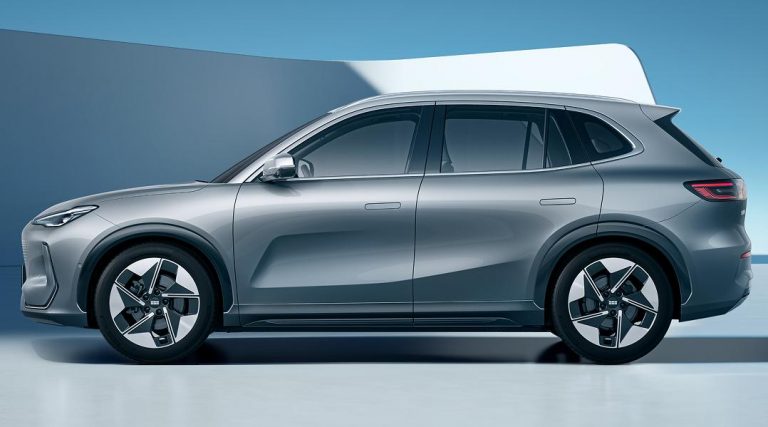
Geely Galaxy E5 – Exterieur
(Mit freundlicher Genehmigung/Courtesy of Geely Auto [Press Release])
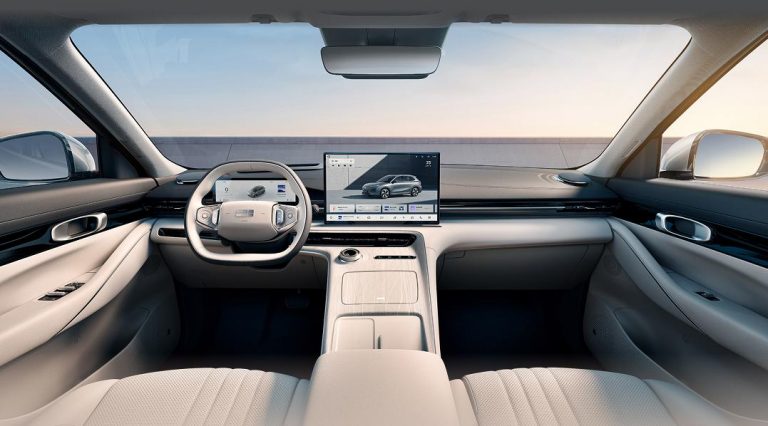
Geely Galaxy E5 – Interieur
(Mit freundlicher Genehmigung/Courtesy of Geely Auto [Press Release])
Galaxy was launched in 2023 as a new NEV brand within Geely Automobile Holdings. Unlike Polestar, Galaxy did not originate from an independent company, but was established directly as a strategic electrification brand for Geely’s automotive division. Geely Automobile is part of Geely Holding Group (GHG), which is China’s third-largest automaker with total sales of around 4.12 million vehicles (figures from 2025).
The brand focuses on plug-in hybrid (PHEV) and battery electric vehicles (BEV) for the Chinese domestic market and is a central component of the Geely Group’s electrification strategy. Within the brand portfolio, Galaxy is positioned in the volume segment and complements higher-positioned group brands such as Zeekr.
The first model was the Geely Galaxy L7 SUV, a plug-in hybrid. This was followed shortly thereafter by other electrified models such as the Geely Galaxy L6 sedan and the Geely Galaxy E8 battery electric series.
Geely does not provide an official breakdown by drive type for the Galaxy brand, but based on the published model figures, a clear trend can be seen for 2025. Pure BEVs are likely to account for the majority of sales at around 60-70%, while plug-in hybrids will account for around 30-40%. EREV models do not yet play a role, as such vehicles are not expected to be on the market until 2026.
Geely is currently by far the fastest-growing NEV brand, with sales figures exceeding the million mark after just two years:
- In 2023, just under 83,500 vehicles were delivered.
- In 2024, the figure was already almost 495,000 units.
- In 2025, sales jumped to around 1,240,000 vehicles.
Emerging BEV brands
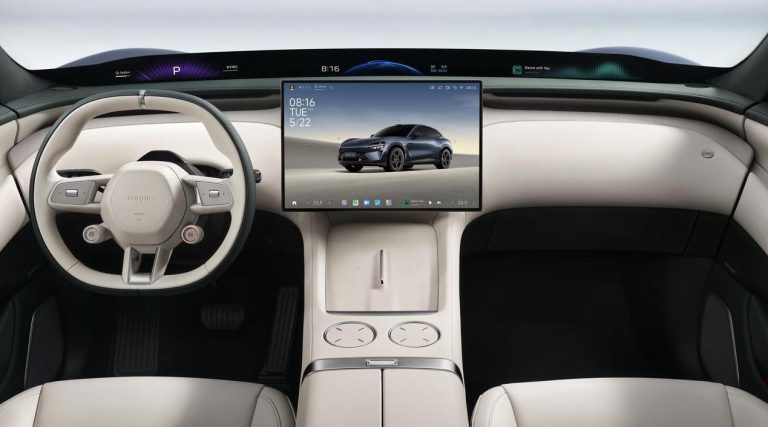
Xiaomi YU7 – Interieur with broadband HUD
(Mit freundlicher Genehmigung/Courtesy of of Xiaomi [Homepage])
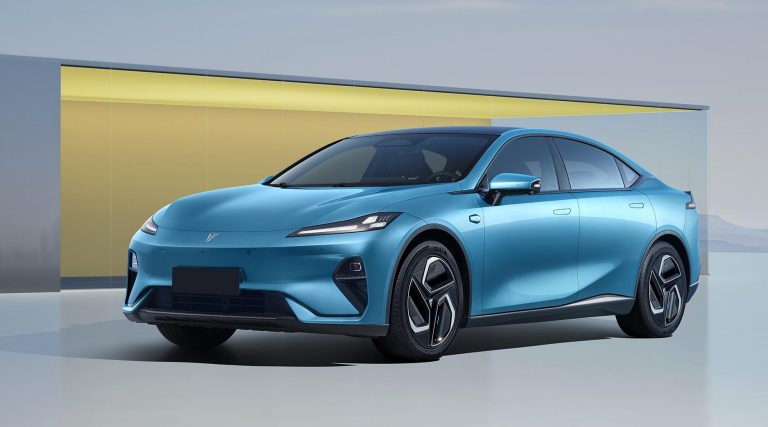
Deepal model L07
(Mit freundlicher Genehmigung/Courtesy of CHANGAN [Homepage])
Founded in 2010, Xiaomi is now one of the world’s largest manufacturers of smartphones and consumer electronics, ranking third in the international smartphone market behind Samsung and Apple.
Apple also pursued its own BEV plans for many years and invested considerable resources, but completely discontinued these activities in 2024. Xiaomi acted much more consistently and entered the automotive industry in a remarkably short time:
- In 2021, it founded its own subsidiary, Xiaomi Automobile, and started building its own vehicle production facility in Beijing.
- Just three years later, in 2024, it entered the market with the mid-range SU7 sedan, an extremely short period of time in automotive manufacturing.
Xiaomi is applying an approach to automotive manufacturing that has already proven successful in the smartphone business: focusing on established products.
The first model, the SU7, clearly draws on the Porsche Taycan in terms of design, proportions, and overall appearance. The second model, the SUV YU7, is clearly based on the Tesla Model Y.
What is often frowned upon as copying in Western markets is an established strategy in Chinese industry. Successful products are analyzed, adapted, and optimized in terms of both functionality and cost.
One example of functional improvement is the integration of the broadband head–up display: BMW presented the concept in 2023, Xiaomi picked up on the idea and implemented it just one year later, significantly faster than BMW.
The sales figures underscore the success of this strategy:
- In the first year of production in 2024, around 135,000 vehicles were delivered.
- In the following year, 2025, sales increased to 412,000 units.
Deepal is a new NEV brand from Chinese state-owned automaker Changan, which was only founded in 2021. Changan itself ranks third among state-owned automakers (sales in 2025).
Deepal operates as an independent brand under the umbrella of Changan Automobile (Changan holds a stake of around 51%). Its model portfolio includes sedans and SUVs, which are available as both battery electric vehicles (BEVs) and range-extender vehicles. Deepal has not disclosed the specific distribution of the drive types it offers. According to market observations, around 70% of the vehicles are said to be purely battery-electric, while around 30% have a range extender.
Deepal has been operating as an independent brand since 2023. Sales figures have risen steadily since then, with around 333,000 vehicles sold in 2025. Deepal is also working on entering the European market, building up a sales and service network and presenting itself at international trade fairs such as the IAA 2025.
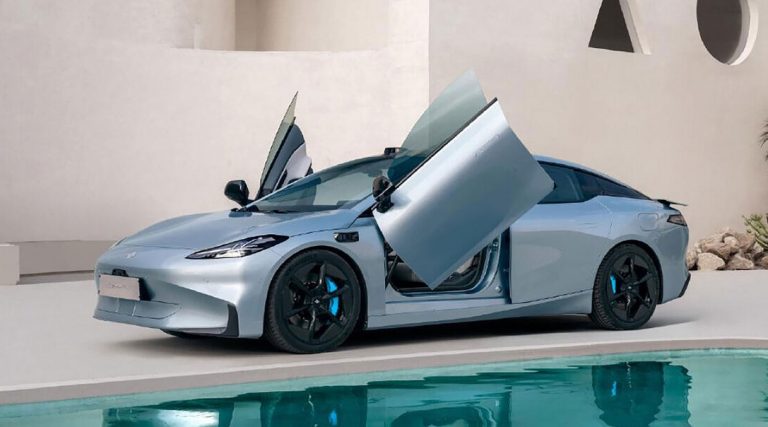
GAC Aion Hyper GT – Exterieur
(Mit freundlicher Genehmigung/Courtesy of GAC Aion New Energy Automobile Co., Ltd. [Press Gallery])

Zeekr 001
(Mit freundlicher Genehmigung/Courtesy of ZEEKR EU B.V. [Press])
GAC Aion was founded in 2017, with GAC standing for Guangzhou Automobile Group. GAC itself is a Chinese state-owned enterprise founded in 1954 and ranks fifth among state-owned automakers (in terms of revenue in 2025).
Battery electric vehicles are clearly the focus of GAC Aion and dominate the brand’s volume portfolio in the compact crossover, mid-size sedan, and SUV segments. In 2025, BEVs accounted for around 98% of sales. It was not until November 2025 that GAC Aion added its first range extender models (REEVs) to its lineup, expanding its previously almost exclusively electric portfolio.
GAC Aion got off to a very successful start, reaching a sales peak of over 480,000 deliveries in 2023, but then saw a gradual decline in sales to 286,000 units in 2025. This once again demonstrates the extreme volatility of the Chinese BEV market.
GAC Aion intends to counteract the decline in sales with an internationalization strategy: In Europe, the brand is focusing on new BEV models, the gradual establishment of sales and service networks, and local partnerships. At the same time, Aion is pushing ahead with its expansion in Asia, particularly in Southeast Asia, with local production and assembly projects (including in Thailand) and collaborations to reduce costs and better serve regional demand.
Zeekr was only founded in 2021; the brand is intended to cover the premium segment within the privately owned Geely Automobile Holdings. Geely Automobile itself belongs to the Geely Holding Group (GHG), which is China’s third-largest car manufacturer with total sales of around 4.12 million vehicles. The holding group also includes the Volvo Cars, Polestar, and Smart brands, among others.
Zeekr started out as a pure BEV brand and is positioning itself with a wide range of fully electric models in various premium segments – from compact SUVs and mid-size sedans to larger SUV and MPV formats. These battery-electric vehicles continue to be the clear focus of sales. Since 2025, the brand has been expanding its portfolio to include range extender models (EREV).
Zeekr’s sales figures rose until 2024, but have since stagnated at around 220,000 vehicles. One possible reason for this is the market entry of Xiaomi’s SU7, which competes directly with the Zeekr 001 model.
Zeekr also plans to cushion stagnating domestic sales through greater internationalization. In Europe, the brand is focusing on Northern Europe and selected core markets such as Sweden, the Netherlands, Norway, Denmark, and Germany, where it is gradually establishing its own sales and service structures.
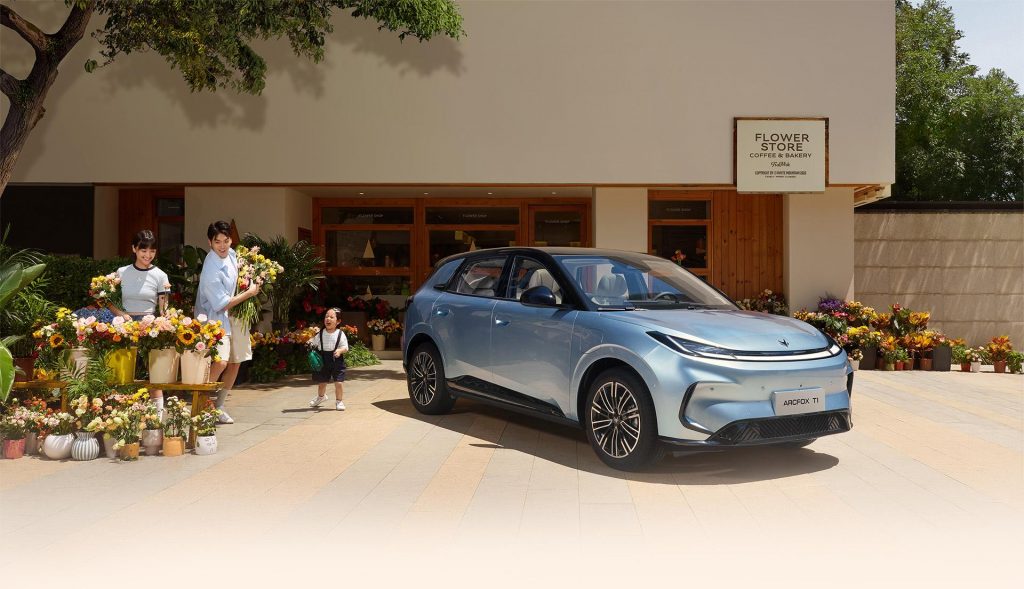
Arcfox T1 – Exterieur
(Mit freundlicher Genehmigung/Courtesy of ARCFOX. [Homepage])
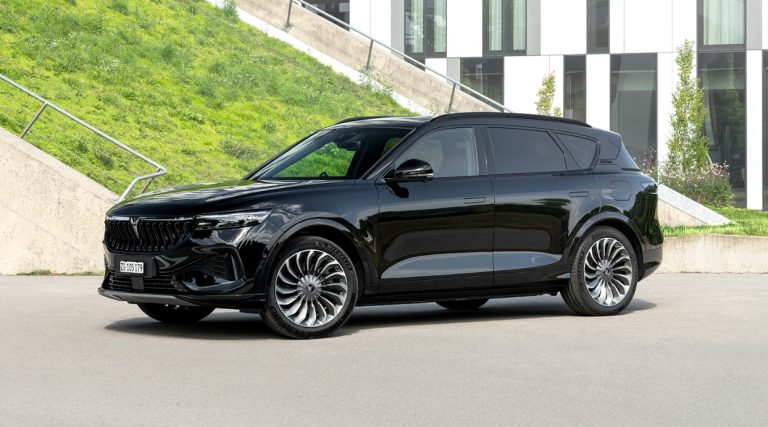
Voyah Free – Exterieur
(Mit freundlicher Genehmigung/Courtesy of NOYO Mobility AG [Homepage])
Arcfox was established as a new BEV brand within the state-owned BAIC Group. Founded in 1958 and headquartered in Beijing, the group is one of the ten largest Chinese automotive OEMs in terms of vehicle sales, selling around 1.75 million vehicles worldwide in 2025.
The brand is positioned in the higher-end segment of the Chinese market and acts as the technological spearhead of electrification within the BAIC Group. The first production model was the Arcfox αT electric SUV (launched in 2020), followed by the Arcfox αS sedan. The portfolio was later expanded to include variants with advanced driver assistance systems developed in cooperation with Huawei.
Originally conceived as a pure BEV brand, Arcfox has been expanding its range to include range extender models since the mid-2020s. After initially moderate development, Arcfox achieved six-figure sales for the first time in 2025 with around 163,000 vehicles.
Voyah is a new NEV brand from Chinese state-owned automaker Dongfeng, which was only founded in 2021. Dongfeng itself ranks fourth among state-owned automakers (sales in 2025).
As a premium brand, Voyah covers the upper segments and produces large SUVs, sedans, and MPVs, with a focus on models with range extender drives. Since its launch, sales have risen steadily, reaching around 150,000 units in 2025, twice as many as in 2024.
Voyah also exports its models to Europe, but remains well below relevant volumes there. Sales figures in 2023 and 2024 were only in the low three-digit range, and no noticeable increase is foreseeable in 2025. Europe is therefore primarily of strategic importance, but does not play the role of a volume market.
Stagnating BEV brands
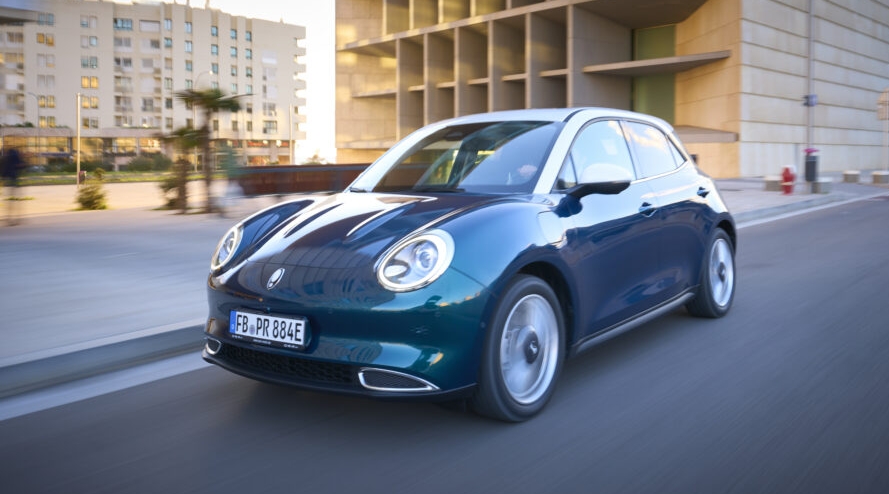
ORA Funky Cat – Exterieur
(Mit freundlicher Genehmigung/Courtesy of O! Automobile GmbH [Press Release])

ORA Funky Cat – Interieur
(Mit freundlicher Genehmigung/Courtesy of O! Automobile GmbH [Press Release])
Ora is the most successful of the stagnating brands. Ora is a new BEV brand from the private Chinese vehicle manufacturer Great Wall Motors, whose parent company is one of the ten largest Chinese carmakers.
The brand presented its first concept studies back in 2008, but series production and market launch in China did not follow until ten years later. The design is based on European models: the rounded front is reminiscent of the classic Volkswagen Beetle, while the rear borrows from the Fiat 500. On the Chinese domestic market, ORA models are classified in the minicar segment.
ORA has been a pure BEV brand to date, but range extender models are now also to be developed as part of a relaunch. Sales initially started successfully with 104,000 vehicles in 2022, but slumped to around 63,000 units in 2024. In 2025, sales figures rose again, with around 90,000 vehicles sold.
ORA has been exporting its vehicles to Europe for several years, albeit at a low level. In Germany, fewer than 2,000 vehicles were sold in 2024, and sales across Europe were below 10,000 units.

Polestar 2 BST edition 230
(Mit freundlicher Genehmigung/Courtesy of Polestar AB [Media Page])

Seres 5 – Exterieur
(Mit freundlicher Genehmigung/Courtesy of Seres Group [Homepage])
Polestar is the only new BEV brand with European roots. Originally founded as a racing company, the Polestar brand is now owned by a Geely–Volvo joint venture. Within the Geely Group, Polestar focuses on sporty vehicles, and its models are currently sold in 27 countries, including Germany.
The first model was a plug-in hybrid, followed by a switch to purely battery-electric vehicles. In 2023/2024, the portfolio was expanded to include two SUV models. Sales figures have stagnated at around 50,000 vehicles since 2022, with a slight increase to 60,000 units in 2025.
Sales in Europe declined: after around 25,000 deliveries in 2023, the volume fell significantly in 2024. In Germany, new registrations halved from around 6,000 to around 3,000 units. No clear upward trend is apparent for 2025, despite hopes that the new SUV models will provide a boost.
SERES is a new NEV brand from the privately owned Chinese Seres Group. The Seres Group is a multi-brand company that sold nearly 517,000 vehicles in 2025.
The SERES brand focuses on SUVs and crossover models. The portfolio includes both pure battery electric vehicles (BEVs) and variants with range extender drives (EREVs), with larger vehicles predominantly relying on EREV technology. BEVs dominate exports, while the share of EREVs is higher in the Chinese market. Overall, the drive mix is roughly divided between 40-60% BEV and 40-60% EREV, depending on the region, with a clear EREV bias for larger models in China.
Sales of the SERES brand initially got off to a successful start with 94,000 vehicles in 2023, but slumped to around 40,000 units in the following year. Sales for 2025 are estimated at around 50,000 vehicles.
Seres’ European sales remained at a manageable level in 2023 and 2024, with available market data showing them in the low four-digit range in each case.
_____________
[cs 13.03.2026]