
Index A-Z - Onboard Tech
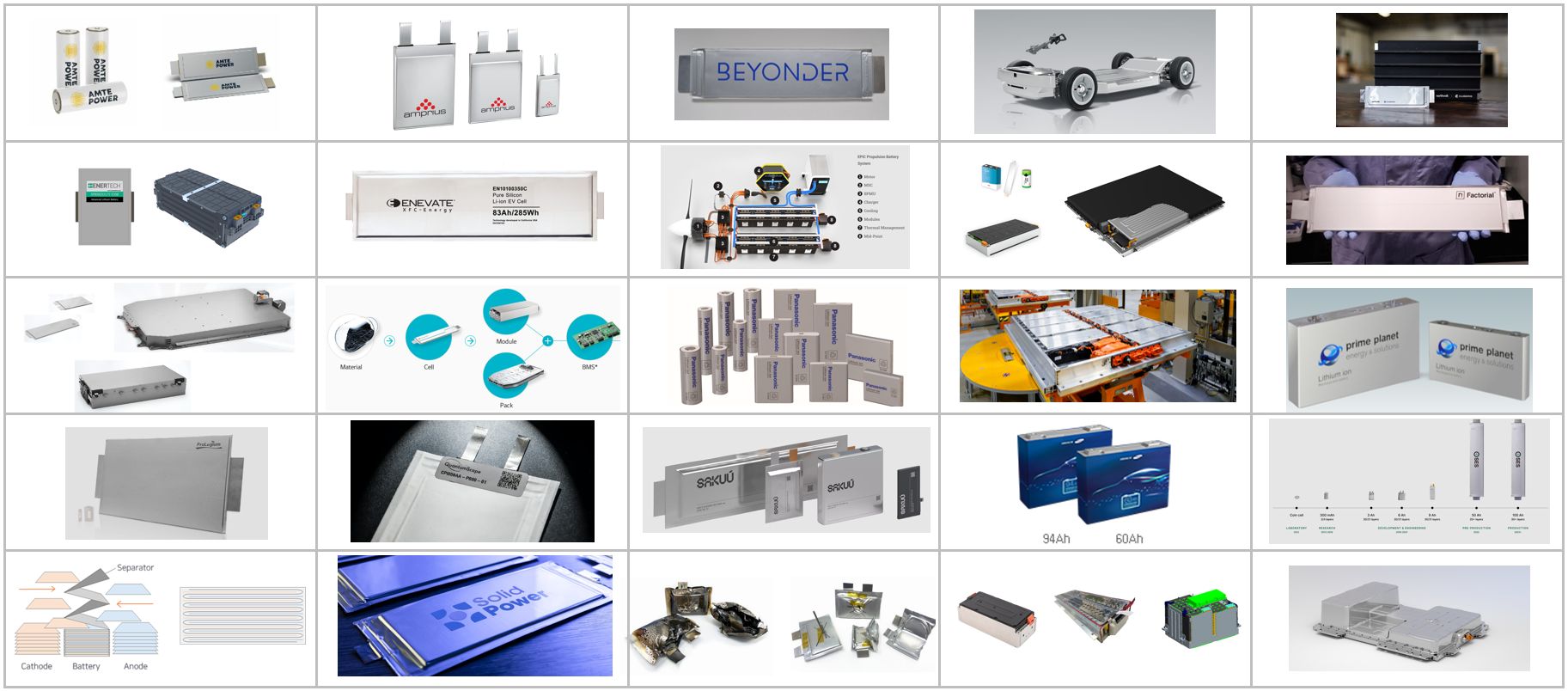
24M ABF ACC ADDEN Energy Addionics AESC Agratas Amprius Amte Power Anaphite BAK Battery Basquevolt Battrion Beyonder Blue Current Blue Solutions Britishvolt BYD CALB CATL Cellforce Group Cuberg Customcells Desten ElevenEs E-Lyte Enertech Enevate Envision AESC EPS – Electric Power Systems Eurocell EVE Energy Factorial Energy Farasis Energy Feon Energy Freyr Battery Gelion Gotion High-Tech Group14 Technologies Gus Technology Ilika iM3NY Innolith Inobat Ion Storage System Ionblox Italvolt LG Energy Solution Lyten Molicel Morrow Batteries Nanograf Northvolt One OneD Panasonic PowerCo Prime Planet ProLogium QantumScape Sakuu Samsung SDI SES AI Sila Nanotechnologies Siro SK On Solid Power Solidion Technology Solithor Soteria Big South 8 Technologies StoreDot Sunwoda SVOLT Talent New Energy Theion Verkor Volexion WeLion West Midlands Gigafacory Zenlabs Zeta Energy
US start-up for cell production technologies, founded in 2015. The underlying processes were developed in research projects at MIT [1], and the company currently has 200 employees [2].
The process is marketed as “24M ETOP™.” These are electrodes for lithium-ion cells that can be integrated directly into a battery pack, eliminating the need for individual cells and modules. The packs can be flexibly configured and manufactured in different sizes to maximize efficiency and performance.
The business model is based on licensing the production process, with Kyocera among the first licensees. The Japanese technology group has also explicitly stated that it will use 24M technology in its energy storage systems (ESS), among other things.
Volkswagen is also a licensee, and PowerCo, the VW subsidiary responsible for the production of the “VW unified cell,” mentions 24M as a technology partner in a promotional film. It remains to be seen whether the 24M process will actually be used by PowerCo in the series production of the standard cell [3].
Other licensees include FUJIFILM Corporation (Fujifilm) and cell start-ups such as Freyr.
Unfortunately, the details of how 24M’s production process works are not explained. It can be assumed that the major Asian cell manufacturers such as CATL, BYD and LG will not allow themselves to become dependent on the cell production technology of a foreign manufacturer, as this is extremely competitive.
24M has now added further technologies to its portfolio, including:
- In March 2024, 24M introduced the “Liforever™” recycling process, which enables the direct reuse of cathode and anode materials without energy-intensive intermediate steps.
- In addition, “Impervio” is a new type of separator being developed to prevent the growth of dendrites and thus increase the safety of lithium-ion cells. The separator communicates via a signal line to the outside if a short circuit has occurred in the cell. This can then be deactivated via the battery management system (BMS). The market launch is planned for 2026.
Sources
[1] https://24-m.com/ (Homepage, Access 28.09.2022, 05.07.2025)
[2] Personal communication Advanced-Automotive-Battery-Conference-Europe-2025 (24.06.2025)
[3] https://www.salzgiga.com/ (Access 28.09.2022)
[cs 28.09.2022, 09.10.2025, 05.07.2025]
ABF – American Battery Factory [↑] [↓] [⇑] [⇓]
US-based battery start-up specializing in prismatic lithium-ion battery cells with LFP chemistry. ABF focuses on developing safe, durable and environmentally friendly batteries with a claimed lifespan of more than 8,000 charging cycles. The LFP chemistry avoids the use of critical raw materials such as cobalt and nickel in the cathode [1].
ABF aims to establish a domestic battery supply chain in the United States, creating manufacturing jobs and reducing dependence on imported battery cells. Its first gigafactory is being developed in Tucson, Arizona, with an initial planned production capacity of approximately 5.5 GWh per year [2].
The company’s main target market is stationary energy storage, including residential, commercial and grid-scale applications. In 2026, ABF reported offtake agreements covering more than 4.5 GWh of planned production and strengthened its partnership with the US energy storage company Lion Energy [2][3].
Sources
[1] https://americanbatteryfactory.com/product (Product specifications, accessed 09.10.2026)
[2] Renewable Energy World (25.03.2026)
[3] ESS News (08.04.2026)
[cs 09.10.2026]
French manufacturer of lithium-ion battery cells and modules for electric vehicles, founded in 2020 as a joint venture involving the French battery specialist Saft, a subsidiary of TotalEnergies, and the automotive group Stellantis. Mercedes-Benz joined as a further shareholder in 2022 [1].
ACC operates its first gigafactory in Billy-Berclau/Douvrin, France, where battery cell production started in late 2023. The company manufactures cells using NMC chemistry (nickel-manganese-cobalt) and is developing further cell generations and more cost-effective battery technologies. The original plan to establish three gigafactories with a combined annual capacity of 120 GWh has been revised. In February 2026, ACC abandoned its planned factories in Kaiserslautern, Germany, and Termoli, Italy, concentrating its industrial activities on the French site [1][2].
Stellantis is an important customer for ACC batteries, which are used in electric vehicles such as the Peugeot E-3008, E-5008 and Opel Grandland. Mercedes-Benz is also involved as a shareholder and prospective customer. The ramp-up of production in France is continuing, although supply bottlenecks were still reported in 2026 [3][4].
Sources
[1] https://www.acc-emotion.com/about-acc (Company profile, accessed 09.10.2026)
[2] Electrive (09.02.2026)
[3] ACC CSR Report 2025 (22.06.2026)
[4] Reuters (29.09.2026)
[cs 09.10.2026]
US start-up for solid-state battery cells, founded in 2021 by researchers from Harvard University. The company develops solid-state batteries with lithium-metal anodes, aiming to achieve high energy density, short charging times and long service life. Early laboratory prototypes demonstrated charging times of just 3 minutes and more than 10,000 charging cycles. Larger pouch-cell prototypes have achieved charging times of around 10 minutes and up to 6,000 cycles with 80% remaining capacity [1][2].
In February 2025, ADDEN Energy commissioned a pilot production line in Waltham, Massachusetts, to manufacture solid-state pouch cells for testing by automotive manufacturers and other potential customers. The company aims to scale up its technology for future commercial applications, particularly in electric vehicles [3].
Sources
[1] https://www.addenenergy.com/ (Company website, accessed 09.10.2026)
[2] Harvard University (January 2024)
[3] Electrive (25.02.2025)
[cs 09.10.2026]
British-Israeli battery technology company, founded in 2018 based on research at Imperial College London. Its investors include Magna, GM Ventures, Scania and, since 2025, Avery Dennison [1][2].
Addionics develops three-dimensional, porous current collectors for the anodes and cathodes of lithium-ion cells. The technology uses 3D-structured copper for the anode and aluminium for the cathode. These structures provide a larger surface area for the active materials, improve electrical conductivity and mechanical stability, and are intended to increase energy density, shorten charging times and extend battery life [1].
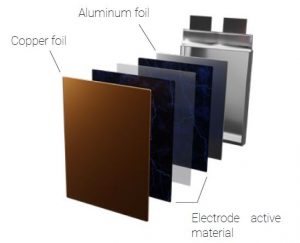
Structure of conventional Li-Io cell
(Mit freundlicher Genehmigung/Courtesy of Addionics Ltd. [White Paper April 2021])

Structure of a lithium-ion cell featuring Addionics’ 3D material
(Mit freundlicher Genehmigung/Courtesy of Addionics Ltd. [White Paper April 2021])
The 3D current collectors developed by Addionics replace the conventional flat copper foil in the anode and aluminium foil in the cathode (see illustration). The porous metal structures provide additional space for active electrode materials and improve ion and electron transport within the cell [1].
The technology can be used with established cell chemistries such as NMC and LFP, as well as emerging technologies including solid-state batteries, lithium-metal batteries and silicon-based anodes. Addionics is working with battery manufacturers and industrial partners to integrate its 3D current collectors into existing production processes. The company is also expanding its industrial manufacturing capabilities [1][3].
Sources
[1] https://addionics.com/technology (Technology overview, accessed 09.10.2026)
[2] Addionics – Avery Dennison investment (28.04.2025)
[3] Addionics – GM Ventures investment (25.07.2024)
[cs 09.10.2026]
AESC (Automotive Energy Supply Corporation) was founded in 2007 by Japanese car manufacturer Nissan and electronics group NEC as a joint venture for lithium-ion cells and battery systems.
In 2018, the Chinese company Envision, headquartered in Shanghai, acquired a majority stake in AESC, which is why the company was temporarily also known as Envision AESC. Envision describes itself as a green tech company that manufactures wind turbines and the associated IT systems for energy management, among other things [1].
In 2025, AESC had a production capacity of around 20–30 GWh, but ranked outside the top 10 in the global EV battery rankings. The ranking—such as that by SNE Research—is based on the actual volume of batteries installed in vehicles, whereas part of AESC’s capacity was still ramping up and therefore not yet fully reflected in the delivery figures.
AESC has a global production presence in all three major markets, with facilities or planned Gigafactories in North America, Europe, and Asia. As part of its expansion strategy, the company states that it aims for a long-term global production capacity of up to approximately 400 GWh—a goal that appears overly ambitious given the current state of expansion.
AESC has historically had close ties to the Renault-Nissan Alliance, which remains one of its most important customers to this day; the company’s cells and battery systems are used in vehicles such as the high-volume Nissan Leaf.
In addition, AESC also supplies other OEMs such as Mitsubishi and the BMW Group for select models and regions. However, AESC was not selected as a cell supplier for BMW’s “New Class” platform and remains heavily dependent on the Renault-Nissan Alliance overall.
AESC currently operates several battery plants in Asia (China, Japan) and the U.S. (including Tennessee), which form the stable foundation of its current production. In Europe, new gigafactories in the UK (Sunderland) and France (Douai) began operations in 2025; however, these are still ramping up and are closely tied to OEM programs from Nissan and Renault, respectively.
At the same time, AESC is planning expansion in North America, although the plant in Kentucky (Bowling Green, ~30 GWh) is being implemented more slowly than planned and is still under construction. The project in South Carolina (for BMW), also designed for around 30 GWh, was temporarily halted in 2025 and scaled back.
Sources
[1] https://www.aesc-group.com/ (Homepage, Access 24.10.2022)
[cs 24.10.2022, 19.12.2023, 04.04.2026]
Battery manufacturer founded in 2023 as part of the Indian Tata Group, which also owns the vehicle manufacturer Tata Motors. Agratas is developing lithium-ion cells for electric vehicles and stationary energy storage applications. The company initially focuses on NMC and LFP cell chemistries [1].
Battery cell factories are under construction in Sanand, Gujarat, India, and Bridgwater, Somerset, UK. The first phase of the Indian plant is designed for an annual production capacity of 20 GWh, with production currently scheduled to begin in 2027. In the UK, construction of the first factory building is progressing. The facilities are intended to supply batteries for electric vehicles and energy storage systems [2][3].
Sources
[1] Agratas – Battery technology (Company website, accessed 09.10.2026)
[2] Agratas – Sanand construction milestone (02.04.2026)
[3] Agratas – UK battery facility (10.02.2026)
[cs 09.10.2026]
US battery technology company founded in 2009 by materials scientist and Stanford professor Yi Cui and others. Amprius develops and manufactures high-performance lithium-ion cells with silicon-based anodes [1].
The company’s original SiMaxx technology uses extremely thin silicon nanowires to accommodate the volume changes of silicon during charging and discharging. The newer SiCore platform uses a different silicon-anode material system designed for scalable production using established lithium-ion manufacturing equipment [1][2].
Amprius supplies battery cells primarily for electric aviation, drones and high-altitude unmanned aircraft. Its customers include AALTO, an Airbus subsidiary that develops the solar-powered Zephyr high-altitude aircraft. In 2025, Amprius also delivered SiCore cells to several other drone manufacturers [2][3].

Pouch Cells from Amprius
(Mit freundlicher Genehmigung/Courtesy of AMPRIUS TECHNOLOGIES [Homepage])
Amprius’ SiMaxx pouch cells achieve a gravimetric energy density of up to 450 Wh/kg and a volumetric energy density of up to 1,150 Wh/L. Selected cell designs can be charged to 80% SoC in approximately 6 minutes, according to the company. The SiCore product range includes cells optimized for high energy density or high power output [1][2].
In September 2026, Amprius introduced a second-generation SiCore cell with 500 Wh/kg, designed particularly for long-endurance drones and high-altitude platform stations (HAPS). Commercial availability is expected in the fourth quarter of 2026. Unlike earlier experimental 500 Wh/kg cells, the new design is intended to be manufactured using conventional lithium-ion production equipment [4].
Amprius is expanding production through contract manufacturing partners while maintaining research, development and pilot manufacturing in Fremont, California. The company has secured access to more than 1.8 GWh of annual contract manufacturing capacity. Its cells are used or evaluated in aerospace, defense and other electric mobility applications [2][3].
Sources
[1] https://amprius.com/ (Company website, accessed 09.10.2026)
[2] Amprius – Annual Report 2025 (06.03.2026)
[3] Amprius – SiCore deliveries to drone customers (22.07.2025)
[4] Amprius – SiCore 500 Wh/kg (02.09.2026)
[cs 09.10.2026]
Former British battery manufacturer, founded in 2013, which developed lithium-ion cells and sodium-ion cells for specialist applications. Its target markets included electric vehicles, stationary energy storage systems and industrial equipment [1].
Amte Power operated a small battery cell production facility in Thurso, northern Scotland, and planned to expand manufacturing with a larger factory in the UK. The company also developed sodium-ion battery technology and reported progress towards transport certification for its sodium-ion cells in 2023 [1].
However, the company encountered serious financial difficulties in 2023 and entered administration in January 2024. Its Thurso production business and assets were sold to the Dutch battery technology company LionVolt, which intended to use the facility for its own battery development and manufacturing activities [2][3].
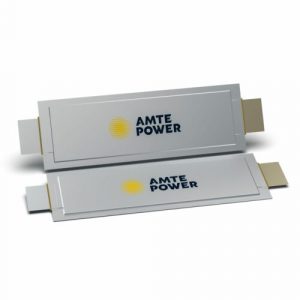
Pouch Cells from Amte Power
(Mit freundlicher Genehmigung/Courtesy of AMTE Power plc.[Homepage])

Cylindrical Cells from Amte Poweer
(Mit freundlicher Genehmigung/Courtesy of AMTE Power plc. [Homepage])
Amte Power developed and manufactured pouch cells and prismatic cells. The previously announced plans for large-scale cell production in the UK were not implemented by the company.
Amte Power was formerly listed on the London Stock Exchange (ISIN GB00BNQRZZ55, WKN A2QRD6). Following its insolvency and liquidation, the company ceased trading. Amte Power plc was dissolved on 15 April 2026 [4].
Sources
[1] AMTE Power – Company overview (2021)
[2] AMTE Power – Appointment of administrators (19.01.2024)
[3] Scottish Financial News – Acquisition by LionVolt (29.01.2024)
[4] UK Companies House – Filing history (15.04.2026)
[cs 09.10.2026]
Anaphite is a start-up from Bristol that has developed an innovative production process for lithium-ion cells. The company was founded in 2018 by Alex Hewitt and Sam Burrow as a spin-out from the University of Bristol.
The technology combines active material, conductive additives and binders in a single, ready-to-use powder. To understand Anaphite’s innovation, you need to know how the production of lithium-ion cells works.
In the first production step, the electrodes are manufactured, i.e. the anode and the cathode. For this purpose, a viscous paste, known as slurry, is applied to a carrier film, which is then dried in ovens.
This drying phase takes several days and requires a lot of energy, which is why alternative coating processes have been researched for many years. One approach is so-called dry coating, in which the electrode material is applied to the carrier film as a dry powder.
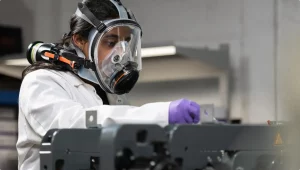
Calendering of DCP® powder
(Mit freundlicher Genehmigung/Courtesy of Anaphite [Homepage])
This is where Anaphite’s process comes in: The start-up has developed a method with which the electrode materials are combined together in liquid form to achieve excellent dispersion and produce a well-structured powder. The highlight is that the liquid is removed in a low energy process to produce the dry powder, which can then be calendered directly onto the current collector.
The so-called DCP® powder (Dry Coating Precursor) can be processed without solvents and energy-intensive drying ovens and is said to reduce energy consumption by up to 30%. It reduces production costs by around 40% and saves space in cell production.
In 2024, the company raised USD 13.7 million in a Series A financing round to scale up its pilot production and further expand initial partnerships with battery manufacturers and automotive OEMs.
The goal is industrialization and market launch from 2028.
Sources
[1] https://anaphite.com/ (Homepage, Zugriff 06.07.2025)
Chinese battery manufacturer, founded in Shenzhen in 2005, specializing in the production of lithium-ion cells and energy storage systems (ESS). BAK Battery manufactures cylindrical, prismatic and polymer (pouch) cells in various formats and with different cell chemistries. Its products are used in electric vehicles, consumer electronics and stationary energy storage applications [1].
BAK Battery also develops sodium-ion batteries in prismatic formats. Its product range includes cells with capacities of 45, 85 and 230 Ah. In 2026, the company introduced a new 150-Ah sodium-ion cell for energy storage applications. Further developments include tabless cylindrical cells, large-format prismatic LFP cells and semi-solid-state battery technology [2][3].
According to the company, BAK Battery supplies more than ten major automotive manufacturers. However, detailed information on individual customers and current supply agreements is not publicly available on its website [1].
Sources
[1] https://www.bakpower.com/about_en.php (Company profile, accessed 09.10.2026)
[2] https://www.bakpower.com/yybk_cpxl_en.php (Battery product specifications, accessed 09.10.2026)
[3] BAK Battery – CIBF 2026 (13.05.2026)
[cs 09.10.2026]
Spanish battery technology company founded in 2022 by a consortium of public and private investors in the Basque Country. Basquevolt develops advanced lithium-based battery technology, particularly solid-state and polymer-electrolyte batteries. The original plan envisaged battery cell production with an annual capacity of 10 GWh by 2027. The company has since placed greater emphasis on the development and industrial supply of its proprietary electrolyte [1][2].
The technology is based on a proprietary polymer-composite electrolyte originating from research at the nearby materials research institute CIC energiGUNE. The original development programme also included anodes with a high silicon content. Research led by Professor Michel Armand provided an important scientific foundation, with several patents licensed to Basquevolt. The company now aims to industrialise and market its electrolyte from 2027, working with battery cell manufacturers and automotive companies [1][2].
In February 2026, Basquevolt signed a joint development agreement with Ampere, part of Renault Group, to advance lithium-metal battery technology for future electric vehicles. In May 2026, Basquevolt introduced its BQV400L cell with an NMC cathode, lithium-metal anode and a reported gravimetric energy density of 402 Wh/kg. The 27 Ah cell is offered to customers, while independent validation of its performance data was still ongoing at the time of the announcement [3][4].
Michel Armand is a long-standing expert in rechargeable battery technologies. In the 1970s, he helped establish the concept of reversible lithium-ion transfer between the electrodes, which later became a foundation of modern lithium-ion batteries.
Sources
[1] Basquevolt – Company website (accessed 09.10.2026)
[2] Basquevolt – Strategic focus on solid-state battery electrolyte
[3] Basquevolt – News, including Ampere cooperation (24.02.2026)
[4] electrive – Basquevolt launches lithium-metal battery cell (22.05.2026)
[cs 09.10.2026]
Attention: Battrion AG is in liquidation, according to the Swiss official company register [1].
Swiss spin-off from ETH Zurich, founded in 2015, which developed innovative manufacturing technology for the anodes of lithium-ion cells. Its Aligned Graphite® technology improves the microstructure of graphite-based anodes by controlling the orientation of graphite particles. This can reduce the internal resistance of the electrode and improve fast-charging performance. According to the company’s published information, the technology could reduce charging times by up to 50% under suitable conditions [2].
In 2022, Battrion cooperated with the German mechanical and plant engineering specialist Jagenberg Converting Solutions to integrate Aligned Graphite® technology into industrial electrode production lines. The partners demonstrated the process on a large-scale coating line at speeds of up to 100 m/min. The technology was also described as compatible with graphite/silicon anode mixtures [2][3].
Battrion AG is still listed in the Swiss company register under the name Battrion AG in Liquidation. Its former development activities and industrial cooperation should therefore be regarded as historical; a continuation of commercial operations has not been confirmed [1].
Sources
[1] Swiss Federal Statistical Office – UID Register, Battrion AG in Liquidation (accessed 09.10.2026)
[2] Jagenberg – Partnership with Battrion (28.03.2022)
[3] Jagenberg – Industrial demonstration at 100 m/min (05.07.2022)
[cs 09.10.2026]
Attention: Beyonder is facing serious financial difficulties. In August 2026, the Norwegian business press reported an urgent need for additional funding and substantial uncertainty about the company’s ability to continue operating. Insolvency proceedings have not been confirmed [4].
Norwegian battery technology company founded in 2016, developing high-power lithium-ion cells and battery modules. Its BePowered technology uses lithium iron phosphate (LFP) chemistry and is designed for very frequent charging and discharging. According to Beyonder, the current 33 Ah pouch cell supports continuous charging at 5C, corresponding to approximately 12 minutes for a full charge under specified conditions [1][2].
Beyonder previously investigated combinations of lithium-ion battery technology and ultracapacitor-like performance. Its current BePowered cell is advertised with a cycle life of more than 20,000 full cycles at 5C and more than 30,000 cycles at 1C, measured to 70% remaining capacity. The earlier figure of 100,000 cycles should not be regarded as a verified specification of the current commercial cell [1][2].
Potential applications include ferries, buses, industrial vehicles and stationary high-power energy storage systems, including buffering for renewable electricity and grid support. The company specifies a cell discharge temperature range of −25 to +55 °C and a charging range starting at −20 °C [1][2].
Beyonder emphasizes sustainable raw materials and manufacturing. Earlier development work included carbon materials derived from sawdust. The current LFP cell is described as containing no cobalt, nickel or graphite. Commercial cell production is outsourced to manufacturing partners, while Beyonder maintains development and pilot-production facilities in Sandnes, Norway [1][3].

Pouch Cell from Beyonder
(Mit freundlicher Genehmigung/Courtesy of Beyonder [Homepage])

Battery Module from Beyonder
(Mit freundlicher Genehmigung/Courtesy of Beyonder Inc. [Homepage])
Beyonder offers pouch cells and battery modules. Its current BePowered pouch cell has a nominal capacity of 33 Ah, an energy density of approximately 120 Wh/kg and a specific peak power of up to 3.3 kW/kg. The BePowered eMobility module has a rated energy of 3.4 kWh and is designed for high-power transport and industrial applications [1][2].
In March 2026, Beyonder and Corvus Energy signed a memorandum of understanding to explore battery systems for maritime applications. However, Beyonder’s financial situation deteriorated significantly. In August 2026, reports described a loss of approximately NOK 143 million for 2025 and the need to raise around NOK 100 million in additional capital. The company’s future therefore remains uncertain [4][5].
Sources
[1] Beyonder – BePowered battery cells (accessed 09.10.2026)
[2] Beyonder – Technical data (accessed 09.10.2026)
[3] Beyonder – Company and production facilities (accessed 09.10.2026)
[4] Dagens Næringsliv – Beyonder seeks new capital (19.08.2026)
[5] Beyonder – Cooperation with Corvus Energy (30.03.2026)
[cs 09.10.2026]
US battery technology company founded in California in 2014, developing innovative lithium-based solid-state cells with a silicon-rich anode and a fully dry composite electrolyte. Investors include Koch Industries, Umicore and, following a financing round completed in December 2025, Amazon. The development goals are high energy density, improved safety and operation at low external cell pressure [1][3][4].
Silicon-rich anodes undergo considerable volume changes when lithium is inserted and removed. Conventional solid-state cell designs may therefore require high external pressure to maintain contact between the electrode materials. Blue Current takes a different approach: its elastic composite materials accommodate these volume changes while maintaining contact between the silicon and the solid electrolyte. The company reports cell operation at pressures below 1 MPa, although the cells are not completely pressure-free [1][2].

Composite material for encasing the anode active material (top)
(Mit freundlicher Genehmigung/Courtesy of Blue Current [Homepage])
Blue Current has developed an elastic composite material that surrounds and connects the silicon anode particles (see illustration). It helps accommodate their expansion and contraction during charging and discharging, rather than completely preventing these changes. The fully dry electrolyte combines polymers, which provide elasticity and adhesion, with ceramic materials, which contribute ionic conductivity. The aim is to achieve stable cycling with a high silicon content and comparatively low external pressure [1][2].
Blue Current reports an energy density of around 750 Wh/L for its technology and cites approximately 1,000–1,500 charge cycles and charging to 50% in 15 minutes as performance figures. These are company-reported development results or specifications, not independently established performance values for mass-produced cells. Independent safety tests on multilayer cells reportedly showed no thermal runaway during nail penetration, crushing and overcharging tests [1][2].
The company is working with industrial partners, including Umicore, on materials and potential automotive applications. In 2026, Blue Current reported that its pilot line in Hayward, California, was operational and producing 2-Ah cells. An USD 81 million financing round completed in December 2025, anchored by Amazon, is intended to support further commercialization and manufacturing scale-up. Large-scale series production has not yet been confirmed [3][4][5].
Sources
[1] Blue Current – Homepage (accessed 09.10.2026)
[2] Blue Current – Silicon elastic composite technology and technical data (accessed 09.10.2026)
[3] Blue Current / Umicore – Investment and technology cooperation (30.03.2023)
[4] Blue Current – USD 81 million financing round (09.12.2025)
[5] Blue Current – Company history and pilot production (accessed 09.10.2026)
[cs 09.10.2026]
Blue Solutions [↑] [↓] [⇑] [⇓]
Blue Solutions is a subsidiary of the French Bolloré Group, whose origins date back to a paper mill established in 1822. The company is a pioneer of solid-state battery technology and has manufactured lithium-metal-polymer (LMP) batteries with a solid rather than liquid electrolyte on an industrial scale since 2011 [1][4].
Blue Solutions manufactures battery cells, modules and packs. Its established LMP technology benefits from the Bolloré Group’s experience in producing and coating thin films. The anode consists of lithium metal, while the cathode is based on lithium iron phosphate (LiFePO4). A solid polymer electrolyte conducts lithium ions between the electrodes [1][2].
The established LMP batteries require an elevated operating temperature of approximately 60–80 °C to achieve sufficient ionic conductivity. Battery systems therefore incorporate thermal management and heating. The company previously specified a volumetric energy density of around 255 Wh/L at module level and targeted approximately 290–295 Wh/L for a subsequent version. The achievement of that earlier target has not been independently confirmed [2][4].
Blue Solutions batteries have been used in electric buses, including applications associated with Daimler Buses and the Bolloré Group’s sister company Bluebus. In April 2022, fires involving two Bluebus electric buses in Paris attracted considerable public attention. In September 2026, Bolloré announced a proposed permanent discontinuation of Bluebus electric bus production and a strategic refocusing of Blue Solutions’ next-generation battery activities. This announcement does not mean that Blue Solutions itself has ceased operations [3][5].
Blue Solutions is developing a new generation of lithium-metal solid-state batteries called GEN4, intended to overcome the high operating-temperature requirement of the earlier LMP technology. Development targets include an energy density of more than 400 Wh/kg, charging to 70% in less than 15 minutes and operation over a wider temperature range. In an update dated 7 October 2026, the company reported that its 10-Ah A-sample cells were approaching 900 cycles, while results on 1-Ah cells had been independently validated by Fraunhofer ISE. These figures describe ongoing development, not confirmed large-scale series production [6].
Industrialization plans include a proposed demonstration line in France with a nominal capacity of approximately 200 MWh per year, intended to supply qualification samples and small commercial volumes before a possible future gigafactory. Blue Solutions has also entered into development partnerships, including with Putailai, and worked with AVL on the safety assessment of its next-generation cells. The timing and scale of future production remain subject to development progress and strategic decisions [5][7][8].
Sources
[1] Blue Solutions – Homepage (accessed 09.10.2026)
[2] electrive – Interview on LMP battery technology (03.03.2021)
[3] electrive – Blue Solutions and potential automotive applications (16.01.2024)
[4] Bolloré – Blue Solutions and LMP battery technology (accessed 09.10.2026)
[5] Blue Solutions / Bolloré – Bluebus discontinuation proposal and GEN4 strategy (08.09.2026)
[6] Blue Solutions – GEN4 battery technology and development update (07.10.2026)
[7] European Investment Bank – Blue Solutions solid-state battery demonstration line (12.11.2025)
[8] Blue Solutions – Partnerships with Putailai and AVL (2025–2026)
[cs 09.10.2026]
Attention: Britishvolt failed. The company entered administration on 17 January 2023 and was placed into liquidation on 28 October 2024. The planned battery gigafactory in Northumberland was abandoned, and the site is being redeveloped for a data centre campus [1][2][3].
British battery start-up, established in 2019 under the legal name Power by Britishvolt Limited, which intended to manufacture lithium-ion cells for the automotive industry. Its investors and commercial partners included Glencore. The company planned to produce cylindrical and prismatic battery cells in the United Kingdom but never achieved commercial-scale cell production [1][4].
Britishvolt’s principal project was a proposed gigafactory in Cambois near Blyth, Northumberland, with an estimated investment of approximately GBP 3.8 billion. The coastal location offered access to port infrastructure and potential renewable electricity supplies, including offshore wind power. Construction preparations began, but work was halted in 2022 because of financing difficulties. The originally announced production start in 2025 was never realised [2][4].
After Britishvolt entered administration in January 2023, the administrators from EY agreed to sell most of the company’s business and assets to Recharge Production UK Limited, associated with the Australian company Recharge Industries, in February 2023. Recharge announced plans to revive battery production, but the acquisition agreement was not fully honoured and the proposed rescue failed. Britishvolt subsequently entered creditors’ voluntary liquidation in October 2024 [1][5].
In 2024, the former gigafactory site was sold to the US investment company Blackstone for redevelopment as a large data centre campus operated through its subsidiary QTS. In March 2025, Northumberland County Council granted outline planning permission for the project, which could involve investment of up to GBP 10 billion. The site will therefore not be used for the battery factory originally planned by Britishvolt [3][6].
Britishvolt is consequently a historical example of an unsuccessful European battery gigafactory project, rather than an active battery cell manufacturer. Its former production plans and technical ambitions should not be interpreted as current commercial activities [1][3].
Sources
[1] EY – Power by Britishvolt Limited: administration and liquidation (accessed 09.10.2026)
[2] electrive – End of the Britishvolt gigafactory project (16.04.2024)
[3] Invest Northumberland – Blackstone/QTS data centre project (accessed 09.10.2026)
[4] Britishvolt – Company history and original production plans (accessed 09.10.2026)
[5] ITV News – Problems with the Recharge Industries takeover (15.02.2024)
[6] Data Center Dynamics – Planning approval for the QTS data centre (05.03.2025)
[cs 09.10.2026]
BYD Company Limited (BYD for short) was founded as a Chinese start–up for battery cells in 1995 by Mr. Wang Chuanfu in the city of Shenzhen, with the abbreviation BYD standing for “Build Your Dream”. In 2003, BYD also became an automobile manufacturer when it acquired a stake in Xian Qinhuan Automobile.
BYD Company Limited’s current corporate structure includes various subsidiaries, the most important of which are BYD Auto, BYD Electronics, and BYD LED. The former joint venture with Mercedes-Benz AG, BYD Daimler New Technology Co., Ltd. (Denza), was gradually dissolved: Mercedes reduced its stake to 10% in 2021 and fully exited in 2024, meaning the brand is now wholly owned by BYD.
For more information on BYD Auto, please refer to our A-Z Street Index; in this article, we focus specifically on the group’s cell and battery operations.
BYD Company Limited’s battery and cell production is consolidated within its subsidiary, FinDreams Battery. This subsidiary produces both traction batteries for electric vehicles and stationary energy storage systems (ESS).
In 2025, BYD was the second-largest manufacturer of EV batteries worldwide, behind CATL, based on the volume of batteries installed in EVs in 2025 (EV Battery Usage, Source: SNE Research).
Year EV Batt. Usage [GWh] Market Share Ranking YoY Growth
2025 194.8 16.4 % #2 26.7 %
2024 153.7 17.2 % #2 38.0 %
2023 111.4 15.8 % #2 58.2 %
2022 70.4 13.6 % #2 (together with LG ES) 166.7 %
The table above shows key figures for battery production at FinDreams Battery (Source: SNE Research). Following rapid growth, the growth momentum has slowed somewhat, which is also reflected in a slightly reduced market share in 2025.
In addition to supplying its own group, the battery subsidiary FinDreams Battery is increasingly supplying external customers, including manufacturers such as Tesla, Toyota, and various Chinese OEMs such as FAW. The company also has partnerships with suppliers like BorgWarner, as well as supply contracts in the stationary energy storage sector, such as for Tesla’s Megapack production.
However, the majority of production continues to be for BYD’s own use, while the share of external customers has so far accounted for only a relatively small portion of the total volume.
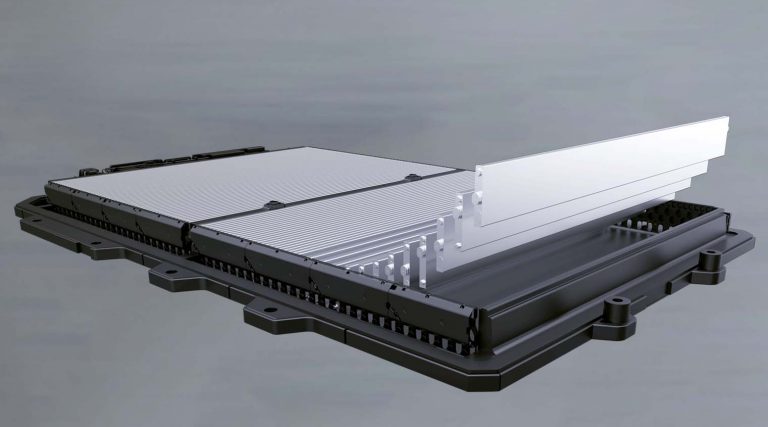
HV Battery from BYD with Blade Cells
(Mit freundlicher Genehmigung/Courtesy of BYD Company Ltd. [Homepage])
BYD attracted particular attention with the presentation of the Blade cell. This is a prismatic cell with an unusual length of almost one metre, which is visually reminiscent of a sword blade.
Blade cells are almost exclusively used in hybrid and electric vehicles. These are prismatic cells with an unusual length of up to almost one meter, which visually resemble a sword blade. The long blade cells are used in BEV models, while short cells are used in BYD’s hybrid vehicles.
The blade cell is only available with lithium iron phosphate (LFP) chemistry, which, unlike NMC chemistry, does not require critical raw materials such as nickel and cobalt and is significantly safer in terms of overheating and fire risk (thermal runaway). An HV battery built from Blade cells is designed to last 1.2 million kilometers or 3,000 charging cycles [2].
BYD is also conducting research into the development of solid–state batteries and, like CATL, is focusing on sulfide-based electrolytes. The company has already produced initial prototypes (20–60 Ah) on pilot lines and plans to begin limited series production around 2027, with the goal of broader industrialization toward the end of the decade.
In this assessment, BYD appears ambitious yet pragmatic: While the company is promising high ranges and cost targets, it is simultaneously pursuing a phased rollout—first in premium vehicles and only later in the mass market.
BYD is listed on the stock exchange, including in Frankfurt under WKN A0M4W9 and ISIN CNE100000296.
Sources
[1] https://de.wikipedia.org/wiki/BYD (Access 10.10.2022)
[2] https://battery-news.de/index.php/2021/03/16/neue-infos-zur-blade-battery-von-byd (Access 11.10.2022)
[cs 11.10.2022, 11.12.2023, 26.03.2026]
CALB – China Aviation Lithium Battery [↑] [↓] [⇑] [⇓]
Chinese producer of lithium–ion cells, which was founded in 2007 in Luoyang in the Chinese province of Henan [1]. The name CALB stands for “China Aviation Lithium Battery” and reflects the company’s roots in the state-owned aviation conglomerate AVIC. Originally, the company focused on batteries for aviation and military applications with stringent safety requirements. Today, however, CALB is clearly focused on the automotive and energy storage markets.
CALB was 2025 the world’s fourth-largest manufacturer of Li-ion cells for EV batteries, based on the battery capacity installed in EVs (EV battery usage, Source: SNE Research).
Year EV Batt. Usage [GWh] Market Share Ranking YoY Growth
2025 62,8 5,3 % 4 59,4 %
2024 39,4 4,4 % 4 19,8 %
2023 32,9 4,7 % 6 64,5 %
2022 20,0 3,9 % 7 153,2 %
The table above shows CALB’s key financial figures (Source: SNE Research). The company has gradually succeeded in expanding its market share, rising from 7th to 4th place within four years. Among CALB’s customers, XPeng, and GAC Aion are the primary growth drivers.
CALB plans to build a European battery cell factory in the port of Sines, Portugal. The project has recently been significantly expanded: The planned total capacity is now around 45 GWh per year, with production set to ramp up gradually and production scheduled to begin toward the end of the 2020s.
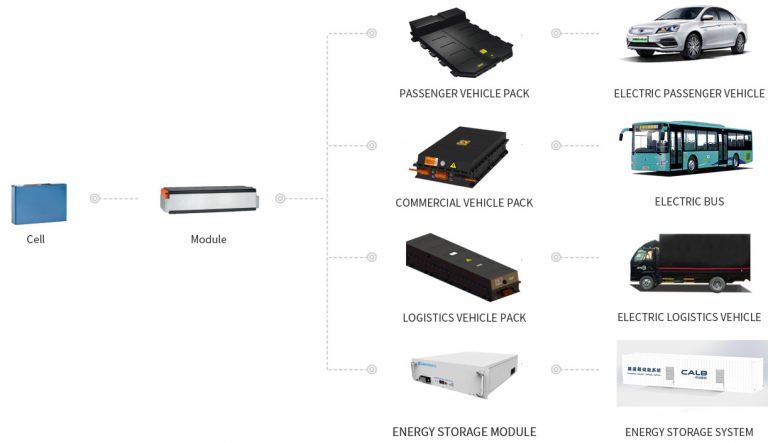
CALB Product Portfolio
(Mit freundlicher Genehmigung/Courtesy of CALB [Homepage])
CALB manufactures prismatic cells using NMC and LFP chemistry. Using its own cells, CALB also manufactures modules and complete battery packs for passenger cars, buses, trucks, and energy storage systems (ESS).
At the 2023 China EV Forum in Beijing, CALB unveiled a novel cylindrical cell design. For the first time, the positive and negative terminals are located on the same side of the cell, which means that the current no longer flows through the casing, allowing for a significant reduction in internal resistance.
With this cell design, CALB promises very high charging rates: According to the company, charging rates of up to 6C are possible, which theoretically allows for a full charge in about ten minutes. The cylindrical cell is expected to be available in two chemistry variants—an NMC version with a gravimetric energy density of approximately 300 Wh/kg and an LFP variant with around 230 Wh/kg.
This concept is not to be equated with the currently developed 46xx cylindrical cells, but rather represents a standalone cell architecture that is still in the prototype stage. While 46xx cells are already being developed toward mass production, concrete details regarding industrialization and potential customers are currently lacking for the new design.
CALB is also working on the development of solid-state batteries with sulfide–based electrolyte systems, which are considered particularly high-performance due to their high ionic conductivity and are currently being pursued as the leading technological approach in China. In parallel, the company is also investigating alternative material systems as well as various cell architectures to improve industrial scalability.
A central component of the strategy is the development of so-called semi-solid batteries. Here, a hybrid electrolyte consisting of solid and liquid components is used as a transitional technology. CALB is already utilizing this hybrid solution in high-performance cells with energy densities of up to approximately 350 Wh/kg.
In parallel, CALB is working on fully solid-state systems, for which pilot production capacities have already been established. The long-term goal is energy densities exceeding 400 Wh/kg, although industrialization still faces challenges such as material stability, interface issues, and costs.
CALB is a listed company and its shares are traded on the Hong Kong stock exchange, among others.
Sources
[1] https://de.wikipedia.org/wiki/CALB (Access 15.10.2022)
[cs 15.10.2022, 12.12.2023, 29.03.2026]
CATL – Contemporary Amperex Technology Co. Limited [↑] [↓] [⇑] [⇓]
Cell start-up from China, founded in 2011 by Robin Zeng. In 2016, CATL was still in third place among the world’s largest cell manufacturers behind Panasonic and BYD, but then grew to become the world’s largest manufacturer of lithium–ion cells within just a few years. CATL produces at four sites in China – Liyang, Ningde, Xining and Yibin, with its headquarters in Ningde.
In 2025, CATL held a global market share of over 39 % for installed EV batteries, which corresponds to an annual volume of 464.7 GWh (EV battery usage, Source: SNE Research).
Including the stationary energy storage (ESS) business, total sales in 2025 had already reached 661 GWh. This means that the former 2030 target of 800 GWh is expected to be achieved well ahead of the original schedule [2].
Year EV Batt. Usage [GWh] Market Share Ranking YoY Growth
2025 464.7 39,2 % #1 +37,0 %
2024 339.3 37,9 % #1 +30,7 %
2023 259.7 36,8 % #1 +35,5 %
2022 191.6 37,0 % #1 +98,1 %
The table above contains CATL’s key financial metrics (Source: SNE Research). It shows that the company has consistently managed to keep pace with the global EV battery market. In 2025, the company was able to further expand its market share.
The German production facility near Erfurt in Thuringia, whose construction began in October 2019, has since been completed and has been in operation since 2023. The facility is currently ramping up and is expected to reach a production capacity of approximately 14 GWh per year upon full completion [3].
Another European factory in Hungary is largely complete and is currently ramping up; series production of battery cells is scheduled to begin in the course of 2026 and reach a capacity of up to 100 GWh upon full completion [4].
CATL’s customers include premium manufacturers such as Mercedes–Benz AG as well as start-ups such as Nio, while other international customers include BMW, Honda, Hyundai, Stellantis (PSA), Tesla, Toyota, Volkswagen and Volvo. Customers on the Chinese market include AIC Motor, Foton Motor, Geely, GAC Group, SAIC Motor, Xpeng, Xiamen King Long, Yutong Bus and Zhongtong Bus.
CATL holds a roughly 14% stake in the EV startup Avatr, a joint venture with Changan and Huawei that focuses on the development of premium electric vehicles.

CATL Integrated Intelligent Chassis
(Mit freundlicher Genehmigung/Courtesy of Contemporary Amperex Technology Co., Limited. [Homepage])
CATL produces cells with NMC-811 and LFP chemistry in all cell formats. CATL also manufatures modules and packs, with its cell-to-pack technology (CtP) CATL achieves an energy density of 265 Wh/kg for the battery.
CATL is also working on a complete vehicle architecture, thereby evolving into a platform provider. The so-called CATL Integrated Intelligent Chassis (CIIC) is a highly integrated skateboard platform that combines key vehicle components—such as the battery, drivetrain, and power electronics—in the underbody, with the aim of reducing development times and costs for OEMs.
The platform is currently still in an early market phase. A strategic partnership exists with the Vietnamese manufacturer VinFast, which also includes the use of the CIIC; however, concrete large-scale production applications have not yet been widely implemented. Further partnerships are under discussion, although established automakers in particular have so far been reluctant to fully outsource their vehicle architecture.
CATL is, of course, also active in the field of solid–state batteries, with a particular focus on sulfide-based systems. The company aims to begin pilot production around 2027 and achieve broader commercialization toward the end of the decade. In its communications, CATL tends to take a relatively conservative approach: While it promises high energy densities, the company continues to emphasize existing challenges—particularly costs and industrial scaling, which currently remain significantly higher than those of conventional lithium-ion batteries.
CATL’s development of sodium–ion batteries is also causing a stir. With the “Naxtra” product line unveiled in 2025, CATL has brought the technology to the brink of mass production. GAC Aion is currently considered the first manufacturer planning to launch a production vehicle equipped with CATL’s sodium-ion batteries starting in 2026. Concurrently, collaborations are underway with other manufacturers, including Changan.
CATL’s sodium-ion batteries have energy densities of up to approximately 175 Wh/kg, approaching the level of LFP batteries. They are also characterized by excellent cold-weather performance, high safety, and fast charging capabilities (e.g., approximately 80% charge in 15 minutes). CATL expects sodium-ion batteries to be deployed on a larger scale starting in 2026 and to play a complementary role alongside lithium-ion technologies.
CATL is a listed company and its shares are traded on the stock exchange in Chenzhen and elsewhere.
Sources
[1] https://cleantechnica.com/2023/09/18/top-battery-producers-in-the-world (Access 13.12.2023)
[2] CATL: Powering the Future of Electric Mobility – A Deep Dive into the Meteoric Rise of the World’s Leading Battery Giant (linkedin.com) (Access 15.10.2022)
[3] https://battery-news.de/2023/01/27/catl-plant-produktionserweiterung-in-thueringen (Access 13.12.2023)
[4] https://www.reuters.com/business/autos-transportation/chinas-catl-build-new-756-bln-battery-plant-hungary-2022-08-12 (Access 13.12.2023)
[cs 15.10.2022, 14.12.2023, 28.03.2026]
Cellforce Group [↑] [↓] [⇑] [⇓]
Cellforce Group GmbH was founded in 2021 as a joint venture between Porsche AG and the battery developer Customcells. The goal was to develop and produce high-performance lithium-ion cells for Porsche sports cars. In May 2023, Porsche acquired Customcells’ shares and became the sole owner of Cellforce Group [1].
Technologically, Cellforce focused on high-performance cells with silicon-based anodes. Group14 Technologies was named as the supplier of the silicon anode material [2]. Cellforce was reluctant to provide further details on the cell chemistry; the cells were intended to impress primarily through high performance, short charging times, and low internal resistance.
A development and pilot production site for battery cells was established in Kirchentellinsfurt-Mahden near Reutlingen. The original plan was to significantly expand the production of high-performance cells. In April 2025, however, Porsche halted the expansion plans for battery cell production. In August 2025, the planned series production was definitively canceled; Cellforce was initially to be continued solely as a research and development unit for battery and cell systems.
In May 2026, the next U-turn finally followed: Porsche announced that it would not continue Cellforce Group GmbH as part of a stronger focus on its core business. This effectively brings an end to the project for a dedicated Porsche battery cell subsidiary. The decision is linked to the slower ramp-up of electromobility, changed market conditions in China and the U.S., and Porsche’s strategic realignment.
Regardless of this, Porsche subsidiary V4Smart (formerly V4Drive) continues to manufacture high-performance cylindrical battery cells, including those used in the Porsche 911 T-Hybrid.
Sources
[1] https://www.cellforce.de/ (Homepage, Access 18.10.2022)
[2] https://www.automobil-produktion.de/produktion/cellforce-und-duerr-etablieren-neue-elektrodenfertigung-279.html (Access 15.12.2023)
[cs 15.09.2022, 14.12.2023, 02.06.2026]
Attention: Cuberg’s operations in California were closed in 2024 after its parent company Northvolt decided to transfer lithium-metal battery research to Sweden. Northvolt AB subsequently entered bankruptcy proceedings in Sweden on 12 March 2025. Cuberg should therefore no longer be regarded as an active independent battery cell developer or manufacturer [4][5].
US battery technology start-up founded in California in 2015 by Richard Wang and acquired by Northvolt in 2021. Cuberg developed advanced lithium-metal battery cells with an NMC cathode, a lithium-metal anode and a proprietary liquid electrolyte designed for this chemistry [1][2].
In independently validated tests published in July 2022, a 5.1-Ah pouch cell achieved a specific energy of 380 Wh/kg and completed 672 full charge-discharge cycles before reaching 80% of its initial capacity. These figures represent historical development results rather than specifications of a currently available commercial product [2].
A major advantage of Cuberg’s technology was its intended compatibility with established lithium-ion cell manufacturing equipment. Potential applications included high-performance vehicles and particularly electric aviation. Cuberg supplied sample cells to aviation companies, including the eVTOL developer Beta Technologies [1][3].

Pouch Cell and Battery Module from Cuberg
(Mit freundlicher Genehmigung/Courtesy of Cuberg, Limited. [Press Kit])
Cuberg developed pouch-format lithium-metal cells and integrated them into battery modules and packs for electric aircraft. In May 2024, the company published independently validated results for an aviation battery module containing 60 lithium-metal pouch cells of 20 Ah each. The module achieved a specific energy of 284.8 Wh/kg and completed 692 cycles to 90% remaining capacity under an eVTOL-type operating profile. The tests were conducted by TÜV SÜD. These results demonstrated technical progress but did not constitute aviation certification or evidence of commercial series production [3].
On 20 August 2024, Northvolt announced that lithium-metal research would be consolidated at Northvolt Labs in Västerås, Sweden, ending Cuberg’s California operations. Northvolt AB and several Swedish subsidiaries subsequently entered bankruptcy proceedings on 12 March 2025. A continuation of Cuberg’s former commercial activities has not been confirmed [4][5].
Sources
[1] Cuberg – Company and technology overview (historical company information, accessed 09.10.2026)
[2] Northvolt – Independent validation of Cuberg lithium-metal cells (21.07.2022)
[3] Northvolt – Validation of Cuberg aviation battery module (14.05.2024)
[4] Northvolt – Transfer of lithium-metal development to Sweden (20.08.2024)
[5] Northvolt – Bankruptcy filing in Sweden (12.03.2025)
[cs 09.10.2026]
Customcells was founded in 2012 as a spin-off of the Fraunhofer Institute for Silicon Technology (ISIT) in Itzehoe, Schleswig-Holstein. The company develops and manufactures custom lithium–ion cells for applications with particularly high demands on performance, energy density, or service life. To do so, Customcells draws on a broad range of different active materials for anodes, cathodes, and electrolytes. Its technology portfolio also includes silicon-graphite anodes to increase energy density and fast-charging capability [1].
Unlike the major Asian cell manufacturers, Customcells focuses on small and medium-scale production runs as well as on applications for which no standard cells are available. In addition to individual battery cells, the company also develops and manufactures complete battery modules, including battery management systems, upon request. The cells can be produced in various designs, such as pouch, cylindrical, or prismatic cells.
In recent years, Customcells has collaborated with various technology partners, including the U.S. companies Ionblox and Enevate. The partnership with Enevate involves the use of XFC technology, which is based on silicon-based anodes, customized electrolytes, and an optimized cell design and is intended to enable particularly short charging times.
Being selected as the battery cell supplier for the startup Lilium represented an important step toward growth. However, following Lilium’s bankruptcy, Customcells also ran into financial difficulties. In 2025, key companies within the group filed for bankruptcy. As part of the subsequent restructuring, the Tübingen site was closed and the corporate structure was significantly downsized.
Today, Customcells focuses on its Itzehoe facility and on custom high-performance cells for select applications, particularly in the fields of defense, drone systems, motorsports, and specialized industrial applications. In doing so, the company continues to pursue a strategy of distinguishing itself from the mass production of standardized battery cells and instead serving technologically sophisticated niche markets.
Sources
[1] https://www.customcells.de/ (Homepage, Access 02.06.2026)
[cs 18.10.2022, 15.12.2023, 02.06.26]
Desten is a US battery technology company based in Palo Alto, California, specialising in ultra-fast-charging lithium-ion cells and battery systems. Its portfolio includes cells using NMC (nickel manganese cobalt oxide) and LFP (lithium iron phosphate) cathode chemistries. The company develops proprietary electrode materials, nanomaterial additives, electrolytes and cell manufacturing processes to achieve high charging and discharging rates [1][2].
Desten develops and manufactures pouch-format cells as well as battery modules and complete energy storage systems. According to company information, its high-power NMC cells can achieve charging rates of more than 10C, while selected LFP cells support fast charging at approximately 6C. Desten reports charging times of less than five minutes for certain NMC applications and approximately six minutes for selected LFP applications. These figures depend on cell chemistry, temperature, charging conditions and the specified state-of-charge range; they should not be interpreted as general performance guarantees for all Desten products [1][2].
The company targets electric vehicles, two- and three-wheelers, marine applications, high-power charging infrastructure and stationary battery energy storage systems. In the automotive sector, Desten supplied high-power NMC cells for the electric LMP3 racing car project of InMotion. According to the project partners, the battery pack demonstrated charging from 10% to 80% in less than four minutes. This is a specific motorsport development result, not evidence that the same charging performance is available in series-production passenger cars [2][3].
Desten has also described production expansion with partners in East Asia and plans to establish manufacturing capacity in North America. The available information does not establish that a large-scale North American cell factory has entered operation [2].
Sources
[1] Desten – Company website and battery technology (accessed 09.10.2026)
[2] Thermo Fisher Scientific – Interview with Desten on fast-charging lithium-ion technology (accessed 09.10.2026)
[3] Thermo Fisher Scientific – Desten battery technology and InMotion racing project (2024)
[cs 09.10.2026]
ElevenEs is a Serbian battery technology company based in Subotica, established as a spin-off of the Al Pack Group. The battery project originated in 2019, while ElevenEs was established as a separate company in 2021. It develops and manufactures lithium-ion cells with LFP chemistry (lithium iron phosphate) in a large-format prismatic blade-cell design, marketed under the EDGE brand [1][2].
The company opened an LFP research and development centre in Subotica in 2022 and commissioned a pilot manufacturing facility with an annual capacity of approximately 10 MWh in April 2023. The facility has produced prototype and sample cells for evaluation by customers in the electric vehicle, commercial vehicle and stationary energy storage sectors. These activities demonstrate ongoing cell development and pilot production, but not yet large-scale commercial manufacturing [1][2].
In February 2025, ElevenEs announced a joint development agreement with the Dutch company CarbonX to test an innovative anode material in its prismatic LFP cells. In October 2025, the company signed a joint declaration of support with representatives of the European Commission and Serbia’s development agency for the expansion of battery manufacturing in Subotica [3][4].
In February 2026, ElevenEs announced the first closing of a Series B financing round, backed by Caterpillar Venture Capital and an affiliate of BST (HK) Ltd.. The investment is intended to support the construction of a new 1-GWh-per-year LFP cell factory in Subotica. Preparatory construction work was authorised in January 2026, and construction activities were reported during 2026. According to the company’s published roadmap, the new factory is scheduled to begin production in 2027. This capacity is therefore a development target, not an already operating gigawatt-hour-scale production facility [5][6][7].
ElevenEs is consequently an active European LFP battery cell developer with pilot manufacturing capabilities and plans for industrial expansion. The company also envisages additional gigafactory projects in subsequent years, but their announced capacities and commissioning dates remain forward-looking plans [1][7].
Sources
[1] ElevenEs – Company history and manufacturing roadmap (accessed 09.10.2026)
[2] ElevenEs – Environmental policy and pilot manufacturing capacity (May 2025)
[3] ElevenEs – Joint development agreement with CarbonX (February 2025)
[4] ElevenEs – Joint declaration of support for battery manufacturing expansion (13.10.2025)
[5] ElevenEs – Series B financing backed by Caterpillar Venture Capital (16.02.2026)
[6] eKapija – Permit for preparatory construction work in Subotica (21.01.2026)
[7] electrive – Caterpillar and BST invest in ElevenEs (25.02.2026)
[cs 09.10.2026]
E-Lyte Innovations GmbH is a German battery materials company founded in 2019 as a spin-off from the Münster Electrochemical Energy Technology (MEET) battery research centre at the University of Münster. Its headquarters and industrial production site are located in Kaiserslautern, while research and development activities continue in Münster [1][2].
E-Lyte develops, formulates and manufactures customised electrolytes for lithium-ion cells, sodium-ion batteries and supercapacitors. Its activities include electrolyte optimisation, analytical testing and participation in national and European battery research projects. The company supplies an essential battery component rather than manufacturing complete battery cells [1][2].
In May 2022, the German lubricants manufacturer FUCHS acquired a 28% stake in E-Lyte. On 13 September 2024, the partners opened an industrial electrolyte production plant in Kaiserslautern with a stated capacity of up to 20,000 tonnes per year. The facility supports the European supply chain for battery electrolytes; the figure represents production capacity, not confirmed annual output [2][3].
E-Lyte remains active in research and industrial partnerships. In June 2026, the company announced closer cooperation with Fraunhofer FFB in Münster to link electrolyte development with innovative battery cell manufacturing. In July 2026, it signed a joint development agreement with PCC Thorion to advance electrolyte additives for lithium-ion and sodium-ion batteries. Earlier cooperation with Customcells is documented historically, but its continuation after Customcells’ 2025 insolvency proceedings has not been confirmed [1][4][5].
Sources
[1] E-Lyte – Company website, products and research activities (accessed 09.10.2026)
[2] E-Lyte – Opening of the Kaiserslautern electrolyte production plant (16.09.2024)
[3] FUCHS – Investment in E-Lyte and production capacity (16.09.2024)
[4] E-Lyte – Cooperation with Fraunhofer FFB (25.06.2026)
[5] E-Lyte – Joint development agreement with PCC Thorion (23.07.2026)
[cs 09.10.2026]
Enertech International [↑] [↓] [⇑] [⇓]
Enertech International is a South Korean battery manufacturer founded in 2001, originally under the name Saehan Enertech. Based in Chungju, South Korea, the company develops and manufactures electrodes, lithium-ion cells, battery modules and complete battery systems. Its applications include electric and hybrid vehicles, stationary energy storage systems (ESS), uninterruptible power supplies and specialised industrial equipment [1][2].
Enertech has a long history of supplying battery cells and components to the automotive industry. Its company records include the supply of battery cells to the Norwegian electric vehicle manufacturer Think in 2008, an electrode and cell development contract with BMW in 2019 and cooperation with Hyundai Motor on hybrid vehicle battery cells beginning in 2020. The company has also supplied cathode and anode electrodes to LG Chem and subsequently worked with LG Energy Solution on electrodes for research and testing. These references include historical projects and do not necessarily indicate ongoing series-production supply agreements [2][3].
In 2021, Enertech entered into a production licensing agreement with the US battery technology company Enevate for its silicon-dominant anode technology, intended to enable high-energy, fast-charging lithium-ion cells. Enertech’s own company history records subsequent development work on a 60-Ah cell for electric two-wheelers. The licence agreement and development programme should not be interpreted as confirmation of large-scale commercial production using this technology [2][4].
More recently, Enertech has expanded its activities in stationary energy storage and the development of additional cell chemistries. In 2024, the company began developing LFP (lithium iron phosphate) and LTO (lithium titanate) cells. During 2025 and 2026, it reported further business development in Asian and European ESS markets. Enertech remains an active battery manufacturer, although announced projects and supply opportunities must be distinguished from completed commercial deliveries [1][2][5].

Pouch Cell and Battery-Module from Enertech
(Mit freundlicher Genehmigung/Courtesy of ENERTECH International Inc. [Homepage])
Enertech manufactures high-energy and high-power lithium-ion cells in pouch format, together with electrodes, modules and complete battery packs. Its portfolio includes NMC-based cells for vehicle and industrial applications, while LFP and LTO cell types are also included in its development programme. The company operates cell and battery system manufacturing facilities in Chungju, South Korea [1][2][3].
In 2023, Enertech announced an expansion of its battery manufacturing facilities, with a planned increase in annual cell production capacity from approximately 150 MWh to 500 MWh. Its company history also records the start of production on a new narrow-format cell line and an automated module manufacturing facility in that year. The announced capacity figures should not be confused with independently confirmed production output or utilisation rates [2][6].
In 2026, Enertech presented battery cells, modules, packs and integrated ESS solutions at international trade exhibitions, including InterBattery in South Korea and ees Europe in Munich. The company is also developing sodium-ion batteries, with commercial production targeted for 2027 according to its published plans. This remains a future objective rather than an established product in series production [1][5].
Sources
[1] Enertech International – Company website, products and news (accessed 09.10.2026)
[2] Enertech International – Company history and development projects (accessed 09.10.2026)
[3] Enertech International – Company brochure and manufacturing overview (2025)
[4] Business Wire – Enevate production licensing agreement with Enertech (22.12.2021)
[5] Enertech International – Company announcements on new battery technologies and markets (accessed 09.10.2026)
[6] Enertech International – Investment in battery factory expansion (2023)
[cs 09.10.2026]
Enevate is a US developer of advanced lithium-ion battery technology, specialising in silicon-dominant anodes and extremely fast charging. The original Enevate Corporation was founded in 2005 in Irvine, California. After its liquidation, its technology assets were acquired by an affiliate of Quantum Valley Investments. The successor company, Enevate Technologies Corporation, launched in August 2026 under founder and CEO Dr Benjamin Park [1][2].
The technology portfolio includes more than 650 issued and pending patents covering silicon-based anodes, electrode materials, electrolytes, cell design and safety. Nobel laureate John Goodenough served as a technical adviser to the original company for more than ten years. Historical investors included the Renault-Nissan-Mitsubishi Alliance, LG Chem, Samsung and Lenovo. These investments should not be confused with the ownership structure of the new company [1][2][3].
Enevate’s XFC-Energy technology combines silicon-dominant anodes with specialised electrolytes and cell designs to improve fast-charging performance. In August 2026, the company reported experimental cell performance of charging in less than five minutes, with energy densities exceeding 350 Wh/kg and approximately 800 Wh/l. These are company-reported technology figures, not verified specifications of a mass-produced automotive battery [2].
The original Enevate reported that its technology had been evaluated by more than 20 battery and automotive manufacturers. However, individual vehicle manufacturers were generally not identified as confirmed series-production customers. The historical investment by Renault-Nissan-Mitsubishi does not establish that its vehicles use Enevate cells. The technology competes in the fast-charging field with approaches developed by companies such as StoreDot [1][3].
The successor company continues to target electric mobility but initially emphasises aviation, defence and specialised high-performance applications, alongside technology licensing and transfer [2].
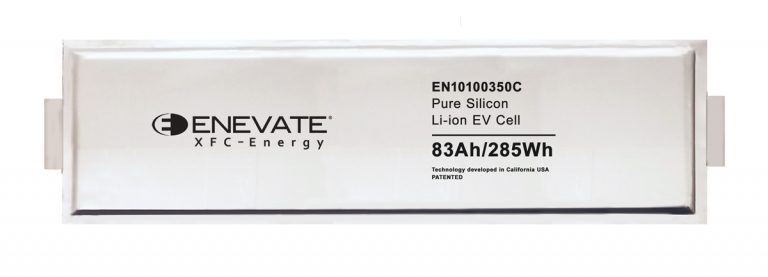
Pouch Celle from Enevate
(Mit freundlicher Genehmigung/Courtesy of Enevate Corporation [Homepage])
Enevate’s business model focuses on licensing battery technology, transferring manufacturing know-how and supporting industrialisation, rather than operating its own large-scale automotive cell factories. The successor company, Enevate Technologies Corporation, continues this approach and operates research and development facilities in Irvine, California [1][2].
The original company concluded technology and production licensing agreements with several battery manufacturers. These included Germany’s Customcells and South Korea’s Enertech International. A partnership with Customcells for silicon-dominant battery cells was announced in December 2023. Following Customcells’ restructuring in 2025, its activities have increasingly focused on defence, motorsport and customised batteries. The current commercial status of the original Enevate licensing arrangement has not been publicly confirmed [4][5].
Enertech International records a 2022 licence agreement for Enevate silicon-anode material, associated with the electric bicycle market. Enertech remains active in battery cells, modules and energy storage systems. However, the licence agreement does not establish that Enevate technology is being used in a particular mass-produced electric car [6][7].
The company develops and validates battery cells to demonstrate performance and assist manufacturing partners. Its XFC-Energy platform targets very short charging times and high energy density, while its broader technology portfolio also addresses safety and high-power applications. The published figures refer to specific development cells and should not be interpreted as guaranteed performance at battery-pack or vehicle level [2].
As of October 2026, no independently confirmed high-volume automotive production programme using Enevate technology has been identified. The company’s renewed commercialisation strategy remains focused on licensing and specialised applications, with electric mobility as a continuing potential market [2].
Sources
[1] Enevate Technologies Corporation – Company and technology overview (accessed 12.10.2026)
[2] Enevate Technologies Corporation – New company launches following acquisition of Enevate assets (25.08.2026)
[3] Enevate – Company history, patents and automotive technology evaluation (accessed 12.10.2026)
[4] Electrive – Customcells licenses Enevate silicon-dominant cell technology (13.12.2023)
[5] Customcells – Restructuring and strategic focus (2025–2026)
[6] Enertech International – Company history and Enevate licensing agreement (accessed 12.10.2026)
[7] Enertech International – Corporate brochure and battery product development (2025)
[cs 19.12.2023, 12.10.2026]
EPS – Electric Power Systems [↑] [↓] [⇑] [⇓]
Electric Power Systems (EPS) is a US manufacturer of battery systems and electric propulsion technology for aircraft, founded in 2016 and based in North Logan, Utah. Its investors and strategic supporters include aerospace companies such as Boeing and Safran [1][2].
EPS develops modular lithium-ion battery systems, battery management electronics and charging infrastructure for electric and hybrid-electric aircraft. The company integrates externally sourced battery cells into aviation-grade modules and systems; EPS is not a battery cell manufacturer [1][3].
Its customers and development partners include manufacturers of conventional aircraft and electric vertical take-off and landing aircraft (eVTOLs). Projects have involved Archer Aviation, SkyDrive and Supernal Aero, as well as Diamond Aircraft, Ampaire, VoltAero and Aura Aero. The partnerships are at different stages of development and aircraft certification [2][4].
EPS designs its battery systems to meet demanding aviation safety requirements, including RTCA/DO-311A for rechargeable lithium batteries and FAA TSO-C179b. According to EPS, its EPiC 1.0 battery system received FAA Technical Standard Order (TSO) authorisation in 2024. Such equipment approval does not by itself constitute certification of an entire aircraft [3][5].

Powertrain Components from EPS
(Mit freundlicher Genehmigung/Courtesy of Electric Power Systems, Inc. [Homepage])
EPS offers its modular EPiC (Electric Propulsion Ion Core) battery platform for electric and hybrid-electric aircraft. The architecture allows battery modules to be combined for different voltage, energy and power requirements. The portfolio includes configurations optimised for energy density and for high power output, including applications in fixed-wing aircraft and eVTOLs [1][3].
A key safety feature is the ability to electrically isolate battery sections in the event of faults or during maintenance. EPS uses a Battery Power Management Unit (BPMU) to monitor system status, detect insulation faults and control protective functions. A separate Midpoint Disconnect (MPD) contains a contactor and high-voltage fuse; removing the fuse reduces the effective battery string voltage for safer handling. Individual modules monitor cell voltage and temperature and provide cell balancing [1][3].
For EPiC 1.0, EPS specifies module-level energy densities of approximately 193–205 Wh/kg, depending on the configuration. The subsequently introduced EPiC 2.0 platform is specified at approximately 265 Wh/kg at module level. These are manufacturer specifications for battery modules, not individual cell energy densities. EPS has also announced improvements in usable flight endurance, but actual aircraft range and flight time depend on the complete propulsion system and mission profile [3].
EPS also develops charging systems and associated ground infrastructure. Its battery technology is used in development and certification programmes for electric aircraft, including the Diamond eDA40 and SkyDrive SD-05. Aircraft-specific certification and commercial entry into service remain separate from the approval of individual battery components [2][4][5].
Sources
[1] Electric Power Systems – Company and technology overview (accessed 12.10.2026)
[2] Electric Power Systems – Commercial aviation applications and project partners (accessed 12.10.2026)
[3] Electric Power Systems – EPiC 1.0 and EPiC 2.0 battery specifications and safety components (accessed 12.10.2026)
[4] SkyDrive – Selection of EPS battery systems for the SD-05 (18.07.2022)
[5] Electric Power Systems – Aviation battery certification and regulatory requirements (accessed 12.10.2026)
[cs 22.10.2022, 19.12.2023, 12.10.2026]
Current status (October 2026): Eurocell’s announced European battery cell factory could not be confirmed as completed. Eurocell EMEA Limited, the British company established for the project, was dissolved in December 2024 [3].
Eurocell was promoted as a British-Korean battery project aiming to manufacture South Korean-developed lithium-ion cells in Europe. The proposed products included battery cells for electric vehicles and stationary energy storage systems [1][2].
In February 2022, Eurocell announced plans to build a European battery cell factory. In August 2022, the Netherlands was identified as the preferred location. According to the company, discussions with public authorities and the regional investment agency NOM were at an advanced stage. The original plans envisaged production starting as early as 2023 and a capacity of more than 40 million cells per year by 2025. However, a final site decision or the actual commissioning of the factory has not been substantiated [1][2].
Eurocell announced both power-optimised cells and energy-optimised cells. For the latter, the company targeted a gravimetric energy density of more than 280 Wh/kg. This figure should be understood as a historical product target rather than a verified specification from current series production. No reliable recent evidence of European mass production is available [1].
The dissolution of Eurocell EMEA Limited on 10 December 2024 is documented in the UK Companies House register. This indicates that the original European expansion project is no longer active in its former corporate structure. It does not, however, establish whether the Korean technology partner has ceased operations [3].
Sources
[1] Electrive – Eurocell announces battery factory in Western Europe (16.02.2022; updated 29.02.2024)
[2] Electrive – Eurocell plans battery factory in the Netherlands (17.08.2022)
[3] UK Companies House – Eurocell EMEA Limited, dissolved on 10 December 2024 (accessed 12.10.2026)
[4] Eurocell Korea – original company website (historical source; accessed 25.10.2022)
[cs 22.10.2022, 19.12.2023, 12.10.2026]
EVE Energy is a Chinese battery manufacturer founded in 2001. The company develops and produces lithium-ion cells and battery systems for electric vehicles, hybrid vehicles and industrial applications. Its automotive portfolio includes high-voltage traction batteries as well as low-voltage lithium-ion systems for 12 V and 48 V vehicle electrical networks [1].
EVE is also a major supplier of stationary energy storage systems (ESS), including large-format battery cells for grid-scale applications [1][4].
In 2025, EVE was the world’s eighth-largest EV battery manufacturer, with 31.3 GWh of installed battery capacity and a global market share of 2.6% (source: SNE Research) [3].
Year EV Batt. Usage [GWh] Market Share Ranking YoY Growth
2025 31.2 2.6 % #8 47.9 %
2024 21.1 2.3 % #9 30.2 %
2023 16.2 2.3 % #9 174.6 %
2022 5.9 1.1 % #9 168.2 %
The table above illustrates EVE Energy’s development in the global EV battery market (source: SNE Research).
EVE Energy’s automotive customers and cooperation partners include BMW, Mercedes-Benz, Hyundai and Kia. BMW selected EVE Energy alongside CATL as a supplier of 46 mm cylindrical cells for its Neue Klasse electric vehicles. The first Neue Klasse model, the BMW iX3, was introduced in 2025. BMW’s cell supply agreements cover planned production in China and Europe; the allocation of individual cell suppliers to specific vehicle models and markets is not fully disclosed [2].
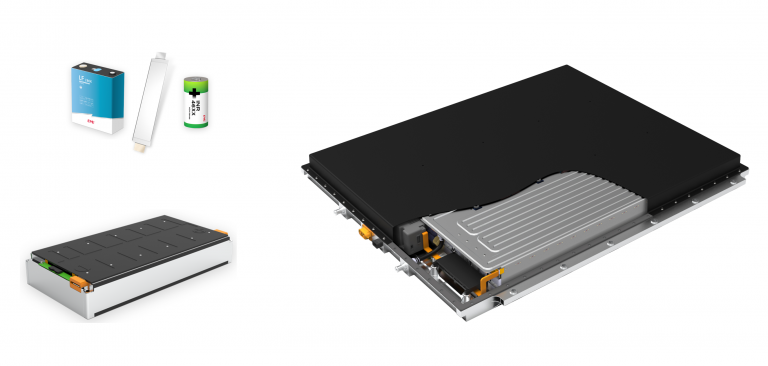
Cell, Module and Battery-Pack from EVE Energy
(Mit freundlicher Genehmigung/Courtesy of EVE Energy Co., Ltd. [Homepage])
EVE Energy manufactures pouch, prismatic and cylindrical lithium-ion cells using different cathode chemistries, including NMC/NCM and LFP. Its product range covers traction batteries, low-voltage automotive batteries and large-format cells for stationary energy storage. For BMW’s Neue Klasse, EVE is developing 46 mm cylindrical cells with a nickel-rich cathode and increased silicon content in the anode [1][2].
EVE is also developing all-solid-state batteries, focusing on sulfide- and halide-based solid electrolytes. In 2025 and 2026, the company presented successive generations of solid-state cells and expanded pilot manufacturing activities. Its development programme includes cells for electric vehicles as well as robotics and aviation applications. These activities represent pilot production and early commercialisation, not established large-scale automotive production [5].
EVE’s solid-state development targets include high gravimetric and volumetric energy density, improved safety and fast-charging capability. Announced values of approximately 350 Wh/kg and future targets exceeding 1,000 Wh/l should be distinguished from independently verified specifications of mass-produced EV batteries [5].
EVE is also a technology and manufacturing partner of Israeli battery developer StoreDot, which specialises in extreme fast-charging lithium-ion cells [1].
Sources
[1] EVE Energy – Company information and battery products (accessed 12.10.2026)
[2] BMW Group – Cylindrical battery cells and suppliers for the Neue Klasse (09.09.2022)
[3] CnEVPost / SNE Research – Global EV battery manufacturer ranking 2025 (04.02.2026)
[4] EVE Energy – Large-format battery technology for stationary energy storage (20.10.2025)
[5] CnEVPost – EVE Energy presents new all-solid-state battery cells (19.03.2026)
[cs 26.10.2022, 21.12.2023, 02.04.2026, 12.10.2026]
Factorial Energy [↑] [↓] [⇑] [⇓]
Factorial Energy is a US developer of advanced lithium-metal battery cells, headquartered in Billerica, Massachusetts. Its technologies are designed to increase energy density and improve battery safety. Automotive development partners and investors include Mercedes-Benz, Stellantis, Hyundai and Kia. Factorial became a publicly traded company on Nasdaq under the ticker FAC in June 2026 [1][2].
The company develops two main battery platforms: FEST, based on a proprietary quasi-solid-state electrolyte system, and Solstice, an all-solid-state technology developed with Mercedes-Benz. Both use lithium-metal anodes and target higher energy density than conventional lithium-ion cells. Their development status differs, and neither technology has been confirmed for mass production in a customer passenger car [1][3].
In February 2025, Mercedes-Benz began road tests with a modified EQS fitted with Factorial solid-state cells and a battery pack developed together with Mercedes-AMG High Performance Powertrains. In August 2025, the vehicle covered 1,205 km from Stuttgart to Malmö without recharging, demonstrating the technology’s potential under real-world conditions [4][5].
Stellantis integrated Factorial FEST cells into a Dodge Charger Daytona development vehicle and began road testing in June 2026. The programme is intended to validate cell performance, safety and durability before possible series-production applications [6].
Factorial operates battery development facilities in Massachusetts and a cell manufacturing site in Cheonan, South Korea, which accounts for most of its production capacity. The Korean facility has space for up to 200 MWh of annual capacity. The previously announced US manufacturing facility in Methuen is no longer leased by Factorial; the lease ended in October 2025 [2].

Pouch Cell from Factorial Energy
(Mit freundlicher Genehmigung/Courtesy of Factorial Inc. [Homepage])
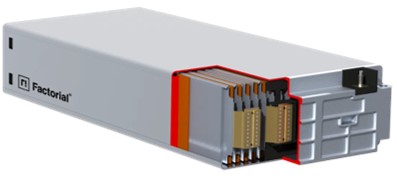
Battery-Module from Factorial Energy
(Mit freundlicher Genehmigung/Courtesy of Factorial Inc. [Homepage])
Factorial’s FEST (Factorial Electrolyte System Technology) uses a proprietary quasi-solid-state electrolyte system and a lithium-metal anode. The technology is designed to use much of the equipment employed in conventional lithium-ion cell manufacturing, potentially reducing industrialisation costs. In 2024, Factorial delivered automotive-scale 100 Ah-class B-sample cells to development partners [1][3][4].
The Factorial FEST cells in the Mercedes-Benz EQS test vehicle require external contact pressure. To maintain this pressure and accommodate changes in cell volume during charging and discharging, Mercedes-Benz and Mercedes-AMG High Performance Powertrains developed a battery system equipped with pneumatic actuators. The system adjusts to cell expansion and contraction, helping maintain reliable operation. This additional pressure-management hardware is relevant to future battery pack design and industrialisation; Mercedes-Benz has not disclosed the required pressure level [4][5].
In validation tests reported with Stellantis in 2025, FEST cells achieved approximately 375 Wh/kg and charged from 15% to 90% in 18 minutes. These figures describe development-cell performance, not the specifications of a mass-produced vehicle battery [6].
Solstice is Factorial’s more advanced all-solid-state battery platform, developed with Mercedes-Benz. It combines a lithium-metal anode with a sulfide-based solid electrolyte and a dry-manufactured cathode. Factorial states a potential energy density of up to 450 Wh/kg and operation at temperatures of approximately 90°C. These are announced development characteristics, not verified mass-production specifications [3][7].
The dry cathode process is intended to eliminate solvent-based coating and energy-intensive drying steps during cell production. Factorial is also pursuing industrial partnerships to scale solid-state manufacturing, including cooperation with Japanese materials specialist Mitsui Kinzoku announced in September 2026 [7][8].
Although Factorial has demonstrated automotive-scale cells and working test vehicles, commercial mass production for passenger cars has not yet been established. The Mercedes-Benz and Stellantis road-test programmes remain validation projects rather than series-production applications [4][5][6].
Sources
[1] Factorial Energy – Company and battery technology (accessed 12.10.2026)
[2] Factorial Energy – SEC filing, manufacturing facilities and company operations (2026)
[3] Electrive – FEST and Solstice development status (18.09.2026)
[4] Mercedes-Benz – Solid-state battery road tests with Factorial cells (24.02.2025)
[5] Mercedes-Benz – EQS solid-state battery test and pneumatic pressure-management system (09.09.2025)
[6] Stellantis – Factorial FEST cell validation and Dodge Charger Daytona road testing (11.06.2026)
[7] Factorial Energy – Solstice all-solid-state technology and dry cathode process (10.09.2024)
[8] Factorial Energy – Investor relations and Mitsui Kinzoku cooperation (accessed 12.10.2026)
[cs 04.10.2023, 26.12.2023, 12.09.2024, 12.10.2026]
Farasis Energy [↑] [↓] [⇑] [⇓]
Farasis Energy is a Chinese battery manufacturer founded in California in 2002. Based in Ganzhou, China, the company develops and manufactures lithium-ion cells, modules and battery packs for electric vehicles and energy storage. Farasis is listed on the Shanghai Stock Exchange and operates internationally [1].
With 13.4 GWh of batteries installed in electric vehicles, Farasis was outside the world’s top ten EV battery manufacturers in 2025 (source: SNE Research).
Mercedes-Benz established a strategic partnership with Farasis in 2020, including an announced equity investment of approximately 3%. Farasis supplied cells for certain EQE and EQS variants, including selected model years through 2026. However, Farasis has not been confirmed as a supplier for the new CLA, GLA or electric GLC. The CLA’s 85 kWh NMC battery uses CATL cells [2][3][4].
Another major customer is GAC Aion. In December 2025, Farasis announced an order for more than 10 GWh of LFP batteries for the European-market Aion V and Aion UT, using its SPS battery system [5].
Farasis also cooperates with Geely Radar on electric pickups, battery technology and energy storage. Its SPS systems have been used in the Radar RD6 Horizon. In Turkey, the Siro joint venture with Togg has produced battery modules and packs in Gemlik since 2023, initially with an annual capacity of 3 GWh [6][7].
Other automotive partners include FAW Jiefang for commercial vehicle batteries and JMEV for SPS and solid-state development. In February 2025, Farasis also announced a strategic partnership with German supplier Eberspächer to develop and market 12 V and 48 V lithium-ion battery systems for automotive applications [8][9][10].

Cell, Module and Battery-Pack from Farasis Energy
(Mit freundlicher Genehmigung/Courtesy of Farasis Energy Europe GmbH [Downloads@Homepage])
Farasis specialises in pouch cells with NMC/NCM chemistry and manufactures battery modules and packs based on these cells. Its portfolio also includes LFP batteries, while LMFP, sodium-ion and solid-state technologies are under development. These technologies are at different stages of commercial maturity [1][11].
Its SPS (Super Pouch Solution) integrates large-format pouch cells into a compact battery pack architecture with fewer intermediate components. SPS systems are used in vehicles including the Geely Radar RD6 Horizon, GAC Aion V and JMEV ELIGHT. The European GAC Aion order also uses SPS with LFP cells [5][6][9].
Farasis develops semi-solid-state and all-solid-state batteries, including oxide/polymer composite and sulfide-based electrolyte technologies. Pilot production and customer validation are being pursued for advanced solid-state cells. Announced energy density targets of 400 Wh/kg or more refer to development programmes, not established automotive mass production [9][12].
Together with Eberspächer, Farasis is developing high-performance lithium-ion batteries for 12 V and 48 V vehicle electrical systems. Beyond passenger cars, the company supplies or develops batteries for commercial vehicles, industrial applications and stationary energy storage [6][7][10].
Sources
[1] Farasis Energy – Company information (accessed 12.10.2026)
[2] Mercedes-Benz – Strategic partnership with Farasis (2020)
[3] Mercedes-Benz Korea – Battery suppliers by model and model year (accessed 12.10.2026)
[4] Electrive – Farasis cells in selected EQE and EQS models (11.03.2026)
[5] Electrive – GAC orders LFP batteries from Farasis (08.12.2025)
[6] Farasis Energy – Partnership with Geely Radar (accessed 12.10.2026)
[7] Farasis Energy – Siro joint venture with Togg (20.04.2023)
[8] Farasis Energy – Cooperation with FAW Jiefang (26.03.2024)
[9] Farasis Energy – JMEV partnership and SPS production (02.10.2024)
[10] Eberspächer – Strategic partnership with Farasis (12.02.2025)
[11] Farasis Energy – Battery product portfolio (accessed 12.10.2026)
[12] Farasis Energy – Pouch cells and solid-state development (2025)
[cs 04.10.2023, 26.12.2023, 06.04.2026, 12.10.2026]
Feon Energy is a US battery technology start-up founded in 2022 as a spin-off from Stanford University. Based in Woburn, Massachusetts, the company develops novel electrolytes for advanced lithium-ion and lithium-metal batteries. Its proprietary EDGE™ technology platform uses molecular-level design to develop electrolyte formulations tailored to different cell chemistries. A particular objective is to stabilize lithium-metal anodes and limit undesirable reactions and dendrite formation. The technology also targets silicon-rich anodes and high-voltage cathodes [1][2].
According to Feon, its experimental lithium-metal cells have achieved energy densities exceeding 400 Wh/kg. The company reported that these cells passed UN 38.3 transport safety testing in November 2023 and that pre-A samples were being supplied to potential customers in the automotive, aviation and consumer electronics industries. These figures refer to development-stage cells and do not establish commercial mass production [3].
Feon’s main commercial focus has increasingly shifted toward supplying advanced liquid electrolytes that can be integrated into established battery manufacturing processes. In 2024, the company announced US$6.1 million in seed financing and reported scaling its electrolyte production to approximately 100 kilograms. In February 2025, it completed the Shell GameChanger programme, reporting further progress in cell production and securing access to a production line with MWh-scale capacity [4][5].
As part of the Shell programme, Feon also demonstrated a lithium-metal battery pack in a first-person-view drone. According to the company, the drone achieved 2.3 times the flight duration of a comparable drone equipped with a conventional lithium-ion battery pack of the same weight. This was a specific demonstration rather than evidence of equivalent performance across all applications [5].
In May 2025, Feon opened a new 13,000-square-foot headquarters in Woburn with facilities for battery development and customer testing. The site also provides space for a planned US pilot production line for electrolytes. In May 2026, Feon signed a memorandum of understanding with Orbia Fluor & Energy Materials to explore the development, scale-up and US manufacturing of next-generation battery electrolytes. The initial focus is on aerospace and defence applications, with potential expansion into electric mobility and stationary energy storage. The agreement does not yet confirm commercial large-scale production [6][7].
Feon has reported cooperation and testing activities with battery manufacturers and customers in several industries, but no named major automotive manufacturer has been publicly confirmed as a series-production customer. As of October 2026, Feon remains primarily a developer and emerging supplier of advanced electrolyte technology rather than an established large-scale battery cell manufacturer [1][6][7].
Sources
[1] Feon Energy – Company information and EDGE electrolyte technology (accessed 12.10.2026)
[2] Feon Energy – Electrolyte technology for advanced battery chemistries (accessed 12.10.2026)
[3] Feon Energy – Lithium-metal cells exceeding 400 Wh/kg and UN 38.3 certification (23.11.2023)
[4] Feon Energy – US$6.1 million seed financing (27.06.2024)
[5] Feon Energy – Shell GameChanger programme, production scale-up and drone demonstration (10.02.2025)
[6] Feon Energy – New headquarters and planned pilot manufacturing facility in Woburn (30.05.2025)
[7] Feon Energy / Orbia – Memorandum of understanding on US electrolyte manufacturing (18.05.2026)
[cs 29.06.2024, 12.10.2026]
A Norwegian startup for lithium-ion cell production, founded in 2018. Originally, the company focused on the development and industrial manufacturing of lithium-ion cells for stationary energy storage and electric vehicles. Production was to be based on the SemiSolid™ technology developed by the U.S. company 24M, which is designed to reduce the proportion of passive cell components, thereby enabling simpler manufacturing and higher energy densities.
The plan was to build a large-scale cell factory in Mo i Rana (northern Norway).
Starting in 2024, Freyr fundamentally changed its corporate strategy. Due to difficult market conditions for building new battery cell factories, high financing costs, and challenges with industrializing 24M’s technology, plans for cell production in Norway were abandoned. In February 2025, Freyr Battery was renamed T1 Energy. At the same time, the company shifted its strategic focus to establishing an integrated U.S. value chain for solar cells and solar modules. As part of this realignment, the licensing agreement with 24M was also terminated [2][3].
The former Giga Arctic battery factory site in Mo i Rana is no longer intended for battery cell production. T1 Energy holds a long-term lease for the site and is examining alternative uses, particularly as a data center. In March 2026, the Norwegian grid operator allocated 50 MW of grid capacity to the project. In August 2026, local authorities approved the partial conversion of the site for data center operations. According to T1 Energy, a 50 MW data center could become operational in 2027, although the company is still evaluating potential partners and commercial arrangements. It also remains in the grid connection queue for additional capacity [4][5].
In June 2026, T1 Energy also announced an agreement to acquire KORE Power, a provider of battery energy storage systems and software solutions. The planned transaction is intended to strengthen T1’s activities in stationary battery storage and data center infrastructure. The announcement itself does not establish that the acquisition has been completed [6].
The former Freyr stock is now traded on the New York Stock Exchange under the name T1 Energy Inc. As part of the name change, the ticker symbol was changed from FREY to TE on 3 March 2025 [3].
Sources
[1] Wallstreet Online – Freyr Battery’s original battery manufacturing plans (accessed 09.10.2023)
[2] Freyr Battery / T1 Energy – Strategic realignment and termination of the 24M license (06.11.2024)
[3] T1 Energy – Stock ticker changes from FREY to TE (03.03.2025)
[4] T1 Energy – 50 MW grid allocation for the Giga Arctic site (18.03.2026)
[5] T1 Energy – Approval for partial conversion of Giga Arctic into a data center (27.08.2026)
[6] T1 Energy – Agreement to acquire KORE Power (03.06.2026)
[cs 04.10.2023, 11.07.2026, 12.10.2026]
Gelion is an Australian-founded battery technology company established in 2015 as a spin-off from the University of Sydney and listed on the London AIM market. Its main focus is the development of lithium-sulfur batteries and advanced sulfur-based cathode materials. Its technologies include the GEN3 lithium-sulfur cell platform, which uses a sulfur cathode and proprietary liquid electrolyte, and the newer nano-encapsulated sulfur (NES™) cathode material. Gelion is also investigating sulfur cathodes for other battery systems, including solid-state applications [1][2].
In April 2024, Gelion demonstrated a 9.5 Ah pouch cell with an energy density of 395 Wh/kg. In September 2024, its next-generation GEN3 semi-solid-state lithium-sulfur pouch cell reached 402 Wh/kg at 12 Ah. These are development-stage results, not specifications of commercially mass-produced cells. The GEN3 system retains a liquid electrolyte component and should therefore not be described as a fully solid-state battery [2][3].
Gelion increasingly focuses on supplying sulfur cathode active material that battery manufacturers can evaluate in their own cell designs. In 2025, it established a major development partnership with Japanese battery manufacturer TDK. By February 2026, TDK had manufactured initial pouch cells incorporating Gelion’s NES material, while British technology company QinetiQ had produced experimental pouch cells using GEN3 cathode material. QinetiQ also completed representative drone mission testing in August 2026. These programmes demonstrate technical validation, but not yet commercial battery cell series production [4][5].
The company’s automotive activities expanded significantly in 2026. In June, Gelion announced a research project with Nissan Technical Centre Europe and the University of Oxford to develop sulfur cathodes for future solid-state EV batteries. In October 2026, it also signed a material transfer agreement with an unnamed global top-15 automotive manufacturer to evaluate its NES cathode technology. These are development and evaluation relationships; a confirmed series-production contract for an electric vehicle has not been announced [6][7].
Industrial partners include Glencore and Japanese materials group Mitsui Kinzoku, with which Gelion agreed a funded development and scale-up programme in August 2026. The company also works with the Max Planck research network on sulfur cathode technology. Its current commercialisation strategy is primarily focused on scaling and qualifying cathode materials rather than operating its own large-scale EV cell factories [1][8].
Gelion is listed on the London Stock Exchange’s AIM market under ticker GELN (WKN A3C8RH, ISIN GB00BNBQZD59). As of October 2026, its lithium-sulfur technology remains in the development, testing and industrial scale-up phase [1][4].
Sources
[1] Gelion – Company information and sulfur battery technology (accessed 12.10.2026)
[2] Gelion – 395 Wh/kg in a 9.5 Ah lithium-sulfur pouch cell (04.04.2024)
[3] Gelion – GEN3 12 Ah lithium-sulfur cell achieves 402 Wh/kg (04.09.2024)
[4] Gelion – NES cathode development with TDK and QinetiQ (11.02.2026)
[5] Gelion – Successful completion of drone mission testing with QinetiQ (26.08.2026)
[6] Gelion – Nissan, University of Oxford and Gelion collaborate on solid-state EV batteries (02.06.2026)
[7] Gelion – Material transfer agreement with a global automotive OEM (06.10.2026)
[8] Gelion – Funded development and scale-up agreement with Mitsui Kinzoku (07.08.2026)
[cs 09.07.2024, 12.10.2026]
Gotion High-Tech [↑] [↓] [⇑] [⇓]
The Chinese company Gotion High-tech was founded in 2006 in Hefei (Anhui Province) and specializes in lithium-ion cells for electric vehicles and energy storage systems. Its headquarters remain in Hefei, while the company has international locations in Germany, the United States and Asia, among other places [1,2].
Since 2021, Volkswagen (VW) has been a major strategic shareholder in Gotion, originally acquiring a stake of approximately 26%. Gotion is also a battery cell supplier to VW and a technology partner of the Group subsidiary PowerCo, supporting cell production, factory planning, equipment and manufacturing processes. In September 2026, VW announced an agreement to sell 5.3 percentage points of its Gotion shareholding while remaining a strategic investor; completion remains subject to regulatory approvals [3][4].
Gotion is involved in the development and industrialization of VW’s prismatic Unified Cell. On 28 September 2026, VW, PowerCo and Gotion announced plans for three joint ventures: Valencia, Spain (LFP Unified Cells; PowerCo planned majority ownership), Šurany, Slovakia (LFP cells; Gotion planned majority ownership) and Kenitra, Morocco (LFP cathode material; Gotion planned majority ownership). The agreements remain subject to regulatory approvals and other closing conditions. The cooperation therefore extends well beyond the original technology partnership [4].
In addition, Gotion holds a stake in the Slovakian battery company InoBat.
In 2025, Gotion was the world’s fifth-largest manufacturer of lithium-ion cells for EV batteries, based on battery capacity installed in electric vehicles (EV battery usage, source: SNE Research). Its installed battery volume reached approximately 53.5 GWh, representing a global market share of 4.5% [5].
Year EB Batt. Usage [GWh] Market Share Ranking YoY Growth
2025 53.5 4.5 % 5 87.7 %
2024 28.5 3.2 % 8 79.2 %
2023 15.9 2.3 % 8 12.8 %
2022 14.1 2.7 % 8 120.3 %
The table above shows Gotion’s key EV battery market figures (source: SNE Research). The company has gradually expanded its market share, rising from eighth to fifth place within four years. A major driver of growth on the customer side has been Chery Automobile.
Other Gotion customers include BAIC, Changan, Chery, JAC, Leapmotor and Wuling.
Gotion manufactures both cylindrical and prismatic cells using LFP and NMC cell chemistries. Prismatic cells play a central role in the company’s partnership with VW.
Gotion High-tech is actively working on solid-state batteries and, like other major manufacturers, is pursuing a multi-stage approach moving from semi-solid to fully solid systems. The focus is particularly on sulfide-based electrolytes, which are expected to enable high energy densities, while hybrid solutions are also being developed in parallel to facilitate industrialization.
The company has unveiled prototypes with reported energy densities exceeding 350–400 Wh/kg and is developing pilot-scale production capacity. However, these figures refer to development-stage cells and do not establish commercial mass production. Broader commercialization is expected toward the late 2020s.
Gotion is listed on the stock exchange, including in Frankfurt under WKN A3CT9J and ISIN LU2360697374.
Sources
[1] Gotion High-tech – Company website (accessed 09.10.2023)
[2] Gotion – International company website (accessed 09.10.2023)
[3] Volkswagen Group – Cooperation with Gotion to industrialize battery cell production in Germany (13.07.2021)
[4] Volkswagen Group – PowerCo and Gotion deepen strategic partnership; joint ventures and planned shareholding adjustment (28.09.2026)
[5] CnEVPost / SNE Research – Global EV battery market shares and installations in 2025 (04.02.2026)
[cs 09.10.2023, 30.03.2026, 12.10.2026]
Group14 Technologies [↑] [↓] [⇑] [⇓]
Group14 Technologies is a US battery materials company founded in Washington State in 2015. It manufactures silicon-carbon anode material for lithium-ion batteries. Its proprietary product SCC55 incorporates silicon into a porous carbon framework designed to accommodate expansion during charging. According to Group14, SCC55 offers approximately five times the lithium storage capacity of graphite, potentially improving energy density and fast charging. This does not imply five times the energy density of a complete battery cell [1][2].
Commercial production began at BAM-1 in Woodinville, USA, in 2021. Group14 started shipping material from BAM-3 in Sangju, South Korea, in 2024 and announced an EV-scale production ramp-up in March 2026. BAM-3 has a nominal annual capacity of 2,000 tonnes, equivalent to material for approximately 10 GWh of battery cells. Group14 acquired full ownership of the facility from its former joint venture partner SK in 2025. The planned BAM-2 factory in Moses Lake, USA, is currently targeting production in 2027 [3][4][5].
Group14 has extensive contacts with major battery manufacturers. In June 2024, it announced five binding multi-year SCC55 supply agreements worth more than US$300 million, including three with EV cell manufacturers whose names were not disclosed. By September 2024, it reported deliveries to more than 100 customers, including manufacturers representing over 95% of global lithium-ion battery production. However, no individual member of the world’s ten largest EV battery manufacturers has been publicly confirmed by name as an SCC55 series customer. The South Korean SK Materials partnership does not establish a supply agreement with SK On [6][7].
Confirmed cell customers and partners include Amperex Technology Limited (ATL), which uses SCC55 in consumer electronics batteries, and Molicel, whose P50B high-performance cell incorporates the material. Other automotive-related partners include InoBat, StoreDot and Sionic Energy. Group14 also signed a supply agreement with CustomCells in 2024, although its continuation following the latter’s financial restructuring remains unclear [4][8][9][10][13].
Porsche is an investor in Group14. Its battery subsidiary Cellforce selected SCC55 in 2022, but Porsche abandoned Cellforce’s industrial manufacturing expansion in 2025 and announced its planned discontinuation in May 2026. Separately, Porsche-controlled V4Smart developed second-generation cylindrical cells using Group14 material. Its earlier-generation booster cells are already used in Porsche production vehicles, but series use of the newer SCC55-based cells in Porsche cars has not been confirmed [11][12].
Group14 also works with BASF on silicon-anode binder technology. As of October 2026, it is an established commercial supplier of silicon-anode material, although the identities and actual series-production volumes of many large EV cell customers remain undisclosed [1][2].
Sources
[1] Group14 Technologies – Company information and SCC55 technology (accessed 12.10.2026)
[2] BASF – Group14 silicon-anode material and binder technology (13.05.2025)
[3] Group14 – EV-scale SCC55 production ramp-up in South Korea (12.03.2026)
[4] Group14 – Financing round, investors and acquisition of SK’s BAM-3 stake (20.08.2025)
[5] Group14 – BAM-2 factory project in Moses Lake (accessed 12.10.2026)
[6] Group14 – Five binding multi-year SCC55 supply agreements (04.06.2024)
[7] Group14 – SCC55 deliveries to more than 100 customers (17.09.2024)
[8] Group14 – SCC55 in Molicel P50B cells (20.05.2024)
[9] InoBat – Partnership with Group14 for automotive batteries (24.08.2021)
[10] Group14 and Sionic Energy – Silicon-anode cell development (03.12.2025)
[11] Porsche – Planned discontinuation of Cellforce (08.05.2026)
[12] Electrive – V4Smart second-generation cells with Group14 material (15.08.2025)
[13] Group14 – SCC55 supply agreement with CustomCells (08.07.2024)
[cs 01.06.2024, 12.10.2026]
Gus Technology [↑] [↓] [⇑] [⇓]
GUS Technology is a Taiwanese battery technology company founded in 2017. It develops and manufactures lithium-ion pouch cells, modules and battery packs for stationary energy storage, industrial equipment and electric vehicles. Its technologies include lithium titanate (LTO), NMC and newer niobium-based anode materials [1][2].
In 2023, GUS opened a battery cell factory in Zhongli, Taoyuan, Taiwan, designed for gigawatt-hour-scale manufacturing. The company has reported commercial production of battery products, including LTO-based cells. Announced capacity expansion targets should not be confused with independently verified annual production volumes [2][3].
GUS has established links to the automotive and commercial vehicle battery market. In October 2022, it signed a manufacturing agreement with Slovak battery developer InoBat to produce InoBat-designed cells in Taiwan. The partnership provides an indirect connection to automotive customers, although actual large-scale series deliveries under the agreement have not been publicly verified [2][4].
In October 2024, GUS signed a technology assistance and licensing agreement with Toshiba for battery cells using niobium titanium oxide (NTO) anodes, targeting applications including electric buses, commercial vehicles and energy storage. GUS also expanded its cooperation with British battery materials developer Echion Technologies through a joint development agreement in June 2024 for fast-charging cells based on Echion’s XNO niobium-based anode material [5][6].
In March 2026, GUS launched an XNO fast-charging battery product range manufactured at its Zhongli facility. The company announced plans to increase XNO production capacity to approximately 300 MWh in 2026 and 600 MWh in 2027. These are announced capacity targets rather than independently confirmed production volumes. The technology is aimed particularly at high-utilisation vehicles, electric buses and industrial applications [7].
Further technology cooperation includes a 2025 development partnership with TYFAST for lithium vanadium oxide anode cells and a 2026 agreement with South Korean Battery Power Solutions (BPS) for LTO battery applications. Despite its automotive-related partnerships and product development, no direct large-scale series-supply contract with a major passenger-car manufacturer had been publicly confirmed as of October 2026 [8][9].
Sources
[1] GUS Technology – Company information and battery technologies (accessed 12.10.2026)
[2] GUS Technology – Opening of the Zhongli gigafactory and international partnerships (26.04.2023)
[3] GUS Technology – LTO battery products and manufacturing activities (21.05.2025)
[4] InoBat – Strategic battery manufacturing agreement with GUS Technology (20.10.2022)
[5] GUS Technology – Technology assistance and licensing agreement with Toshiba for NTO cells (11.10.2024)
[6] Echion Technologies – Joint development agreement with GUS Technology for XNO cells (18.06.2024)
[7] GUS Technology – Launch of XNO fast-charging battery products and capacity plans (18.03.2026)
[8] GUS Technology and TYFAST – Development of lithium vanadium oxide battery technology (2025)
[9] GUS Technology – Cooperation agreement with Battery Power Solutions (08.05.2026)
[cs 10.10.2023, 12.10.2026]
Ilika is a British battery technology company spun out of the University of Southampton in 2004. It develops two types of solid-state lithium-ion batteries: Goliath, large-format pouch cells for electric vehicles, and Stereax, miniature batteries for medical implants and industrial sensors [1].
The Goliath cells combine a silicon-based anode, a ceramic-based solid electrolyte and a conventional lithium-ion cathode. Ilika aims to improve safety, energy density and charging performance. Previously reported values of approximately 250 Wh/kg are development-stage figures, not verified commercial production specifications [1][2].
Ilika has worked with automotive companies including BMW Group, Jaguar Land Rover (JLR), Honda and McLaren on battery research and development. BMW participated in the HISTORY programme, while JLR provided strategic guidance for the PRIMED project in 2025–2026. Battery manufacturer Agratas, part of the Tata Group, cooperated with Ilika on the SiSTEM industrialisation project and signed a technology collaboration agreement in 2024. These partnerships do not constitute confirmed automotive series-production contracts [2][3][4].
In October 2025, Ilika commissioned an automated Goliath pilot line with a nominal capacity of 1.5 MWh per year. Deliveries of 10 Ah prototype cells to customers, including automotive companies, began in December 2025. Although initial 50 Ah prototypes were produced, Ilika announced in September 2026 that it would first optimise the 10 Ah cells. Their performance was also independently evaluated by About:Energy. Automotive mass production has not yet been confirmed [5][6][7].
For its separate Stereax miniature battery technology, Ilika cooperates with US medical-device manufacturer Cirtec Medical. The first commercial Stereax electrode deliveries took place in March 2026. Ilika’s longer-term Goliath commercialisation strategy includes licensing its technology to industrial battery manufacturers [1][8].
Sources
[1] Ilika – Company information, Goliath and Stereax technologies (accessed 12.10.2026)
[2] Ilika – Annual Report 2025, Goliath development and automotive partnerships (2025)
[3] Ilika – Annual Report 2022, earlier automotive collaborations (2022)
[4] Ilika – SiSTEM industrialisation project with Agratas, UKBIC and Mpac (15.04.2025)
[5] Ilika – Commissioning of the Goliath pilot line (21.10.2025)
[6] Ilika – Delivery of 10 Ah Goliath prototypes (11.12.2025)
[7] Ilika – PRIMED project, 10 Ah optimisation and independent cell testing (10.09.2026)
[8] Ilika – First commercial Stereax electrode delivery to Cirtec Medical (10.03.2026)
[cs 02.07.2024, 12.10.2026]
iM3NY (Imperium3 New York) was a US battery manufacturer founded in 2017, based in Endicott, New York. The company was established to manufacture prismatic lithium-ion cells for stationary energy storage and electric mobility. Its technology and manufacturing concept were based on a licence from US battery developer Charge CCCV (C4V) [1][2].
iM3NY planned to manufacture prismatic cells using C4V’s proprietary BM-LMP battery chemistry, which was promoted as a nickel- and cobalt-free alternative to conventional NMC cathode chemistries. The technology originated from battery research associated with Binghamton University and its research environment, including Nobel Prize-winning lithium-ion battery pioneer M. Stanley Whittingham. However, Whittingham’s scientific work should not be equated with direct development of every commercial BM-LMP cell design [1][3].
The manufacturing facility in Endicott began producing cells in 2022, initially in limited quantities. It was intended to reach an annual capacity of more than 1 GWh, with much larger expansion plans of up to 38 GWh discussed for the longer term. These figures were capacity targets rather than verified production volumes. The company also promoted a supply chain with a high proportion of non-Chinese suppliers [2][4].
Following financing difficulties and operational setbacks, iM3NY and its subsidiary Imperium3 New York filed for Chapter 11 bankruptcy protection on 27 January 2025. In April 2025, the sale of major company assets to Musashi Auto Parts Michigan for approximately US$10 million was completed. The bankruptcy proceedings were dismissed in June 2025, following the asset sale. This dismissal did not represent a successful restart of the original battery manufacturing business [1][5][6].
The former iM3NY production facility was subsequently shut down, and remaining equipment was offered for sale. As of October 2026, there was no confirmed continuation of commercial battery cell manufacturing by iM3NY. The previously announced gigafactory expansion plans were therefore not realised [5][7].
Sources
[1] iM3NY – US Bankruptcy Court filing, company history, ownership and Chapter 11 proceedings (27.01.2025)
[2] Ramboll – iM3NY lithium-ion gigafactory in Endicott and initial cell production (accessed 12.10.2026)
[3] Pipe Dream – iM3NY’s origins, C4V and connection to Binghamton University (08.02.2025)
[4] CleanTechnica – Initial battery cell production and expansion plans (23.09.2022)
[5] NYSCAR – iM3NY asset sale and motion to dismiss bankruptcy proceedings (28.04.2025)
[6] Magnis Energy Technologies – Asset sale to Musashi and dismissal of Chapter 11 proceedings (03.07.2025)
[7] WNBF – Closure of the Endicott facility and sale of equipment (2025)
[cs 11.10.2023, 09.11.2023, 12.10.2026]
Innolith is a Swiss battery technology company founded in 2018, headquartered in Basel with a research and development centre in Bruchsal, Germany. Its proprietary I-STATE technology uses an inorganic liquid electrolyte for lithium-ion cells. Unlike solid-state batteries, I-STATE retains a liquid electrolyte but does not use conventional organic electrolyte solvents [1][2].
According to Innolith, the non-flammable electrolyte offers high voltage stability, improved safety and a wide operating temperature range. The company specifies cell discharge operation from −40 to +60 °C and charging from −20 to +60 °C. Its 21700 cylindrical high-energy cell is reported to achieve approximately 300 Wh/kg and 825 Wh/L, with 1,100 cycles to 80 % remaining capacity. These are company-reported performance figures, not verified mass-production specifications [2][3].
Innolith has developed 21700 B-sample cells for evaluation by industrial partners and is pursuing commercialisation primarily through technology licensing and electrolyte supply to battery manufacturers. In June 2023, the company announced preliminary customer agreements for applications including aviation, mining and off-road machinery. These agreements did not constitute confirmed series-production volumes [2][4].
In February 2023, Innolith and Irish battery system manufacturer Xerotech announced a partnership to integrate I-STATE cells into Xerotech’s Hibernium battery packs for industrial and off-road machinery. In September 2023, Innolith and German electric aircraft developer [⇑] announced a cooperation to develop and test I-STATE battery technology for electric regional aircraft (eCTOL). Both partnerships concern technology development and potential commercial applications; confirmed large-scale series deliveries have not been publicly demonstrated [5][6].
The Karlsruhe Institute of Technology (KIT) has also been named as a technology partner. As of October 2026, large-scale commercial production of I-STATE cells had not been publicly confirmed [1][2].
Sources
[1] Innolith – Company history, Basel headquarters and Bruchsal development centre (accessed 12.10.2026)
[2] Innolith – I-STATE technology, 21700 cell development and licensing model (accessed 12.10.2026)
[3] Innolith – Inorganic liquid electrolyte, cell performance and operating temperatures (accessed 12.10.2026)
[4] Innolith – Commercialisation announcement and preliminary customer agreements (13.06.2023)
[5] Xerotech and Innolith – Partnership to integrate I-STATE cells into Hibernium battery packs (01.03.2023)
[6] Vaeridion – Cooperation with Innolith on battery development and testing for eCTOL aircraft (18.09.2023)
[cs 14.07.2024, 12.10.2026]
InoBat is a Slovak battery company founded in 2019, specialising in customised lithium-ion cells and battery energy storage systems (BESS). Its development activities in Voderady, Slovakia, cover pouch and prismatic cells, including NMC-based chemistries and next-generation battery technologies. InoBat focuses on tailored solutions for automotive, industrial and specialist applications rather than only standardised mass-market cells [1][3].
InoBat cooperates with Gotion High-Tech through the joint venture Gotion InoBat Batteries (GIB), in which Gotion holds 80 % and InoBat 20 %. GIB is developing a battery gigafactory in Šurany, Slovakia, initially designed for 20 GWh per year of LFP cells, with potential expansion to 40 GWh. Series production is now targeted for late 2027; these figures represent planned capacity, not current production [3][4]. InoBat has also cooperated with Taiwanese cell manufacturer GUS Technology on Asian-market supply.
InoBat is also expanding into stationary energy storage. At Voderady, the company is developing a BESS module, pack and container assembly operation with a targeted capacity of up to 5 GWh per year. This is a battery-system assembly target and should not be confused with cell manufacturing capacity [3].
In November 2023, German eVTOL developer Lilium announced a partnership with InoBat for battery cell production at Volta I, with a further 4 GWh facility envisaged. InoBat subsequently confirmed that it had supplied Lilium. However, following Lilium’s renewed insolvency in February 2025, the planned high-volume supply programme was not realised [2][5].
Sources
[1] InoBat – Corporate website, battery technology and development activities (accessed 12.10.2026)
[2] Lilium – Battery cell manufacturing partnership with InoBat (November 2023)
[3] InoBat – SEC registration statement, business activities, Voderady and GIB investment (24.09.2026)
[4] Gotion InoBat Batteries – Šurany gigafactory, planned capacity and production timetable (accessed 12.10.2026)
[5] InoBat – Board statement confirming supplier relationship with Lilium (23.02.2025)
[cs 10.10.2023, 05.12.2023, 12.10.2026]
Ion Storage System [↑] [↓] [⇑] [⇓]
Ion Storage Systems (ISS) is a US start-up founded in 2015 in the Baltimore–Washington metropolitan area. It develops ceramic solid-state lithium-metal batteries for consumer electronics, medical devices, defence, aerospace and, in the longer term, electric vehicles. Investors and development partners include Toyota Ventures, Lockheed Martin, Saint-Gobain and KLA. The company also receives funding from the US Department of Energy’s ARPA-E programme [1][3].
Anode and separator technology from Ion Storage System based on ceramic materials
(Mit freundlicher Genehmigung/Courtesy of Ion Storage System [Homepage])
ISS is developing anodeless solid-state lithium-metal cells based on a three-dimensional porous ceramic structure (see figure). The ceramic material acts as a solid electrolyte and separator. During charging, lithium metal is deposited within the porous structure, rather than being stored in a conventional graphite anode [1][2].
The ceramic structure is supported by a dense ceramic layer that separates the electrodes. According to ISS, this architecture allows operation without external mechanical compression and avoids the volume expansion associated with many conventional battery anodes [1][2].
According to ISS, the main advantages are:
- The ceramic separator helps suppress the formation and propagation of lithium dendrites.
- The cell architecture is dimensionally stable during cycling and requires no external compression.
- The non-flammable ceramic electrolyte offers safety advantages over conventional liquid electrolytes.
ISS does not develop the cathode itself. According to the company, its ceramic solid-state platform can be combined with conventional cathode materials such as NMC as well as potentially with next-generation chemistries. The company aims to achieve fast charging, high energy density and improved thermal safety, with reduced cooling requirements. These advantages depend on the cell design and application and have not all been demonstrated at automotive production scale [1][2].
In February 2025, ISS reported that a 40 × 40 mm single-layer cell had exceeded 1,000 charge cycles while retaining more than 80 % of its capacity, tested at room temperature and a C/5 charge/discharge rate without external compression. In March 2025, the company produced its first multi-layer ceramic solid-state cells on a semi-automated production line [4][5].
ISS commissioned a pilot manufacturing facility in Beltsville, Maryland, in May 2024. The original targets were 1 MWh in 2024, 10 MWh in early 2025 and up to 500 MWh by 2028. These were planned production volumes, not verified actual output. In May 2025, ISS announced investment in a larger ceramic sintering furnace to support future manufacturing expansion [2][6]. A potential manufacturing challenge is the ceramic sintering process, which requires high temperatures and can involve long processing times. Scaling up production therefore depends on achieving sufficient furnace throughput, energy efficiency and consistent ceramic quality.
In August 2025, ISS began shipping samples of its first commercial-generation Cornerstone™ cells to consumer electronics manufacturers. In March 2026, the company announced successful customer qualification of Cornerstone cell performance and reported sample deliveries to industrial, consumer electronics and automotive companies. Production at Beltsville was scheduled to begin in 2026. ISS is initially prioritising smaller, high-value applications rather than electric vehicle mass production. As of October 2026, no automotive series-supply contract or verified large-scale cell output had been publicly confirmed [7][8].
Sources
[1] ION Storage Systems – Corporate website and ceramic solid-state technology (accessed 12.10.2026)
[2] ION Storage Systems – Commissioning of Beltsville pilot facility and production targets (06.05.2024)
[3] ION Storage Systems – ARPA-E SCALEUP programme with Saint-Gobain and KLA (26.06.2024)
[4] ION Storage Systems – 40 × 40 mm cell and more than 1,000 cycles (25.02.2025)
[5] ION Storage Systems – First multi-layer solid-state cells (26.03.2025)
[6] ION Storage Systems – Investment in pilot ceramic sintering furnace (28.05.2025)
[7] ION Storage Systems – Cornerstone launch and sample shipments (12.08.2025)
[8] ION Storage Systems – Customer qualification of Cornerstone cell performance (10.03.2026)
[cs 09.07.2024, 12.10.2026]
Ionblox is a US battery technology start-up founded in 2017 under the name Zenlabs. The company develops advanced lithium-ion cells for electric vehicles and electric aviation. Its development has been supported by US government programmes and the US Advanced Battery Consortium (USABC), backed by Ford, GM and Stellantis. In 2022, the German eVTOL developer Lilium also invested in Ionblox [1][3].
Ionblox uses a patented silicon-monoxide-based anode that is additionally enriched with lithium through pre-lithiation. This compensates for initial lithium losses and enables a combination of high energy density, power output and fast charging. For electric vehicles, Ionblox reports pouch-cell performance of approximately 335 Wh/kg and charging from 0 to 80 % in around 10 minutes. The proposed 50 Ah automotive format remains under development; smaller sample cells are available [1][4].
For electric aviation, Ionblox offers a 12 Ah pouch cell with a specified energy density of 340 Wh/kg and 850 Wh/l, weighing 121 g. The technology was selected for the planned Lilium Jet, with prototype cells tested and a manufacturing process developed together with Customcells. Independent testing reported 88 % energy retention after 800 cycles. Lilium filed for insolvency again in February 2025; the aircraft programme did not reach series production [2][5][6].
As of October 2026, Ionblox continues to promote its technology for automotive and advanced air mobility applications and reports producing pouch cells for customer evaluation. However, large-scale commercial cell production and a confirmed automotive series-supply contract have not been publicly established [1][4].
Sources
[1] Ionblox – Corporate website, technology and markets (accessed 12.10.2026)
[2] Ionblox – Aviation cell specifications, 12 Ah (accessed 12.10.2026)
[3] Ionblox – Lithium-silicon cells, company history and automotive development (04.10.2023)
[4] Ionblox – Automotive cell performance and development status (accessed 12.10.2026)
[5] Lilium – Ionblox cell testing and Customcells pilot production (28.03.2023)
[6] tagesschau – Lilium files for insolvency again (21.02.2025)
[cs 05.12.2023, 12.10.2026]
Italvolt was an Italian battery start-up founded in 2021 by Swedish entrepreneur Lars Carlström. The company planned to manufacture lithium-ion cells for electric vehicles and stationary energy storage systems. Its proposed gigafactory was to be built on the former Olivetti industrial site in Scarmagno, near Turin, with a target capacity of 45 GWh per year and an estimated investment of approximately €3.4 billion [1][2].
The project initially involved industrial partners including ABB, while Italvolt explored nickel-manganese-cobalt (NMC) cell technology with silicon-based anodes. Production was originally scheduled to begin around 2024–2025. However, difficulties securing the site, inadequate electricity grid capacity and financing problems prevented construction from progressing [2][3][4].
In January 2024, Italvolt entered a court-supervised financial crisis procedure in Milan. The Scarmagno gigafactory project was subsequently abandoned. Founder Lars Carlström shifted his focus to a separate battery initiative in the United Arab Emirates. As of October 2026, there was no operational Italvolt cell factory or verified commercial battery production. The announced 45 GWh represented an unrealised project target, not installed capacity or actual output [3][5].
Sources
[1] Italvolt – Original corporate website and gigafactory plans (accessed 11.10.2026)
[2] Prelios – Planned 45 GWh gigafactory in Scarmagno (2021)
[3] Quattroruote – Italvolt financial crisis and failed gigafactory project (04.01.2024)
[4] DMove – Abandoned Scarmagno location and electricity grid problems (2023)
[5] Mobility in the City – Italvolt project abandonment and subsequent status (updated 2026)
[cs 11.10.2023, 11.10.2026]
LG Energy Solution [↑] [↓] [⇑] [⇓]
Korean manufacturer of lithium–ion cells and battery systems, which was spun off from the electronics group LG in 2020. Fields of application are energy storage systems and electromobility [1]. According to LG ES, customers and partners include Audi, BMW, Ford, GM, Hyundai, Kia, Mercedes–Benz, Renault, Stellantis and Toyota].
LG ES is a key technology partner of GM under the Ultium program, which originally called for several battery cell factories in the U.S. (including in Ohio, Tennessee, and Michigan). However, the structure has since been adjusted: GM has sold its stake in the jointly planned facility in Lansing, Michigan, to LG Energy Solution, meaning that it will be operated entirely by the Korean manufacturer in the future, while the partnership will continue at other Ultium plants.
In 2025, LG ES was the world’s third-largest producer of lithium-ion cells for EVs, with a market share of approximately 9.2 %; based on the volume of batteries installed in EVs in 2025 (EV battery usage, Source: SNE Research).
Year EV Batt. Usage [GWh] Market Share Ranking YoY Growth
2025 108.8 9.2 % #3 13.0 %
2024 96.3 10.8 % #3 1.3 %
2023 95.1 13.5 % #3 35.5 %
2022 70.4 13.6 % #2 (together with BYD) 16.9 %
The table above contains LG ES’s key performance metrics (Source: SNE Research). It shows that the company has been losing market share since 2022. The decline in 2025 is primarily due to weaker EV demand in the U.S. and Europe, as well as production cuts by key partners such as GM and Ford.
At the same time, competition from Chinese manufacturers such as CATL and BYD is growing significantly faster, particularly in the low-cost LFP segment. LG ES has long been heavily focused on NMC-based batteries and was late to begin expanding its LFP capacity, which further weakens its competitive position.
However, the company remains the leading non-Chinese supplier.

Pouch Cells from LG Energy Solution
(Mit freundlicher Genehmigung/Courtesy of LG Energy Solution Europe GmbH [Homepage])

Product Portfolio from LG Energy Solution
(Mit freundlicher Genehmigung/Courtesy of LG Energy Solution Europe GmbH [Homepage])
LG ES produces pouch cells in various formats as well as modules, packs and battery management systems (BMS).
In addition to traditional lithium-ion batteries, LG ES is actively working on several next-generation technologies designed to significantly improve energy density, safety, and lifespan.
A key focus is on all-solid–state batteries, LG Energy Solution is developing both oxide– and sulfide–based technologies in this area and plans to commercialize them gradually starting in the second half of the 2020s.
In addition, the company is researching lithium–sulfur (Li-S) batteries, which offer significantly higher theoretical energy potential than today’s lithium-ion cells and do not require nickel or cobalt. This technology is particularly interesting for applications where weight reduction is a key advantage (e.g., aviation), but it still faces challenges regarding cycle stability and lifespan.
In addition, LG Energy Solution is also investigating other cell chemistries, such as cobalt-free high-nickel systems, as well as optimizations in the LFP sector, to further improve costs and scalability.
Sources
[1] https://www.lgensol.com/de/index/ (Homepage, Access 11.10.2023)
[cs 11.10.2023, 09.11.2023, 28.03.2026]
Lyten is a US start-up founded in 2015, specialising in graphene-based advanced materials and innovative battery cells. Its proprietary material is marketed as Lyten 3D Graphene™. Investors and partners include Honeywell, FedEx and Stellantis [1].
Lyten uses its 3D graphene technology to develop lithium-sulphur batteries, lightweight composite materials and sensors for automotive, aerospace and industrial applications. In 2024, Lyten supplied lithium-sulphur A-sample cells to Stellantis and other automotive manufacturers for evaluation. The technology was also presented for the Chrysler Halcyon concept EV. Early applications and demonstrations include drones, defence systems and space technology. However, no automotive series-production supply contract had been publicly confirmed as of October 2026 [8][9].
Lyten has also expanded into industrial battery manufacturing through acquisitions of assets from Northvolt, the Swedish battery manufacturer that filed for bankruptcy in 2025 (see below).
Graphene is a single layer of carbon atoms arranged in a hexagonal lattice. Andre Geim and Konstantin Novoselov received the 2010 Nobel Prize in Physics for pioneering experiments on graphene, first isolated in 2004. The theoretical concept had already been studied decades earlier.
Graphene combines high electrical conductivity, mechanical strength and flexibility. It is also highly impermeable to gases. Lyten develops a proprietary three-dimensional graphene structure for use in batteries, lightweight materials and other industrial technologies.
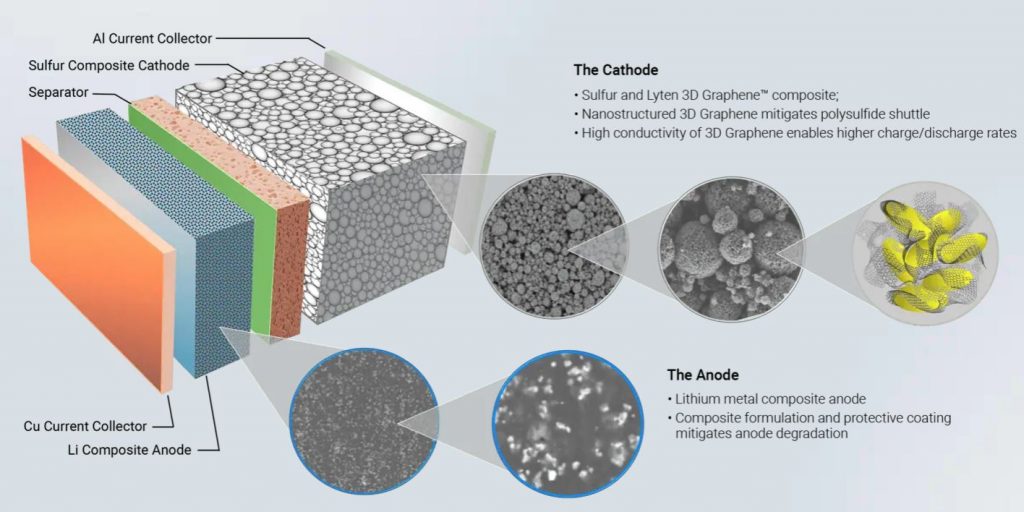
Cell chemistry of Lyten
(Mit freundlicher Genehmigung/Courtesy of Lyten Inc. [Homepage])
Lyten has acquired several key assets from Northvolt, including the Cuberg plant in California (2024), the BESS product portfolio with associated intellectual property and teams (2025), and the energy storage facility in Gdańsk, Poland, acquired in October 2025 [3][4].
In February 2026, Lyten completed the acquisition of Northvolt Ett in Skellefteå and Northvolt Labs in Västerås, Sweden, including facilities with approximately 16 GWh of installed annual cell manufacturing capacity. Production restart and ramp-up are ongoing; this figure does not represent verified annual output [5]. The proposed acquisition of Northvolt Drei in Heide, Germany, remained incomplete as of October 2026 [6][7].
Lyten is pursuing a dual strategy involving two battery cell chemistries:
- Existing production facilities for NMC-based lithium-ion cells are intended to serve the automotive and stationary energy storage markets.
- Lyten plans to gradually introduce its own lithium-sulfur technology, starting with the former Cuberg facility in the United States and potentially expanding to European sites.
- The acquired Polish facility strengthens Lyten’s battery energy storage systems (BESS) business. No definitive cell chemistry or production timetable has been announced for the proposed Heide project.
Lyten uses its own graphene material for the cathode together with a sulphur-lithium compound. Lithium-metal composite technology is used for the anode (see figure).
Lyten uses a specially developed liquid electrolyte in its lithium-sulphur batteries, which is stabilized with the 3D graphene. This keeps the sulphur firmly bound, prevents unwanted side reactions and makes the battery more powerful, safer and longer-lasting [2].
Lyten produces sample cells in pouch and round format on a pilot line in San Jose, including round cells in 18650 format. According to Lyten, the cells can be produced using standard processes and achieve an energy density of up to 275 Wh/kg [2].
The main advantages of Lyten cells are said to be the lower costs and the lower weight. As the cathode does not require heavy minerals such as nickel, manganese and cobalt (NMC) or iron and phosphorus (LFP), this results in a weight reduction of up to 50 % compared to NMC cells and up to 75 % compared to LFP cells. Similar values are achieved for the anode.
Sources
[1] Lyten – Corporate website, battery technology and 3D graphene (accessed 11.10.2026)
[2] Lyten – Lithium-sulfur battery technology, Power Sources Conference (accessed 20.08.2025)
[3] Lyten – Cuberg acquisition and Northvolt BESS portfolio (28.07.2025)
[4] Lyten – Completed acquisition of Northvolt Dwa in Gdańsk (16.10.2025)
[5] Lyten – Completed acquisition of Northvolt Sweden (27.02.2026)
[6] Lyten – Exclusive memorandum of understanding for Northvolt Drei (01.07.2026)
[7] tagesschau/NDR – Delay to the Heide acquisition (30.09.2026)
[8] Lyten – Lithium-sulfur A-samples supplied to Stellantis and other automotive manufacturers (08.05.2024)
[9] Lyten – Drone initiative and aerospace and defence applications (08.05.2025)
[cs 14.07.2024, 20.08.2025, 13.07.2026, 11.10.2026]
Molicel is a Taiwanese manufacturer of lithium-ion cells, operated by E-One Moli Energy within TCC Group Holdings. The brand traces its origins to Canada’s Moli Energy, founded in 1977; the Taiwanese company was established in 1998. Molicel specialises in high-performance cylindrical 18650 and 21700 cells for electric vehicles, motorsport, aviation, drones, power tools and stationary backup power systems [1][2].
Its product portfolio includes high-power cells such as the 21700-P45B and P50B, with the latter entering mass production in 2024. Further developments announced in 2025–2026 include the P60C and the P70X, for which Molicel claims 340 Wh/kg and high discharge capability. Customers and technology partners include Archer Aviation and Vertical Aerospace, as well as motorsport and high-performance vehicle manufacturers [1][2].
Molicel operates battery production in Tainan, Taiwan, and commissioned a new gigafactory in Kaohsiung. However, a major fire on 14 July 2025 severely damaged the Kaohsiung plant, which remained shut down in early 2026. Molicel redirected orders to Tainan, increased backup production capacity and pursued overseas manufacturing partnerships. A planned Canadian factory was deferred in November 2024. Reliable current annual cell production volumes have not been published; factory design capacities must not be mistaken for actual output [2][3][4][5].
As of October 2026, Molicel remains an established supplier of high-performance cylindrical cells. Its key challenges are restoring manufacturing capacity following the Kaohsiung fire and meeting demand from aviation, high-performance mobility and data-centre backup systems [1][3][4].
Sources
[1] Molicel – Company history, products and industrial partnerships (accessed 11.10.2026)
[2] Molicel – 2024 ESG Report, manufacturing and product milestones (2025)
[3] Molicel – Report on the Kaohsiung factory fire and production adjustments (13.08.2025)
[4] Molicel – Kaohsiung plant shutdown status (05.01.2026)
[5] Taiwan News – Production transfer to Tainan following the fire (17.07.2025)
[cs 09.11.2023, 11.10.2026]
Morrow Batteries [↑] [↓] [⇑] [⇓]
Morrow Batteries was a Norwegian lithium-ion cell manufacturer founded in 2020. Its investors included ABB, Siemens and the Danish pension fund PKA. The company focused on prismatic lithium iron phosphate (LFP) cells for energy storage and industrial applications, while also developing cobalt-free lithium nickel manganese oxide (LNMO) technology [1].
In August 2024, Morrow opened a battery cell factory in Arendal, Norway, designed for 1 GWh or approximately three million cells per year. Production ramp-up was slower than planned, and the original expansion target of 43 GWh annually by 2028 was not achieved. Commercial deliveries began in early 2026, including supplies to Proventia. No reliable figure for actual annual cell production was published [2][3][4][5].
On 6 May 2026, Morrow resolved to file for bankruptcy after failing to secure a new industrial investor and sufficient additional financing. High production ramp-up costs, international competition and price pressure made it difficult to establish economically sustainable cell manufacturing [3][7][8].
In August 2026, US battery company Lyten signed a memorandum of understanding to acquire Morrow’s insolvent business and assets. Completion had not been confirmed as of October 2026, leaving the future of the manufacturing facilities and battery technology uncertain [9][10].
Sources
[1] Morrow Batteries – Corporate website and battery technology (accessed 11.10.2026)
[2] Morrow Batteries – Opening of the Arendal cell factory (16.08.2024)
[3] electrive – Expansion plans and bankruptcy (11.05.2026)
[4] Morrow Batteries – Production ramp-up (09.01.2026)
[5] Morrow Batteries – Cell deliveries to Proventia (09.04.2026)
[6] Morrow Batteries – Defence-sector contract (17.04.2026)
[7] Morrow Batteries – Bankruptcy filing decision (06.05.2026)
[8] Eurofound – Morrow Batteries bankruptcy (2026)
[9] electrive – Proposed Lyten acquisition (27.08.2026)
[10] Metal Supply – Outstanding acquisition conditions (02.09.2026)
[cs 12.11.2023, 11.10.2026]
NanoGraf was founded in 2012 as SiNode and was based in Chicago, USA. The company developed patented silicon-enhanced anode materials for lithium-ion cells. Its technology aimed to increase energy density while remaining largely compatible with existing manufacturing processes. Research and industry partners included Ford and General Motors [1].
In October 2022, NanoGraf reported an 18650 cylindrical cell with 4.0 Ah capacity and an energy density of 810 Wh/l. A 3.8 Ah version received UL 1642 and IEC 62133 safety certifications in 2023. In late 2024, the company introduced Onyx, a silicon anode material intended for applications including electric vehicle batteries [2][3][5].
In December 2023, NanoGraf opened a silicon anode material manufacturing facility in Chicago with an announced capacity of approximately 35 tonnes per year. A subsequent expansion target of 50 tonnes annually was reported. A larger facility in Flint, Michigan, was planned with a capacity of up to 2,500 tonnes per year, supported by an announced US$60 million award from the US Department of Energy. These figures represent capacity or expansion targets; actual annual production volumes have not been disclosed [4][6][9].
In June 2024, NanoGraf reported manufacturing approximately 50,000 M38 18650 cells for military applications through an external cell manufacturer. This was a documented production batch, but not evidence of continuous series production at a comparable rate. No reliable annual cell production figure has been published [9].
In May 2026, Monomyth Materials acquired substantially all NanoGraf assets and integrated its silicon anode technology into the new M2Innovations business. The technology therefore continues under new ownership, while NanoGraf should no longer be regarded as an unchanged independent start-up. As of October 2026, widespread series production of its cells for electric vehicles has not been established [7][8].
Sources
[1] NanoGraf – Company website and silicon anode technology (accessed 11.10.2026)
[2] NanoGraf – 4.0 Ah 18650 cell with 810 Wh/l (20.10.2022)
[3] NanoGraf – Safety certifications for its 18650 cell (12.12.2023)
[4] NanoGraf – Chicago manufacturing facility (01.12.2023)
[5] NanoGraf – Introduction of Onyx anode material (10.12.2024)
[6] NanoGraf – Company developments and manufacturing plans (07.07.2025)
[7] Monomyth Materials – Acquisition of NanoGraf assets (12.05.2026)
[8] Charged EVs – Integration into M2Innovations (18.05.2026)
[9] NanoGraf – Production of approximately 50,000 battery cells for military applications (27.06.2024)
[cs 12.11.2023, 11.10.2026]
Northvolt was a Swedish battery manufacturer founded in 2017 by former Tesla executives Peter Carlsson and Paolo Cerruti. Its investors included Volkswagen, BMW, Volvo and Goldman Sachs. The company aimed to establish a European supply chain for lithium-ion cells, primarily for electric vehicles and stationary energy storage systems [1].
Northvolt pursued an ambitious expansion strategy, targeting around 150 GWh of annual battery production by 2030. Its flagship factory, Northvolt Ett in Skellefteå, Sweden, was designed to use low-carbon electricity and initially targeted a capacity of 16 GWh per year. Further projects included Northvolt Drei near Heide, Germany, a planned factory near Montreal, Canada, and the Novo Energy project in Gothenburg. Northvolt also established a battery energy storage systems facility in Gdańsk, Poland. Most of the original expansion plans were not realised [1][2].
In 2021, Northvolt acquired the US battery technology company Cuberg, which specialised in high-energy lithium-metal cells. Northvolt sought to combine battery cell manufacturing, materials development and recycling within its own industrial network [1][2].
Northvolt’s failure resulted from a combination of production problems, overly rapid expansion and financial pressure. Its flagship factory in Skellefteå struggled to manufacture sufficient quantities of high-quality battery cells, leading to delivery delays and the cancellation of a major BMW supply contract worth approximately €2 billion in June 2024. At the same time, Northvolt invested in multiple gigafactories, cathode materials, recycling and new battery technologies before its core cell production had reached a stable industrial scale. The resulting high costs and cash consumption coincided with weaker EV battery demand, intense competition from established Asian manufacturers and increasingly difficult financing conditions. The inability to secure sufficient additional funding ultimately made the company’s restructuring unsuccessful [2][3][8][9].
On 21 November 2024, Northvolt filed for Chapter 11 bankruptcy protection in the United States in an attempt to restructure its finances. The restructuring failed, and on 12 March 2025, Northvolt AB and several Swedish subsidiaries entered bankruptcy proceedings in Sweden. The collapse became one of the largest corporate bankruptcies in Swedish history [2][3].
In August 2025, the US battery company Lyten signed agreements to acquire major remaining Northvolt assets. The acquisition of Northvolt Ett and Ett Expansion in Skellefteå and Northvolt Labs in Västerås was formally completed on 27 February 2026. The transaction included facilities representing approximately 16 GWh of installed annual cell manufacturing capacity and Northvolt’s Swedish battery research infrastructure. Lyten announced plans to restart commercial cell production and establish a broader industrial hub at Skellefteå. Installed capacity should not be confused with verified production output after the restart [4][5].
Lyten also acquired Northvolt’s battery energy storage systems activities in Poland and pursued the former Northvolt projects in other countries. For the planned Northvolt Drei factory near Heide, Germany, Lyten signed an exclusive memorandum of understanding in July 2026. However, the transaction had not yet been completed by the end of September 2026 because legal and commercial issues remained unresolved. The German project therefore remained uncertain as of October 2026 [4][6][7].
Northvolt no longer operates as the independent European battery manufacturer originally envisaged. Nevertheless, important parts of its manufacturing equipment, research facilities and technology are being preserved or redeveloped under Lyten. The distinction between completed asset acquisitions, planned factory restarts and projects still awaiting final agreements is essential when assessing Northvolt’s industrial legacy [4][5][7].
Sources
[1] Northvolt – Corporate website and historical company information (accessed 11.10.2026)
[2] Northvolt – Filing for Chapter 11 restructuring in the United States (21.11.2024)
[3] Northvolt – Bankruptcy filing in Sweden (12.03.2025)
[4] Lyten – Agreements to acquire Northvolt assets in Sweden and Germany (07.08.2025)
[5] Lyten – Completed acquisition of Northvolt’s Swedish assets (27.02.2026)
[6] State Government of Schleswig-Holstein – Agreement framework for the Northvolt Drei project (01.07.2026)
[7] Tagesschau / NDR – Further delay in the acquisition of the Heide battery factory project (30.09.2026)
[8] Reuters – Northvolt’s production delays, BMW contract cancellation and expansion problems (13.09.2024)
[9] European Commission – Northvolt’s production problems, market competition and bankruptcy (2025)
[cs 13.11.2023, 17.08.2025, 11.10.2026]
Our Next Energy (ONE) is a US battery manufacturer founded in 2020 and headquartered in Novi, Michigan. The company develops and manufactures lithium-ion cells and battery systems, primarily using lithium iron phosphate (LFP) chemistry. Following a strategic change announced in January 2026, ONE now focuses on stationary energy storage, rail transport, industrial and defence applications, rather than developing batteries for passenger electric vehicles [1][2].
ONE originally developed prismatic LFP cells and its innovative Gemini dual-chemistry battery, combining LFP cells for everyday driving with high-energy anode-free cells for extended range. In a prototype BMW iX, ONE demonstrated a driving range of approximately 608 miles (979 km) on a single charge. This was a technology demonstration, not a commercially available production battery. The company also developed Aries LFP battery packs for commercial vehicles and Aries Grid systems for stationary energy storage [1][3].
In October 2023, ONE began producing initial LFP cells on a 10 MWh pilot and customer-validation line at its ONE Circle facility in Van Buren Township, Michigan. The factory was originally planned for an annual capacity of 20 GWh. However, the planned large-scale expansion was delayed and the original investment and employment targets were not achieved. In September 2026, Michigan reduced the company’s state grant from US$200 million to US$150 million and revised the project’s milestones. The 20 GWh figure must therefore not be interpreted as verified current production capacity [4][5].
In May 2025, ONE introduced a portfolio of US-manufactured LFP cells, battery modules and battery management systems for grid-scale storage. Its product range includes the Aries Grid family, while its Michigan operations also support industrial and rail applications. The company aims to establish a predominantly US-based battery supply chain and benefit from applicable domestic-content incentives, although this does not mean that every raw material or component is sourced exclusively from North America [1][6].
On 7 January 2026, ONE announced that it would discontinue investment in passenger EV battery programmes and concentrate on infrastructure and defence-related markets. The decision followed changes in customer demand and included a workforce reduction of approximately 45%. ONE reported US$35 million in new orders from rail and defence customers. As of October 2026, the company remains active, but its business strategy differs substantially from the automotive battery ambitions described in 2023 [2][7].
Sources
[1] Our Next Energy – Company website and current product portfolio (accessed 11.10.2026)
[2] Our Next Energy – Strategic shift towards infrastructure and defence batteries (07.01.2026)
[3] Our Next Energy – Gemini dual-chemistry battery technology (accessed 11.10.2026)
[4] Our Next Energy – ONE Circle factory and LFP pilot production (accessed 11.10.2026)
[5] The Detroit News – Michigan reduces incentives for ONE battery factory (22.09.2026)
[6] Our Next Energy – Launch of US-manufactured grid storage products (15.05.2025)
[7] State of Michigan – Our Next Energy workforce reduction notice (06.01.2026)
[cs 13.11.2023, 11.10.2026]
OneD Battery Science [↑] [↓] [⇑] [⇓]
OneD Battery Sciences is a US battery materials company based in Palo Alto, California. Its SINANODE technology incorporates silicon nanowires into graphite particles to improve the anode materials used in lithium–ion cells. The aim is to increase energy density and charging performance while retaining much of the existing manufacturing infrastructure for graphite-based anodes. The technology is designed to mitigate the problems caused by silicon’s volume expansion during charging. However, a higher specific anode capacity does not automatically translate into an equivalent increase in the energy density of a complete battery cell [1][2].
In September 2022, General Motors (GM) agreed to jointly develop the technology with OneD. At the same time, GM Ventures participated in a US$25 million funding round. Former Volkswagen and Opel executive Karl-Thomas Neumann has also been associated with the company as an investor and board member.
In June 2023, OneD announced a technology partnership with German specialist battery cell manufacturer Customcells. Its customers included Porsche and electric aircraft developer Lilium. Following Lilium’s insolvency in 2024, Customcells also filed for insolvency in 2025. The use of OneD technology in series-produced batteries for these customers has not been confirmed [3][4][7][8].
In July 2024, OneD commissioned a SINANODE pilot production facility in Moses Lake, Washington. The plant is intended to provide material for battery cell qualification and demonstrate the scalability of the manufacturing process. According to the company, the facility is designed for a production capacity of up to 100 tonnes of SINANODE material per year. This nominal capacity should not be confused with verified actual annual output [5].
On 4 November 2025, OneD announced a joint development agreement with Shanghai Putailai New Energy Technology (PTL), a major Chinese anode material manufacturer. The partners aim to combine SINANODE technology with PTL’s industrial manufacturing capabilities to develop cost-effective silicon-graphite anode materials for large-scale production. The agreement represents further industrialisation efforts, but does not confirm that mass production has already begun [6].
As of October 2026, OneD remains active in the development and industrialisation of silicon-enhanced anode materials. Its pilot facility and industrial partnerships demonstrate progress. However, widespread use of SINANODE materials in mass-produced electric vehicles has not yet been established [1][5][6].
Sources
[1] OneD Battery Sciences – Company website and SINANODE technology (accessed 11.10.2026)
[2] OneD Battery Sciences – Business model and SINANODE pilot programme (accessed 11.10.2026)
[3] General Motors – Joint development agreement and investment in OneD (29.09.2022)
[4] OneD Battery Sciences – Technology partnership with Customcells (15.06.2023)
[5] OneD Battery Sciences – Commissioning of the Moses Lake pilot facility (26.08.2024)
[6] OneD Battery Sciences – Joint development agreement with Putailai (04.11.2025)
[7] GÖRG – Insolvency of Lilium and successor company Lilium Aerospace (24.02.2025)
[8] pv magazine – Customcells files for insolvency following payment defaults by Lilium (02.05.2025)
[cs 13.11.2023, 11.10.2026]
Founded in 1918, Panasonic is a Japanese electronics group and a long-standing battery technology partner of Tesla. Its automotive lithium-ion cell business is operated by Panasonic Energy Co., Ltd., a Panasonic Group operating company established in April 2022. Panasonic Energy develops and manufactures rechargeable batteries for electric vehicles and other applications [1][2].
In 2025, Panasonic ranked as the world’s seventh-largest EV battery manufacturer by battery capacity installed in electric vehicles, according to SNE Research. Its installed volume was approximately 44.2 GWh, representing a global market share of around 3.7%. In the more recent January–August 2026 reporting period, Panasonic ranked sixth, with approximately 29.7 GWh and a 3.5% market share. The latter figures are an interim result and should not be confused with the full-year 2025 ranking [3][4].
Year EV Batt. Usage [GWh] Market Share Ranking YoY Growth
2025 44.2 3.7 % #7 25.9 %
2024 35.1 3,9 % #6 -21.8 %
2023 44.9 6.4 % #4 18.2 %
2022 38.0 7.3 % #4 4.7 %
The table above illustrates Panasonic’s loss of ranking positions over recent years, from fourth place to seventh place in the 2025 full-year comparison (Source: SNE Research). Its strong historical concentration on Tesla and high-energy-density cylindrical cells has contributed to a narrower customer and chemistry portfolio than those of some rapidly expanding competitors. However, Panasonic’s sixth-place position in the first eight months of 2026 demonstrates that rankings can change between reporting periods [3][4].
Chinese manufacturers such as CATL and BYD have expanded rapidly with lithium iron phosphate (LFP) batteries, as well as other chemistries and cell formats. Panasonic’s automotive strategy remains focused primarily on high-energy-density cylindrical lithium-ion cells, including the 2170 and newer 4680 formats [2][3][5].
In North America, Panasonic Energy manufactures automotive cells at the Gigafactory Nevada in Sparks, where it has worked with Tesla since the factory’s early years. On 14 July 2025, the company officially opened its second US automotive battery factory in De Soto, Kansas, and began mass production of 2170 cylindrical cells. The Kansas plant is designed to reach an annual capacity of approximately 32 GWh in the future; this is a planned capacity rather than confirmed actual annual output [5].
Panasonic Energy also operates battery development and manufacturing facilities in Japan. Its development programme includes higher-capacity cylindrical cells, silicon-containing anode materials and improved production processes. In September 2026, the company opened Energy Innovation Square in Kadoma, Osaka, as a research and development centre covering materials, cell design and prototypes for automotive and other battery applications [6][7].
Although Tesla remains a key automotive customer, Panasonic is pursuing additional customer relationships and battery applications. In April 2025, for example, Panasonic Energy announced that it would supply battery cells to Harbinger, a US manufacturer of medium-duty electric commercial vehicles. The company is thus working to broaden its customer base beyond its historically dominant Tesla relationship [8].
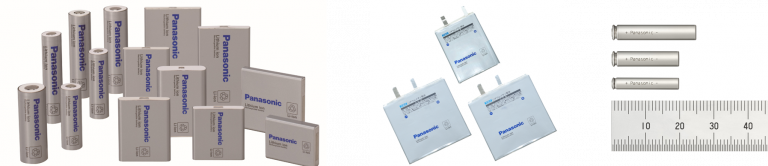
Cells with different formats from Panasonic Industries
(Mit freundlicher Genehmigung/Courtesy of Panasonic Industry [Homepage])
Panasonic Energy specialises in high-energy-density cylindrical lithium-ion cells for electric vehicles. Its established 2170 format measures approximately 21 mm in diameter and 70 mm in length. The company is also developing and industrialising larger 4680 cells, measuring approximately 46 mm in diameter and 80 mm in length. Compared with smaller cylindrical cells, larger formats can reduce the number of individual cells and electrical connections required in a battery pack, although the benefits depend on the overall pack design and manufacturing process [2][5].
Panasonic’s automotive cells are known for using nickel-rich cathode materials to achieve high energy density. Its cylindrical cell technology has been developed over many years in cooperation with Tesla. The company reported a volumetric energy density of approximately 800 Wh/l for its advanced 2170 technology. This is a cell-level figure, not the energy density of a complete vehicle battery pack [5][9].
In December 2023, Panasonic Energy announced a technology and procurement partnership with Sila Nanotechnologies, a US developer of silicon-based anode materials. Under the agreement, Panasonic plans to procure Sila’s Titan Silicon nanocomposite material from the company’s US manufacturing operations. The aim is to replace a larger proportion of the graphite in conventional anodes with silicon and thereby increase cell capacity while controlling the material’s expansion during charging [10].
Panasonic’s longer-term technology roadmap targets an increase in volumetric cell energy density from approximately 800 Wh/l to 1,000 Wh/l by 2031, equivalent to a 25% improvement. Silicon-containing anodes are a central part of this strategy. In a 2026 technical overview, Panasonic described an intermediate development target in the 900 Wh/l class, followed by further improvements towards 1,000 Wh/l. These are development objectives, not performance specifications already demonstrated across mass-produced automotive cells [9][10].
The main technical challenge of increasing silicon content is the material’s substantial volume expansion and contraction during charging and discharging. Repeated mechanical stress can damage electrode structures and accelerate capacity loss. Panasonic and its materials partners are therefore developing anode compositions and manufacturing techniques intended to balance higher energy density, cycle life and reliability [9][10].
Panasonic Energy’s new Kansas factory, opened in July 2025, manufactures 2170 cylindrical lithium-ion cells. Its planned annual production capacity is approximately 32 GWh. Panasonic continues to improve the production efficiency and performance of its cylindrical cell portfolio, while the larger 4680 format forms part of its next-generation automotive cell strategy. Factory nameplate capacity should not be interpreted as actual annual output during the production ramp-up [5][11].
Panasonic is also developing all-solid-state batteries. Unlike conventional lithium-ion cells, which use liquid electrolytes, these batteries employ solid electrolytes. Panasonic is investigating electrolyte materials, electrode interfaces and cell structures, with particular emphasis on ionic conductivity, durability, manufacturability and reliable contact between solid components. The company has discussed the importance of stable interfaces and of adapting production techniques to the requirements of solid-state cells [12].
In a technical update published in May 2026 and revised in June, Panasonic Energy described a step-by-step commercialisation strategy for all-solid-state batteries. Instead of immediately targeting large automotive traction batteries, the company intends to gain experience with smaller cell sizes and suitable initial applications, where manufacturing variations can be controlled more easily. Panasonic indicated that development and evaluation were proceeding with a view to sample shipments during fiscal year 2026. This should not be interpreted as a confirmed launch date for mass-produced solid-state batteries in electric cars [12].
In September 2026, Panasonic Energy opened Energy Innovation Square in Kadoma, Osaka. The new research centre combines work on battery materials, cell design and prototyping, and is intended to cooperate with the company’s Suminoe production development facility. Its purpose is to accelerate the transition from battery research to manufacturable products for automotive and other applications [7].
Overall, Panasonic’s near-term automotive technology development continues to centre on cylindrical lithium-ion cells, especially improvements in silicon-containing anodes, energy density and manufacturing efficiency. All-solid-state batteries remain a separate development programme, with early samples and application testing preceding any potential large-scale automotive deployment. The distinction between laboratory targets, prototype performance, planned factory capacity and verified series production is essential when assessing Panasonic’s battery roadmap [5][9][10][12].
Sources
[1] Panasonic – Corporate website (accessed 11.10.2026)
[2] Panasonic Energy – Company and battery business (accessed 11.10.2026)
[3] CnEVPost / SNE Research – Global EV battery market shares in 2025 (04.02.2026)
[4] CnEVPost / SNE Research – Global EV battery market shares, January–August 2026 (02.10.2026)
[5] Panasonic Energy – Opening of Kansas battery factory and 2170 cell production (14.07.2025)
[6] Panasonic Energy – Medium- to long-term strategy and next-generation cells (2024)
[7] Panasonic Energy – Opening of Energy Innovation Square in Osaka (16.09.2026)
[8] Panasonic Energy – Press releases, including Harbinger supply agreement (2025)
[9] Panasonic Energy – Technology roadmap for higher-capacity EV batteries (2026)
[10] Panasonic Energy – Partnership with Sila for silicon anode materials (13.12.2023)
[11] Panasonic Energy – Kansas battery factory and North American production (2025)
[12] Panasonic Energy – Development and commercialisation strategy for all-solid-state batteries (28.05.2026; updated 26.06.2026)
[cs 15.11.2023, 15.12.2023, 31.03.2026, 11.10.2026]
PowerCo SE is the Volkswagen Group’s battery cell company, established in July 2022 and headquartered in Salzgitter, Germany. The European company (Societas Europaea) is responsible for battery cell development and industrial production, the expansion of Volkswagen’s battery manufacturing network and the integration of key parts of the battery value chain [1][2].
At the centre of its strategy is the Unified Cell, a standardised prismatic lithium-ion cell architecture designed for different vehicle segments, Volkswagen Group brands and battery chemistries. The cell format was originally intended for use in up to 80% of the Group’s electric vehicles. Volkswagen’s manufacturing strategy combines PowerCo’s own cell factories with external suppliers. One of these partners is Gotion High-tech, which already manufactures Unified Cells in China. The initial PowerCo-produced version in Salzgitter uses NMC chemistry, while LFP variants and future battery technologies are also part of the platform strategy [2][3][4][11].
On 17 December 2025, PowerCo commissioned its first gigafactory, Salzgiga, in Salzgitter and manufactured its first Unified Cells. The industrial production ramp-up was scheduled for 2026. The first expansion stage provides for up to 20 GWh of annual production capacity, corresponding to approximately 250,000 battery electric vehicles with an assumed average battery capacity of 80 kWh. With smaller 50 kWh batteries, the same theoretical cell output could supply approximately 400,000 BEVs. These calculations do not account for manufacturing losses or other production constraints. The facility can be expanded to 40 GWh annually if required and serves as the reference factory for PowerCo’s international production network [4].
The first planned vehicle applications of PowerCo’s Unified Cell are the Volkswagen Group’s Electric Urban Car Family, comprising compact electric vehicles from Volkswagen, Škoda and CUPRA. The cells are designed to operate with a newly developed cell-to-pack battery system. The presentation of production-ready technology in September 2025 and the start of cell manufacturing in December 2025 do not, by themselves, establish that all the planned vehicle models have entered customer deliveries [3][4].
Further PowerCo gigafactories are being developed in Valencia/Sagunto, Spain, and St. Thomas, Ontario, Canada. Both follow the standard-factory concept established in Salzgitter. Production capacities and commissioning schedules are being adjusted to expected electric vehicle demand. Earlier plans for six European factories totalling 240 GWh by 2030 should therefore be regarded as historical expansion ambitions rather than confirmed capacity already under construction or in operation [2][5].
Gotion High-tech is both a strategic development partner and an industrial manufacturer of Volkswagen’s Unified Cell. The company began mass production at its Hefei plant in China in November 2025, before PowerCo commissioned its Salzgitter factory. The supply arrangement covers 2026 to 2032 and includes LFP and other Unified Cell variants. On 28 September 2026, Volkswagen Group, PowerCo and Gotion announced an expanded partnership covering European LFP cell production and cathode active materials. Planned joint ventures involve Valencia, Spain, Šurany, Slovakia, and Kenitra, Morocco. Valencia is intended to become a European production hub for LFP technology. These European projects are distinct from Gotion’s existing cell production in Hefei [8][11].
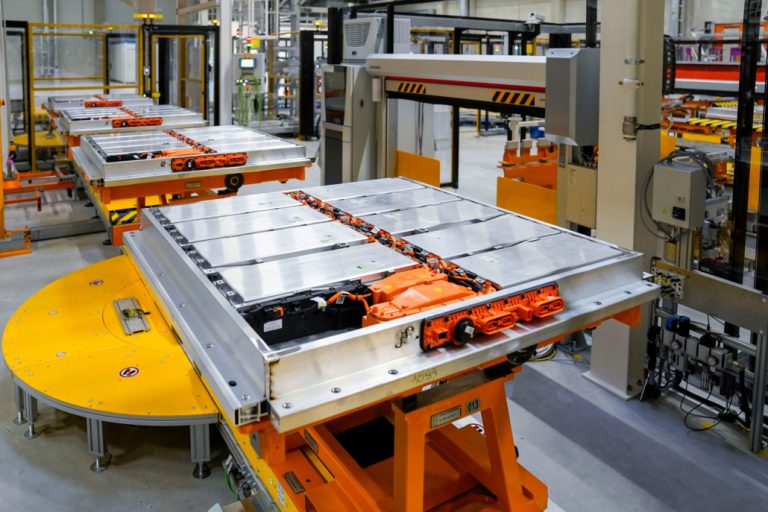
VW Standard Cell from PowerCo installed in a Battery-Pack
(Mit freundlicher Genehmigung/Courtesy of Volkswagen AG [Homepage])
The PowerCo Unified Cell is a standardised prismatic battery cell designed to accommodate different electrode materials and cell chemistries within a common architecture. Unlike the particularly long BYD Blade cell, the Unified Cell uses a more compact format intended to support flexible integration into different vehicle battery systems. Earlier comparisons suggested possible advantages for particular commercial-vehicle packaging concepts, but these applications should not be presented as confirmed PowerCo production programmes [2][9].
The Unified Cell has its electrical terminals on a narrow side, leaving the two larger surfaces available for thermal management. Its mechanical design also provides for controlled venting of gases in the event of cell failure. These features are intended to facilitate battery cooling and system safety; their effectiveness depends on the design and validation of the complete battery pack [9].
The first PowerCo Unified Cell manufactured in Salzgitter uses NMC cathode chemistry. Volkswagen specifies a volumetric energy density of approximately 660 Wh/l, around 10% higher than the cells used previously in comparable applications. The company presented the production-ready cell in September 2025 and began manufacturing the first cells in December 2025. These are cell-level figures and must not be confused with the lower volumetric energy density of a complete battery pack [3][4].
The Unified Cell is designed to work with a new cell-to-pack (CTP) battery architecture, which integrates the cells more directly into the battery housing and reduces the need for conventional intermediate module structures. The combination is intended to improve packaging efficiency, vehicle range and manufacturing costs. Initial applications are planned for the Volkswagen Group’s Electric Urban Car Family, covering models from Volkswagen, Škoda and CUPRA [3][4].
Alongside NMC technology, the Unified Cell architecture supports LFP variants for cost-sensitive and high-volume vehicle applications. Gotion High-tech began mass-producing Unified Cells for Volkswagen at its Hefei plant in China in November 2025, with the supply arrangement covering 2026 to 2032. The cells include LFP-based products and other compatible chemistries. This external production is separate from the NMC Unified Cells manufactured by PowerCo in Salzgitter. The expanded PowerCo–Gotion cooperation announced in September 2026 also covers future European LFP cell manufacturing and cathode active materials, with Valencia envisaged as a major European production hub [4][8][11].
For future solid-state lithium-metal batteries, PowerCo is collaborating with the US company QuantumScape, in which Volkswagen has invested. In January 2024, PowerCo reported that a QuantumScape prototype cell had retained more than 95% of its original capacity after over 1,000 charging cycles in laboratory endurance testing. This result demonstrated promising durability under the specified test conditions but did not establish series-production readiness [6].
In July 2024, PowerCo and QuantumScape replaced their earlier joint manufacturing venture with a non-exclusive technology licensing and industrialisation agreement. Subject to technical progress and contractual conditions, the agreement provides for production of up to 40 GWh of QuantumScape-based cells annually, with an option to expand to 80 GWh. These figures represent potential licensed manufacturing capacity, not existing production or an announced solid-state factory output [7].
At IAA Mobility 2025, PowerCo, Ducati and Audi presented an electric Ducati V21L demonstration motorcycle equipped with a battery system designed for up to 980 QuantumScape QSE-5 cells. The technology combines a lithium-metal anode with a proprietary ceramic separator. The demonstrator provided evidence of progress towards vehicle integration, while further development was required before commercial series production [3].
PowerCo is also developing dry electrode coating in cooperation with the German printing machinery specialist Koenig & Bauer. Instead of applying electrode materials as a solvent-based slurry and subsequently drying them in large ovens, the process uses a powder-based coating method that deposits active materials directly onto the current collector foil. PowerCo estimates potential savings of approximately 30% in energy consumption and 15% in factory floor space for the relevant manufacturing processes. Industrial application was originally envisaged from 2026/2027; this remains a development and scale-up objective rather than proof that all Salzgitter production lines already use dry coating [10].
PowerCo has moved from cell development to initial industrial manufacturing of NMC Unified Cells, while Gotion has already begun mass production of Unified Cells in China. European LFP production partnerships, the broader international factory network and QuantumScape-based solid-state cells are at different stages of development, industrialisation or ramp-up. Cell energy densities, laboratory endurance results and planned factory capacities should be distinguished from validated performance and output in mass-produced vehicle battery systems [3][4][7][8][11].
Sources
[1] PowerCo – Company website (accessed 11.10.2026)
[2] Volkswagen Group – Annual Report 2025, battery strategy and PowerCo production network (2026)
[3] Volkswagen Group – Unified Cell, cell-to-pack battery and solid-state demonstrator (08.09.2025)
[4] Volkswagen Group – Start of Unified Cell production in Salzgitter (17.12.2025)
[5] Volkswagen Group – PowerCo gigafactory development in Spain and Canada (accessed 11.10.2026)
[6] Volkswagen Group – QuantumScape solid-state cell endurance test (04.01.2024)
[7] Volkswagen Group – PowerCo and QuantumScape industrialisation agreement (11.07.2024)
[8] Volkswagen Group – Expanded LFP partnership with Gotion High-tech (28.09.2026)
[9] Elektroautomobil – Unified Cell format, cooling and safety design (accessed 11.10.2026)
[10] Volkswagen Group – Dry electrode coating developed with Koenig & Bauer (2023)
[11] Electrive – Gotion High-tech begins mass production of Volkswagen Unified Cells in Hefei (21.11.2025)
[cs 16.11.2023, 04.01.2024, 11.10.2026]
Japanese battery cell joint venture established by Toyota (51%) and Panasonic Holdings (49%). The partners began exploring the joint venture in 2017, agreed on its establishment in 2019, and launched Prime Planet Energy & Solutions (PPES) on 1 April 2020. The company develops and manufactures prismatic lithium-ion cells and battery systems for hybrid electric vehicles (HEVs), plug-in hybrid electric vehicles (PHEVs) and battery electric vehicles (BEVs). Its development activities also cover next-generation automotive batteries [1][2].
PPES is a major battery development and manufacturing partner within Toyota’s electrification strategy. Toyota models explicitly listed by PPES as equipped with its battery products include the bZ4X (BEV), the plug-in hybrid versions of the Prius, Harrier and Crown Sport, and the hybrid versions of the Prius, Corolla, Corolla Touring, Corolla Sport, Corolla Cross, Noah, Voxy and Crown. The Toyota Mirai also appears in the company’s vehicle list; as a fuel-cell vehicle, it uses a battery within its electric powertrain rather than as its primary energy source [3].
Under Toyota’s premium brand Lexus, PPES lists the RZ 450e (BEV), the plug-in hybrid models RX 450h+ and NX 450h+, and the hybrid models ES and UX 300h. PPES also supplies vehicle programmes of other manufacturers, including Subaru, Honda, Nissan, Mazda and Isuzu. The published vehicle list represents a selection and does not imply that all variants, model years and sales markets are equipped exclusively with PPES batteries [3].
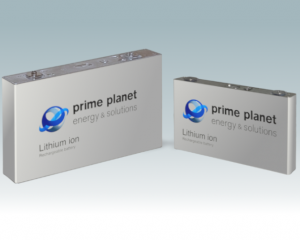
Prismatic Cells from Prime Planet
(Mit freundlicher Genehmigung/Courtesy of Prime Planet Energy & Solutions, Inc. [Homepage])
PPES manufactures prismatic lithium-ion battery cells for different vehicle applications and operates production facilities in Japan and China. Its Himeji plant in Japan produces cells for BEVs and PHEVs, while other production lines serve the hybrid vehicle market. Depending on customer requirements, the company supplies automotive manufacturers with cells, modules and battery packs or complete battery systems [1][3][4].
In 2022, PPES announced an expansion of its Himeji facility intended to add approximately 7 GWh of annual BEV battery production capacity, originally targeting a start in 2024. A new production line subsequently began mass production in January 2025, as confirmed by the company in October 2025. The new prismatic cells offer increased capacity and energy density while retaining the dimensions of their predecessors. PPES confirmed their use in the updated Toyota bZ4X, the new Lexus RZ and the Subaru Solterra [4][5].
For the updated Toyota bZ4X, with deliveries in Germany starting in January 2026, Toyota explicitly confirms PPES as its battery supplier. Two battery versions are offered: 57.7 kWh gross capacity with 78 prismatic cells arranged in three modules, and 73.1 kWh gross capacity with 104 cells in four modules. Each module contains 26 cells. The smaller battery is offered with front-wheel drive, while the larger version is available with front-wheel or all-wheel drive. Compared with the previous configuration using 96 cells, the new module structure accommodates a higher number of cells per module without increasing its external dimensions [5][11].
The updated bZ4X battery system also features improved thermal management and battery preconditioning. Toyota specifies a DC charging time of approximately 28 minutes from 10% to 80% state of charge with a fully preconditioned battery. Thermal management combines liquid cooling and battery heating. These specifications refer to the complete vehicle battery system, including its control and cooling functions, and must therefore not be interpreted as isolated performance figures for PPES cells [11].
PPES is also preparing next-generation performance batteries for future Toyota BEVs. These are liquid-electrolyte lithium-ion cells incorporating advanced materials and a revised mechanical design, intended to improve driving range, charging performance and vehicle integration. Production at Himeji was scheduled to begin in 2026. Following the staged expansion, Himeji’s total annual production capacity is expected to reach approximately 30 GWh. As of October 2026, the available company announcements did not establish that series production of this particular next-generation cell had already started. This programme must be distinguished from the cells manufactured since January 2025 and used in the updated bZ4X [6][7].
In 2025, PPES established a North American subsidiary in Michigan, USA, to provide technical support for automotive battery customers and Toyota Group activities in the region. In March 2026, Toyota Tsusho America acquired a 20% stake in this subsidiary, strengthening its customer support and supply-chain activities. This development does not imply that PPES has established its own cell manufacturing facility in North America [8][9].
Although Toyota also procures batteries from other suppliers, including LG Energy Solution, this does not diminish PPES’s established role in Toyota’s battery manufacturing network. Its activities differ from those of PowerCo, the Volkswagen Group’s battery company, in ownership structure, production network and customer portfolio. A direct assessment of their strategic importance based solely on individual factory capacity announcements would therefore be misleading [2][10].
Sources
[1] Prime Planet Energy & Solutions – Company profile (accessed 11.10.2026)
[2] Toyota – Establishment of the automotive battery joint venture with Panasonic (03.02.2020)
[3] Prime Planet Energy & Solutions – Vehicle applications and specific models equipped with PPES batteries (accessed 11.10.2026)
[4] Prime Planet Energy & Solutions – Expansion of BEV battery production capacity (31.08.2022)
[5] Prime Planet Energy & Solutions – Start of mass production of new BEV cells at Himeji (09.10.2025)
[6] Prime Planet Energy & Solutions – Next-generation performance battery production plans (06.09.2024)
[7] Toyota – Certification of next-generation battery development and production plans (06.09.2024)
[8] Prime Planet Energy & Solutions – North American subsidiary (06.02.2026)
[9] Prime Planet Energy & Solutions – Toyota Tsusho investment in North American subsidiary (01.04.2026)
[10] Reuters – Toyota and LG Energy Solution sign EV battery supply agreement (04.10.2023)
[11] Toyota Germany – Updated bZ4X: battery capacities, cell counts, module structure and thermal management (25.11.2025)
[cs 16.11.2023, 11.10.2026]
Taiwanese battery technology company founded in 2006, specialising in the development and manufacture of solid-state battery cells. ProLogium has developed proprietary lithium-ceramic battery technology and reports a portfolio of more than 1,200 granted and pending patents [1][3].
Mercedes-Benz has collaborated with ProLogium since 2016 and is a strategic investor with representation on the company’s board of directors. In 2022, the partners announced a technology cooperation agreement for next-generation battery cells [2]. On 24 September 2026, they announced a new joint testing agreement giving Mercedes-Benz priority access to ProLogium’s fourth-generation (Gen4) cells. The programme includes electrical, thermal and safety testing as well as preliminary evaluations for future vehicle applications. The agreement represents a further validation step, but does not confirm a series-production supply contract [7].
In September 2025, ProLogium and Rimac Technology signed a Memorandum of Understanding (MoU) to jointly develop a solid-state battery platform for electric vehicles. The cooperation focuses on module-free cell-to-pack integration, packaging efficiency and thermal management. A joint battery pack concept was showcased at CES 2026. In August 2026, ProLogium also announced the intended appointment of Antony Sheriff, CEO of Rimac Group, to its board, subject to completion of a planned business combination. These steps do not yet constitute a confirmed series-production supply agreement [10][11][12].
Further automotive development partnerships include FEV, focusing on battery module and pack engineering, MAHLE, working on battery thermal management, and OPmobility, with which ProLogium announced cooperation on solid-state battery modules and packs in 2026. These programmes are intended to support the integration and validation of the company’s cells in vehicle battery systems [13][14][15].
ProLogium has also entered into a strategic investment and materials cooperation agreement with POSCO, covering battery materials including cathode and anode technologies. The collaboration supports the development of an industrial supply chain for future battery generations [16].
In 2024, ProLogium inaugurated its first GWh-class battery factory in Taoyuan, Taiwan, providing an industrial base for lithium-ceramic cell production and manufacturing process development [1][3].
ProLogium is also developing a European gigafactory in Dunkirk, France. The project was announced in 2023, and the official groundbreaking ceremony took place in February 2026. In September 2026, the company reported progress on site preparation, electrical infrastructure and grid connection works. Production is now planned to begin around the end of 2028, followed by a gradual ramp-up. The first factory is intended to reach approximately 4 GWh of annual capacity by 2030, while substantially larger capacities remain long-term expansion plans. The originally announced production start in 2026 is therefore no longer applicable. ProLogium also signed an MoU with Schneider Electric in 2024 covering automation, energy management and electrical infrastructure for the site [3][4][17].

Solid-state Cell from ProLogium with Pouch Format
(Mit freundlicher Genehmigung/Courtesy of ProLogium Technology CO., Ltd. [Homepage])

Battery-Module from ProLogium
(Mit freundlicher Genehmigung/Courtesy of ProLogium Technology CO., Ltd. [Homepage])
ProLogium develops lithium-ceramic solid-state battery cells with a proprietary ceramic separator. Earlier cell generations included silicon-based anodes and high-nickel cathode materials. Its fourth-generation technology (Gen4), introduced in 2025, combines an all-ceramic separator with a proprietary Superfluidized Inorganic Electrolyte (SFIE). In October 2026, ProLogium described the electrolyte’s Dynamic Coordination Network (DCN), in which changing local coordination structures are intended to facilitate lithium-ion transport. The company also incorporates an Active Safety Mechanism (ASM) intended to mitigate thermal runaway under elevated-temperature conditions. These characteristics remain subject to validation under automotive operating conditions [5][8].
The development programme includes cells with a 100% silicon-composite anode and a future lithium-metal anode architecture. For Gen4 silicon-anode technology, ProLogium specifies a gravimetric energy density of 360–400 Wh/kg and a volumetric energy density of 860–940 Wh/l. Its lithium-metal technology roadmap cites potential values of 430–470 Wh/kg and 1,000–1,100 Wh/l. These are company-reported cell-level specifications and development targets, not confirmed performance figures for mass-produced automotive battery packs [5][6].
In September 2026, ProLogium announced mass production of its Gen3.5 lithium-ceramic cells at its manufacturing facility in Taiwan. According to the company, a 185.4 Ah large-format cell achieved 381 Wh/kg and 903 Wh/l, with the energy density values documented in a third-party TÜV test report. These measured Gen3.5 values must not be confused with the separate Gen4 development specifications. The announcement provides evidence of manufacturing progress, but does not establish the production volume of this specific cell type or its deployment in series-production vehicles [9].
ProLogium manufactures pouch-type cells and is also developing prismatic formats and bipolar cell architectures. Together with Mercedes-Benz, the company has evaluated different lithium-ceramic cell formats and is now testing Gen4 cells for electrical performance, thermal behaviour and safety. The results are intended to inform the assessment of potential future vehicle applications; the testing programme does not itself establish production readiness or vehicle qualification [7].
At battery system level, Rimac Technology is working with ProLogium on a module-free cell-to-pack architecture that integrates solid-state pouch cells directly into the battery pack. The development objectives include higher packaging efficiency, reduced structural weight, advanced thermal management, scalability and the possibility of disassembling the pack down to individual cells for repair or recycling. These are engineering objectives of the joint development programme rather than demonstrated characteristics of a series-production battery pack [10].
For conventional module and pack integration, FEV contributes battery system design, battery management system (BMS) integration and thermal propagation optimisation. The partners presented a next-generation EV battery module concept at CES 2026. Separately, OPmobility is conducting electrical performance evaluations of ProLogium cells and developing compatible automotive battery modules and packs. A jointly developed pack prototype was announced for presentation at the 2026 Paris Motor Show. Both collaborations aim to translate cell-level performance into practical vehicle battery systems [8][13][15].
The cooperation with MAHLE focuses on thermal characterisation of solid-state cells and the development of suitable battery thermal management systems. The partners have also discussed a potential joint battery pack prototype. The work is intended to address operating temperatures, safety and service life, but should not be interpreted as evidence of a completed or series-qualified pack design [14].
Earlier ProLogium specifications indicated a module-level volumetric energy density of approximately 440–485 Wh/l. This historical module figure must be distinguished from the higher cell-level energy densities reported for Gen3.5 and targeted for Gen4, because battery modules and packs also contain structural components, electrical connections, thermal management equipment and other inactive materials [1][5].
ProLogium has established industrial cell manufacturing and reports mass production of its Gen3.5 technology. Its Gen4 platform is being developed and evaluated with automotive partners, while broader vehicle integration, qualification and large-scale deployment remain further steps. Performance targets for future cell generations should therefore be distinguished from independently tested individual cells and from the characteristics of complete automotive battery packs [7][8][9].
Sources
[1] ProLogium – Company website and battery technology (accessed 11.10.2026)
[2] Mercedes-Benz – Technology partnership with ProLogium (27.01.2022)
[3] ProLogium – Groundbreaking of the Dunkirk gigafactory (10.02.2026)
[4] ProLogium – Progress on Dunkirk site infrastructure (29.09.2026)
[5] ProLogium – Core technologies and fourth-generation battery specifications (accessed 11.10.2026)
[6] ProLogium – Investor presentation (27.05.2026)
[7] ProLogium – Joint testing agreement with Mercedes-Benz for Gen4 battery cells (24.09.2026)
[8] ProLogium – DCN electrolyte architecture and automotive battery applications with FEV and OPmobility (08.10.2026)
[9] ProLogium – Gen3.5 cell mass production and TÜV-tested energy density (02.09.2026)
[10] ProLogium – Memorandum of Understanding with Rimac Technology (08.09.2025)
[11] ProLogium – Automotive partnership announcements and CES presentations (accessed 11.10.2026)
[12] ProLogium – Planned board appointment of Antony Sheriff (24.08.2026)
[13] ProLogium – Solid-state battery module developed with FEV (06.01.2026)
[14] ProLogium – Solid-state battery thermal management cooperation with MAHLE (25.07.2023)
[15] OPmobility – MoU for solid-state battery modules and packs (2026)
[16] ProLogium – Strategic battery materials partnerships, including POSCO (accessed 11.10.2026)
[17] ProLogium – Industrial partnerships, including Schneider Electric (accessed 11.10.2026)
[cs 18.11.2023, 11.10.2026]
US battery technology company developing innovative lithium-metal battery cells, founded in 2010 [1]. Volkswagen has collaborated with QuantumScape since 2012 and has invested in the company in several financing rounds. In 2024, Volkswagen’s battery subsidiary PowerCo entered into an agreement to industrialise QuantumScape’s technology through a licensing-based production model [3].
In October 2024, QuantumScape published detailed specifications for its approximately 5 Ah QSE-5 cell. The company reported a volumetric energy density of 844 Wh/l and a gravimetric energy density of 301 Wh/kg. The cell uses a flexible packaging concept called FlexFrame, combining characteristics of pouch and prismatic cell designs. These figures describe the development cell rather than a commercially mass-produced battery [1][3].
QuantumScape is developing anode-free lithium-metal cells. In the discharged state, the cell does not contain a conventional graphite or silicon anode. Instead, lithium metal is deposited on the anode current collector during charging. A proprietary solid ceramic separator is designed to enable lithium-ion transport while limiting dendrite-related short circuits. The technology can potentially be combined with different cathode materials, although performance data for QSE-5 should not be assumed to apply equally to every cathode chemistry [1][3].
QuantumScape describes its technology as a solid-state lithium-metal battery because it uses a solid ceramic separator instead of a conventional porous polymer separator. However, the cathode contains a liquid electrolyte component. The design therefore differs from an all-solid-state battery in which both electrodes and the separator operate without liquid electrolyte. Terminology varies across the industry, so this distinction is more informative than assigning a single alternative category [3].
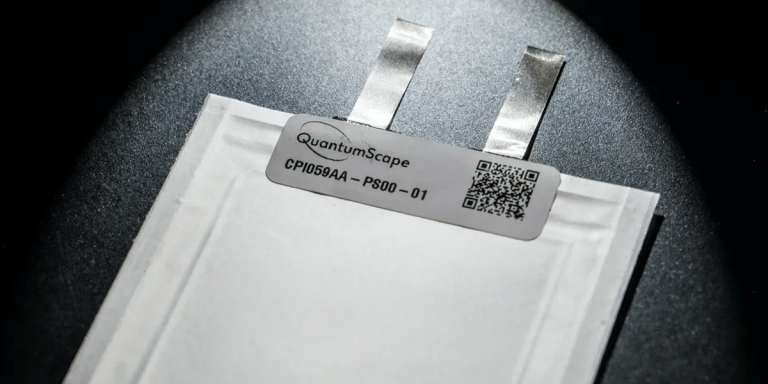
Prismatic Cell from QuantumScape
(Mit freundlicher Genehmigung/Courtesy of QuantumScape Corporation [Homepage])
QuantumScape’s QSE-5 is an approximately 5 Ah lithium-metal cell with a volumetric energy density exceeding 800 Wh/l. According to the company, its fast-charging technology enables charging from 10% to 80% in less than 15 minutes under specified test conditions. These performance figures relate to development cells and do not establish identical performance in a complete vehicle battery pack [3].
QuantumScape began supplying early A0 prototype cells to automotive manufacturers in 2022. In January 2024, Volkswagen’s battery subsidiary PowerCo reported that a QuantumScape prototype cell had completed more than 1,000 charging cycles while retaining over 95% of its original capacity in its endurance test [2]. This was an important validation result, although it should not be interpreted as a lifetime guarantee for every subsequent cell design.
In 2024, QuantumScape began delivering its first QSE-5 B-sample cells for automotive testing. The company subsequently introduced its Cobra manufacturing process, designed to increase the production throughput of its proprietary ceramic separators. In September 2025, QuantumScape and Volkswagen demonstrated QSE-5 technology powering a Ducati V21L electric racing motorcycle, an important step towards vehicle-level testing [3][4].
On 4 February 2026, QuantumScape inaugurated its Eagle Line pilot production facility in San Jose, California. The highly automated line incorporates the Cobra separator process and is intended to produce cells for customer sampling, validation and technology transfer. It serves as a manufacturing blueprint for potential future large-scale production by licensing partners; it is not yet an automotive mass-production plant [4].
In July 2026, QuantumScape and PowerCo revised their collaboration agreement, updating milestones for QSE-5 validation, larger-format automotive cells and technology transfer. Their cooperation continues to envisage a potential licensed production capacity of up to 85 GWh per year, subject to further agreements and successful industrialisation. This is a contractual potential, not existing production capacity [5][6].
QuantumScape also announced a research collaboration with Honda in 2026 and expanded its exploration of applications beyond passenger cars, including aerospace and defence and energy storage for AI data centres. The company demonstrated the feasibility of manufacturing larger ceramic separators for future cell formats. As of October 2026, QSE-5 remained in the pilot production and customer validation phase [6][7].
Sources
[1] https://www.quantumscape.com (Homepage, Access 19.11.2023)
[2] Volkswagen Group – PowerCo confirms QuantumScape endurance test results (04.01.2024)
[3] QuantumScape – 2025 Annual Report (2026)
[4] QuantumScape – Eagle Line pilot production inauguration (04.02.2026)
[5] QuantumScape – July 2026 amendment to PowerCo collaboration agreement (16.07.2026)
[6] QuantumScape – Quarterly Report, second quarter 2026 (2026)
[7] QuantumScape – Second quarter 2026 shareholder letter (22.07.2026)
[cs 18.11.2023, 04.01.2024, 28.10.2024, 11.10.2026]
US battery technology company founded in 2016 in San Jose, California, specialising in an innovative cell manufacturing process. With its Kavian platform, Sakuu has developed an additive dry-printing process for manufacturing battery electrodes. Dry electrode materials are deposited onto metallic current collector foils using a printing process. Unlike conventional wet coating, the process does not use a solvent-based electrode slurry, eliminating the subsequent energy-intensive drying stage. Sakuu aims to reduce production costs, energy consumption and the factory space required for battery manufacturing [1][2].
Sakuu’s Kavian platform is designed to manufacture both cathodes and anodes using different battery chemistries. In 2025, the company began commercialising the equipment and reported initial customer orders and deliveries of dry-printed electrodes to battery manufacturers and electric vehicle customers. Its business model focuses on supplying manufacturing equipment and associated process technology rather than exclusively producing its own battery cells [2][3].
The platform has demonstrated compatibility with NMC, NCA and LFP cathodes as well as graphite and silicon-graphite anodes. Sakuu’s manufacturing technology is therefore not restricted to a particular cell chemistry and can also be used with established lithium-ion battery materials [3].
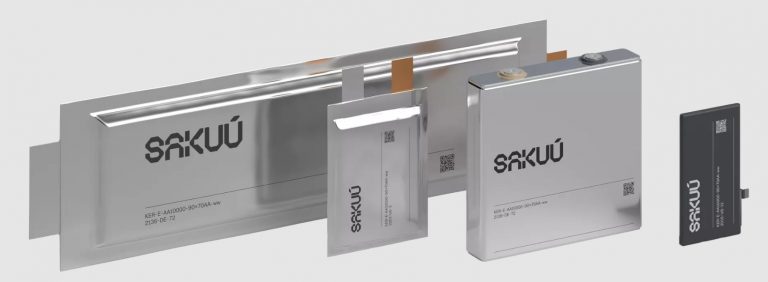
Sakuu cells manufactured using the 3-printing process
(Mit freundlicher Genehmigung/Courtesy of SAKUU CORPORATION [Homepage])
Sakuu’s manufacturing technology can be used to produce electrodes for different battery cell formats, including prismatic and pouch cells. The Kavian platform is intended to allow manufacturers to adapt electrode composition, dimensions and thickness to their requirements [2].
In addition to its manufacturing platform, Sakuu has developed its own Cypress lithium-metal cell technology. Earlier development specifications included a volumetric energy density of approximately 750–800 Wh/l. In December 2024, Sakuu reported that its Cypress lithium-metal cells had achieved more than 1,500 charge-discharge cycles to 80% remaining capacity, tested at 100% depth of discharge and charge/discharge rates of 0.3C/1C. These are company-reported development results, not evidence of automotive series production [2].
The performance of cells manufactured with Sakuu’s dry electrode technology must be distinguished from that of its proprietary lithium-metal chemistry. In October 2025, Sakuu reported that an NMC lithium-ion test cell with a dry-printed cathode retained 83% of its capacity after 4,000 cycles [4]. In February 2026, the company stated that the same 1 Ah laboratory cell, combining a dry-printed NMC811 cathode with a graphite anode, had reached 4,412 cycles before falling below 80% remaining capacity. The test was conducted at 1C charge and 1C discharge [5].
These results demonstrate promising cycle stability for the dry-printed electrode process, but the 4,412-cycle result must not be attributed to Sakuu’s lithium-metal cells. Furthermore, results from a 1 Ah laboratory cell do not by themselves establish the performance or durability of large-format automotive cells.
Sakuu reported supplying dry-printed electrodes to battery and electric vehicle customers in 2025. However, publicly available information does not establish that its proprietary Cypress lithium-metal cells are being used in series-production vehicles [3].
Sources
[1] https://www.sakuu.com/ (Homepage, Access 19.11.2023)
[2] Sakuu – Kavian Platform and Cypress lithium-metal cell progress (10.12.2024)
[3] Sakuu – Activity Update: Kavian commercialisation and customer deliveries (18.08.2025)
[4] Sakuu – Dry-processed cathode cell retains 83% capacity after 4,000 cycles (30.10.2025)
[5] Sakuu – Dry-printed validation cell reaches 4,412 cycles (04.02.2026)
[cs 18.11.2023, 11.10.2026]
Samsung SDI was founded in 1970 in South Korea as a subsidiary of the Samsung electronics group. Samsung SDI is primarily active in the field of lithium–ion cells technology, with applications in electromobility and energy storage systems. A smaller division is active in the semiconductor and display systems business [1].
Samsung SDI is one of the investors in the Israeli startup StoreDot, which is conducting research into fast-charging battery cells.
In 2025, Samsung SDI was the world’s nignth-largest manufacturer of EV battery cells, based on the volume of batteries installed in EVs in 2025 (EV battery usage, Source: SNI Research).
Year EV Batt. Usage [GWh] Market Share Ranking YoY Growth
2025 28.9 2.4 % #9 -2.4 %
2024 29.9 3.3 % #7 -9.2 %
2023 32.6 4.7 % #7 34.3 %
2022 24.3 4.8 % #6 84.1 %
The table above shows that Samsung SDI has gradually lost market share in recent years and has fallen from 6th to 9th place in the global EV battery rankings over the course of four years (Source: SNI Research). One reason is that Rivian has selected Gotion as a second cell supplier, specifically for the more cost-effective LFP cells.
Further customers include BMW, Audi, GM, Stellantis and Rivian, with a focus on high-priced cells with NMC chemistry. As a result, Samsung SDI is not represented in the high-volume entry-level segment.
Chinese manufacturers such as CATL and BYD, on the other hand, are focusing on low-cost LFP cells. Samsung SDI has since expanded its portfolio to include LFP chemistry, but has not yet been able to secure any customers in the price-driven volume segment.
As part of the transition to the “New Class,” Samsung SDI is losing BMW as a customer, as the automaker is relying on new suppliers such as CATL and EVE, as well as new cell formats (46xx), for its new model series.
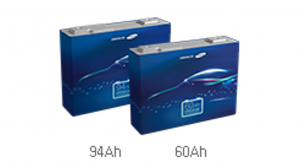
Prismatic Lithium-Cells from Samsung SDI
(Mit freundlicher Genehmigung/Courtesy of SAMSUNG SDI CO.,LTD. [Homepage])
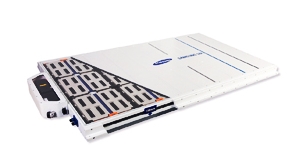
Battery-Pack from Samsung SDI
(Mit freundlicher Genehmigung/Courtesy of SAMSUNG SDI CO.,LTD. [Homepage])
Samsung produces prismatic and cylindrical cells with NMC chemistry. Is also uses them to manufacture battery modules and packs for plug-in hybrids and BEVs.
Samsung SDI is expanding its production capacity in the U.S. in partnership with GM and Stellantis. These projects are supported by the Inflation Reduction Act (IRA). However, the regulatory framework has changed significantly: key demand incentives, such as the U.S. tax credit for electric vehicles, expired at the end of September 2025, causing market momentum to slow noticeably. At the same time, other subsidy programs have been partially scaled back or made time-limited, while industrial policy incentives for battery production remain in place, albeit with reduced planning certainty.
Against this backdrop, some of the U.S. projects—particularly the joint venture with Stellantis—are facing increasing strategic pressure, as investment decisions must be guided more strongly by actual EV demand.
In October 2023, Samsung SDI presented its progress on solid–state batteries at the Korea Future Mobility Expo and confirmed a corresponding industrialization roadmap. The company plans to begin mass production of all-solid-state batteries in 2027, though this is likely to be an early phase of commercialization with limited volumes.
In addition, Samsung SDI joined a partnership between BMW and Solid Power in late 2025. Under this partnership, the U.S. startup supplies sulfide–based solid electrolytes, which Samsung SDI integrates into cells, while BMW handles the integration into modules, packs, and demonstration vehicles. Initial prototypes are already being tested in test vehicles; however, widespread industrial application is not expected until the late 2020s.
Sources
[1] https://www.samsungsdi.com/ (Homepage, Access 21.11.2023)
[cs 21.11.2023, 31.03.2026]
US battery technology company developing innovative lithium-based battery cells, founded in 2012 by former MIT researcher Dr. Qichao Hu. Originally known as SolidEnergy Systems, the company initially researched solid-state lithium-metal batteries before shifting to lithium-metal cells with liquid electrolytes. Its technology uses a lithium-metal anode and specially developed electrolytes to improve energy density and manage safety risks [1][3].
Historically, investors and strategic partners have included LG, Geely and SAIC, while General Motors, Honda and Hyundai participated in automotive battery development and evaluation programmes. These partnerships relate to the company’s earlier focus on high-energy-density lithium-metal cells for electric vehicles and should not automatically be interpreted as current series-production supply agreements [1][3].
A key technical challenge is the formation of lithium dendrites and other degradation mechanisms at the lithium-metal anode. SES AI has developed high-concentration liquid electrolyte formulations and battery monitoring technologies to improve cell stability and safety. These approaches are intended to reduce risks, but cannot be regarded as guaranteeing the complete prevention of dendrites under all operating conditions [3].
Since 2024, SES AI has increasingly expanded into AI-assisted battery materials discovery through its Molecular Universe platform. By 2026, the company’s main commercial priorities had shifted towards drone battery cells, energy storage systems (ESS) and battery materials, rather than large-scale production of automotive lithium-metal cells [4][5].
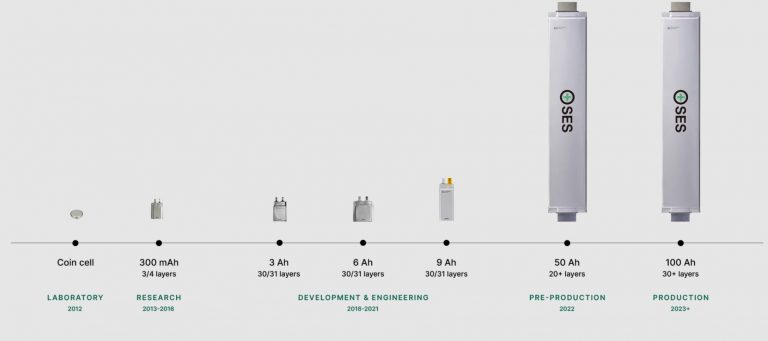
Lithium-ion cells from SES over time
(Mit freundlicher Genehmigung/Courtesy of SES AI Corporation [Homepage])
In 2021, SES AI presented its Apollo lithium-metal cell with a capacity of 107 Ah, an important milestone in the development of large-format lithium-metal batteries. The company reported gravimetric energy densities of approximately 400 Wh/kg and volumetric values of up to 1,000 Wh/l for its development cells. These figures were development-stage performance claims, not verified specifications of a mass-produced automotive battery [1][3].
SES AI aimed to adapt established lithium-ion cell manufacturing processes for its lithium-metal technology, but production of thin lithium-metal anodes and specialised electrolytes required additional process development and quality control. The assertion that no changes to manufacturing technology would be needed is therefore too broad [3].
A 2023 SES AI data report documents cycle testing of a 50 Ah lithium-metal cell over approximately 315 charge-discharge cycles [2]. This documented cycle count is not yet sufficient to demonstrate the long-term durability required for automotive applications. Established lithium-ion cells typically achieve 1,000 to 3,000 cycles, and sometimes more, depending on cell chemistry and testing conditions. Direct comparability depends particularly on the test conditions and the remaining cell capacity.
In 2024, SES AI reported that its 100 Ah lithium-metal B-sample cells had passed testing under the Chinese electric vehicle battery safety standard GB 38031-2020. This represented progress in prototype validation but did not establish commercial series production for electric vehicles [3][6].
During 2025 and 2026, SES AI redirected its battery manufacturing activities towards high-energy-density cells for drones and other specialised applications. In the first quarter of 2026, the company completed the conversion of its production line in Chungju, South Korea, from large-format EV cells to drone-format pouch cells. It planned to expand the line to an annual capacity of more than one million drone cells. In September 2026, SES AI announced ISO 9001:2015 certification for the Chungju facility [4][7].
SES AI also developed its Molecular Universe AI platform to identify and evaluate new battery materials, particularly electrolytes. Its business activities expanded into energy storage systems through UZ Energy. In the second quarter of 2026, the company reported US$5.1 million in revenue, including US$1.2 million from its materials business, and approximately US$163 million in liquidity. The company remained loss-making, reporting a quarterly net loss of approximately US$17.8 million [5].
SES AI is listed on the New York Stock Exchange under the ticker SES (ISIN US78397Q1094, WKN A3DEJZ).
Sources
[1] https://ses.ai/ (Homepage, Access 21.11.2023)
[2] https://ses.ai/wp-content/uploads/2023/07/SES-50Ah-Li-Metal-Cell-Data-Report.pdf (Access 23.11.2023)
[3] SES AI – Annual Report 2024: Lithium-metal cell technology and development (2025)
[4] SES AI – First quarter 2026 shareholder letter (23.04.2026)
[5] SES AI – Second quarter 2026 financial results (11.08.2026)
[6] SES AI – 100 Ah lithium-metal B-sample safety testing (29.10.2024)
[7] SES AI – Chungju battery facility ISO 9001 certification (28.09.2026)
[cs 21.11.2023, 11.10.2026]
Sila Nanotechnologies [↑] [↓] [⇑] [⇓]
US battery materials company for innovative cell materials, founded in 2011 by a team including former Tesla engineer Gene Berdichevsky. The company is based in Alameda, California [1][2].
Sila develops a silicon-carbon (Si/C) anode active material marketed as Titan Silicon™. It is designed to replace some or all of the graphite in lithium-ion battery anodes, depending on the cell design. Target applications include electric vehicles, consumer electronics and other battery-powered products. According to Sila, the material can enable up to approximately 20% higher cell energy density compared with leading graphite-based cells, with further improvements targeted in future generations. These are manufacturer performance claims, not universal values for every battery cell [2][4].
Sila states that Titan Silicon can be incorporated into existing lithium-ion cell manufacturing processes and used in different cell formats, including cylindrical, prismatic and pouch cells. Nevertheless, cell manufacturers must qualify the material and adapt electrode formulations and production parameters to their particular designs. Sila supplies anode material, rather than manufacturing complete automotive battery cells [2][4].
Mercedes-Benz has been a technology partner since 2019. In 2022, the companies announced plans to use Sila’s silicon anode material in a future electric G-Class. However, the Mercedes-Benz G 580 with EQ Technology introduced in 2024 should not be described as already using Titan Silicon without a specific confirmation of that series application. The original announcement concerned a planned future use, not proof of installation in the initial production vehicle [3][5].
In December 2023, Panasonic Energy signed an agreement to purchase Sila’s silicon anode material for next-generation electric vehicle batteries. Panasonic, a long-standing battery supplier to Tesla, has stated a long-term target of increasing volumetric cell energy density from approximately 800 Wh/l to 1,000 Wh/l by fiscal year 2031. This is a development target, not a confirmed energy density already achieved through Sila material in series-produced Panasonic cells [6].
In September 2025, Sila announced the start of operations at its first automotive-scale anode material plant in Moses Lake, Washington. The initial phase involved commissioning, testing and refining production processes ahead of a broader commercial ramp-up. The facility was designed for staged expansion; its initial capacity was reported at approximately 2 GWh of battery-equivalent material per year. This capacity figure refers to the amount of anode material needed for batteries, not to Sila manufacturing complete cells [4][7].
In July 2026, Sila secured approximately US$300 million in private financing to accelerate production of Titan Silicon and support further expansion of the Moses Lake facility. The company outlined a long-term expansion concept of up to 250 GWh of annual battery-equivalent anode material capacity. This represents a future ambition, not existing production capacity [7].
Sources
[1] https://www.energytrend.com/news/20230501-31790.html (Access 24.11.2023)
[2] https://www.silanano.com/ (Homepage, Access 24.11.2023)
[3] https://autotech.news/catl-to-become-battery-supplier-for-mercedes-benz-g-class-ev (Access 24.11.2023)
[4] Sila – Start of operations at Moses Lake anode plant (23.09.2025)
[5] Mercedes-Benz – G 580 with EQ Technology: vehicle specifications (2024)
[6] Panasonic Energy – Agreement to purchase silicon anode material from Sila (13.12.2023)
[7] electrive – Sila raises US$300 million to expand silicon anode production (22.07.2026)
[cs 24.11.2023, 11.10.2026]
Joint venture between Farasis Energy and Togg Auto, established in 2021 to develop and manufacture lithium-ion battery solutions for automotive and other applications in Turkey [1].
Siro began series production of battery modules and packs in March 2023 at its facility in Gemlik, Turkey, using lithium-ion battery technology from Farasis Energy. The facility initially had an annual production capacity of 3 GWh; Farasis Energy subsequently reported a capacity of 8 GWh per year in 2024 [2][3].
Construction of a separate lithium-ion cell manufacturing plant in Gemlik began in April 2023. Cell production was originally scheduled to start in 2026, with annual capacity planned to reach 20 GWh by 2031 [1]. However, as of October 2026, a confirmed start of commercial cell production could not be established from the available sources. The existing module and pack production should therefore be distinguished from the planned local manufacture of battery cells.
Sources
[1] Farasis Energy – Siro lays foundation stone for cell factory (26.04.2023, Access 24.11.2023)
[2] Farasis Energy – Siro starts battery module and pack production (20.04.2023)
[3] Farasis Energy – Five years of Farasis Energy Europe (2024)
[cs 24.11.2023, 11.10.2026]
Subsidiary of the Korean SK Group, a conglomerate with a very broad positioning. SK On produces lithium–ion cells and was only founded in 2021; however, it was previously active in this business segment under a different name [1].
In 2025, SK On was the sixth-largest manufacturer of EV battery cells worldwide, with a market share of 3.7%, based on the battery capacity installed in EVs (EV battery usage, Source: SNE Research).
SK On’s major customers include Hyundai, Ford, Volkswagen, and Mercedes–Benz.
Year EV Batt. Usage [GWh] Market Share Ranking YoY Growth
2025 44.5 3.7 % #6 14.1 %
2024 39.0 4.4 % #5 13.4 %
2023 34.4 4.9 % #5 8.5 %
2022 31.7 6.1 % #5 89.8 %
The table above shows SK On’s market share (Source: SNE Research). Hyundai is currently the most important customer, with the Ionic 5 and 6 models.
However, the company is gradually losing market share, due in part to weak demand from Ford. The original plan was to significantly expand its U.S. operations in partnership with Ford through the BlueOval SK joint venture.
Two large battery plants—one in Glendale, Kentucky, and one in Stanton, Tennessee—were planned, representing a total investment of approximately $11.4 billion. However, due to weaker EV demand and strategic adjustments, the joint venture was dissolved at the end of 2025.
Ford will take over the two plants in Kentucky, while SK On will fully control and operate the facility in Tennessee. The timelines have also shifted significantly: while production in Kentucky began in 2025, further expansion has been delayed. Production at the Tennessee plant is currently expected to begin in 2026/2027.
In addition, SK On is operating a joint venture with the Hyundai to build a battery cell factory in Cartersville (Georgia, USA). Both partners hold a 50% stake each, with a total investment of approximately $5 billion. The facility is designed for an annual production capacity of approximately 35 GWh and is intended to supply battery cells for Hyundai, Kia, and Genesis models in North America.
However, the originally planned production start in the second half of 2025 has been delayed; a launch is currently expected sometime in 2026.

Z-folding for lithium-ion cells from SK on
(Mit freundlicher Genehmigung/Courtesy of SK on Co., Ltd. [Homepage])
SK On manufactures lithium-ion cells in pouch format with classic NMC811 chemistry, but also so-called high-nickel cells. In this cell type, the nickel content is 90% and the proportion of the critical raw materials cobalt and manganese is only 5% each; SK On refers to this as NMC91/21/2 cell chemistry.
According to SK On, another special feature is the so-called Z-folding in the production process, whereby a cathode and an anode layer are placed between the zig-zag folded separator.
In July 2024, the news agency Reuters reported that SK On is in ongoing talks with vehicle manufacturers to enter into the production of prismatic cells. Specific names have not yet been mentioned.
SK On is one of the battery manufacturers also working on solid-state batteries. SK On is taking a multi-stage approach and is working in parallel on two systems: polymer-oxide composites (semi-solid) and sulfide-based all-solid-state batteries.
The composite solutions serve as a bridge technology to facilitate industrialization, while sulfide systems are expected to enable higher energy densities in the long term. Technologically, SK On is focusing in particular on lithium-metal anodes and the stabilization of interfaces, for example through protective layers to extend cycle life.
For industrialization, the company is building a pilot plant in Korea; initial commercialization steps are expected to begin around 2028 (hybrid) and 2029/2030 (all-solid-state).
Sources
[1] http://eng.sk-on.com/main.asp (Homepage, Access 24.11.2023)
[cs 24.11.2023, 19.07.2024, 21.01.205, 30.03.2026]
US battery technology company for innovative lithium-ion cells, founded in 2011 as a spin-off from the University of Colorado Boulder. Solid Power is based in Louisville, Colorado. Its technology partners include vehicle manufacturers BMW and Ford, battery manufacturer SK On and Samsung SDI [1][5].
Solid Power develops all-solid-state battery technology based on a sulfide-based solid electrolyte. Its cell development has included NMC cathodes and silicon-rich anodes, as well as research into other electrode combinations. Prototype cells have been manufactured in pouch format. The company’s current business model focuses primarily on producing and supplying solid electrolyte and licensing battery cell designs and manufacturing processes to industrial partners, rather than establishing itself as a large-scale manufacturer of complete battery cells [1][6].
Solid-state Cell in pouch format from Solid Power
(Mit freundlicher Genehmigung/Courtesy of Solid Power [Homepage])
In January 2023, BMW announced that it had acquired a research and development licence to establish a prototype production line based on Solid Power technology at its Cell Manufacturing Competence Center in Parsdorf, Germany [2].
In November 2023, Solid Power delivered its first A-sample cells to BMW for testing [3]. At that time, BMW representatives indicated that industrialising the technology could take until the end of the decade [4].
A major milestone followed in May 2025, when BMW presented a BMW i7 test vehicle equipped with large-format all-solid-state battery cells from Solid Power. The vehicle was operated in the Munich area to evaluate the cells under real driving conditions, including battery-pack integration, cell expansion, operating pressure and temperature management. This was a demonstration vehicle, not a production model [5].
In October 2025, Solid Power, Samsung SDI and BMW announced a joint evaluation agreement. Under the agreement, Solid Power supplies its sulfide-based electrolyte to Samsung SDI, which is intended to manufacture solid-state cells for evaluation by BMW and potential integration into a further demonstration vehicle. The agreement concerns technology development and validation, not confirmed series supply [6].
Solid Power also cooperates with SK On on pilot cell manufacturing. In the first half of 2026, the company completed site acceptance testing and the associated line installation agreement for SK On’s pilot production line in South Korea. The partners were subsequently negotiating a new collaboration agreement. Solid Power also began installing a continuous pilot production line for sulfide electrolyte in Colorado, with commissioning planned for the fourth quarter of 2026. The company was additionally exploring a potential joint venture for commercial-scale electrolyte production in South Korea [7].
As of August 2026, these activities remained at the development, demonstration and pilot-production stages. Solid Power had not announced established large-scale commercial production of solid-state battery cells. The company reported an operating loss of approximately US$30.3 million in the second quarter of 2026, while its available liquidity amounted to approximately US$419 million at the end of June [7].
Solid Power has been listed on the Nasdaq under the ticker SLDP since 2021 (ISIN US83422N1054, WKN A3C859).
Sources
[1] https://www.solidpowerbattery.com/ (Homepage, Access 26.11.2023)
[2] https://www.press.bmwgroup.com/deutschland/article/detail/T0407744DE/bmw-group-und-solid-power-vertiefen-entwicklungspartnerschaft (Access 26.11.2023)
[3] https://battery-news.de/2023/11/09/solid-power-liefert-erste-festkoerperbatterie-an-bmw (Access 26.11.2023)
[4] https://www.elektroauto-news.net/news/bmw-batterie-entwicklung (Access 02.12.2023)
[5] Solid Power / BMW – All-solid-state cells tested in a BMW i7 (20.05.2025)
[6] Solid Power – Joint evaluation agreement with Samsung SDI and BMW (30.10.2025)
[7] Solid Power – Second quarter 2026 results and operational update (04.08.2026)
[cs 26.11.2023, 11.10.2026]
Solidion Technology [↑] [↓] [⇑] [⇓]
US battery technology company for innovative lithium-ion cells, originating from a business founded in 2015 under a different name. Solidion is headquartered in Dallas, Texas, and has pilot production facilities in Dayton, Ohio. The company develops battery materials, components and complete battery systems. One of its technologies aims to enable cost-effective production of battery-grade graphite from sustainable sources such as biomass [1][2].
Solidion’s portfolio includes silicon-based anode materials, particularly graphene-enhanced silicon and silicon oxide (SiO)-based composites. The company is also working on advanced lithium-metal and lithium-sulfur battery technologies. According to its own statements, Solidion holds a portfolio of more than 525 patents covering different aspects of battery technology [1][2].
In 2025 and 2026, Solidion expanded its development activities beyond anode materials. In particular, it demonstrated a 9.5 Ah high-power pouch cell intended for industrial and military drones. According to the company, the prototype retained approximately 95% of its discharge capacity at a 10C discharge rate. Commercial availability was planned for 2026, but the announcement alone does not establish that volume production or regular customer deliveries have begun [3].
Solidion also introduced its PEAK Series, an uninterruptible power supply (UPS) battery system designed for AI data centres. The system is based on the company’s silicon-carbon anode technology. Solidion claims potential advantages in space requirements and service life compared with conventional backup batteries. Initial integration and testing with selected partners were reported, while broader commercial availability was targeted for 2026 [3].
In May 2026, Solidion reported its first quarterly revenue, generated from government contracts and deliveries of its proprietary silicon-anode material. This represents an initial commercial milestone, although the company remained at an early stage of commercialisation [3]. In June 2026, it raised approximately US$35 million in gross proceeds through a private placement. According to its report for the first half of 2026, Solidion nevertheless continued to record operating losses and limited sales. The additional financing improved its liquidity position but does not by itself demonstrate profitability or established large-scale battery production [4][5].
Solidion is listed on the Nasdaq under the ticker STI (ISIN US8342121022, WKN A3EKZR). Its technologies and prototype performance figures should be distinguished from independently verified specifications of mass-produced commercial battery cells [2][5].
Sources
[1] https://www.solidiontech.com/ (Homepage, Access 16.07.2024)
[2] Solidion Technology – Company profile and patent portfolio (31.10.2025)
[3] Solidion Technology – Q1 2026 results, drone cell and PEAK Series (21.05.2026)
[4] Solidion Technology – Investor relations and June 2026 financing announcement (10.06.2026)
[5] Solidion Technology – SEC Form 10-Q, first half of 2026 (2026)
[cs 16.07.2024, 11.10.2026]
Belgian start-up for innovative lithium-ion cells, founded in 2022 as a spin-off from imec, one of the leading research institutes for chip and nanotechnology. The company is based in Sint-Truiden, Belgium [1].
Solithor develops all-solid-state lithium-metal cells with a thin lithium-metal anode and a proprietary solid composite electrolyte (SCE). The electrolyte is based on a proprietary sol-gel chemistry rather than a conventional sulphide, oxide or polymer-only approach. The technology does not require liquid electrolyte filling and is designed to operate at approximately room temperature [1][4].
In October 2024, Solithor confirmed the use of high-loading NMC cathodes in combination with its thin lithium-metal anode and solid electrolyte. This replaced the earlier assumption about the cathode chemistry with a confirmed company statement [2].
In May 2024, the company reported less than 7% capacity loss after 500 full charging cycles in a prototype pouch cell tested at 25°C under external pressure. In October 2024, Solithor announced 1,000 full charging cycles with more than 80% capacity retention, also at 25°C and under moderate external pressure. Separately, the company reported energy densities of 384 Wh/kg and 1,026 Wh/l at stack level. These performance figures were obtained on different prototype cells and should not be interpreted as a single cell simultaneously achieving all reported results [2][5].
In February 2026, Solithor received a €1.7 million grant from the Flemish innovation agency VLAIO for its CelliSafe 3.0 research project. The 18-month programme focuses on scaling up 3 Ah solid-state pouch-cell prototypes, developing improved electrode and electrolyte combinations, and validating cell safety through abuse testing [3].
In June 2026, Solithor announced its first 10 Ah multilayer pouch demonstration cell and reported energy densities of up to 465 Wh/kg and 1,400 Wh/l at electrode-stack level using a high-loading cathode. The company also reported discharge rates of up to 5C and short 10C pulses in prototype tests, as well as successful nail penetration and overcharge tests without thermal runaway under the specified conditions. These results represent development milestones rather than independently confirmed performance specifications for a mass-produced commercial cell [4].
Solithor is initially targeting aviation, aerospace, defence and maritime applications. In November 2025, it joined the EU-funded MODABAT project to develop battery systems for hybrid-electric aircraft. In March 2026, the company also announced a strategic collaboration with DronePort to support battery development, testing and certification for aerospace and drone applications. Its commercialisation strategy increasingly includes technology licensing and industrial partnerships; large-scale series production has not yet been confirmed [6][7].
Sources
[1] https://www.solithor.com/ (Homepage, Access 18.07.2024)
[2] SOLiTHOR – 1,000 charging cycles and NMC cathode confirmation (29.10.2024)
[3] SOLiTHOR – CelliSafe 3.0 funding (06.02.2026)
[4] SOLiTHOR – Energy density and 10 Ah demonstration cell (10.06.2026)
[5] SOLiTHOR – 500 charging cycles (29.05.2024)
[6] SOLiTHOR – MODABAT aviation project (04.11.2025)
[7] SOLiTHOR – DronePort collaboration (12.03.2026)
[cs 18.07.2024, 11.10.2026]
US start-up from Greenville, South Carolina, which develops technologies to improve the safety of lithium–ion cells. Its approach combines a particularly heat-resistant separator film with thin, metallized polymer current collectors. Soteria also operates a technology licensing platform and an industry consortium [1].
Soteria works with numerous companies and research institutions through its consortium. Members listed on the company’s website have included the following organizations [2]:
- Cell manufacturers such as Amprius, Amte Power, Cuberg and Saft,
- Tier-1 suppliers such as Bosch,
- Vehicle manufacturers such as Daimler Truck, Mercedes-Benz and Rimac,
- Computer manufacturers such as Lenovo,
- US research organizations such as Oak Ridge National Laboratory and NASA, as well as
- Universities such as Ohio State University.
This list includes historical consortium participants and should not be interpreted as confirmation that every organization remains an active member today.
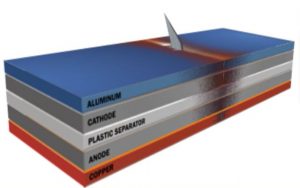
Layers of a standard lithium cell with plastic separator
(Mit freundlicher Genehmigung/Courtesy of Soteria [Homepage])

Lithium-ion cell with Soteria separator
(Mit freundlicher Genehmigung/Courtesy of Soteria [Homepage])
Standard lithium-ion cells consist of a cathode and an anode, which are kept physically apart by a porous separator film. The separator prevents direct electronic contact between the electrodes while allowing lithium ions to pass through the electrolyte contained in its pores.
If an internal short circuit occurs between the cathode and anode, a high current can flow locally, causing rapid heating. Under unfavorable conditions, this can initiate thermal runaway, potentially leading to venting, fire or other hazardous cell failure.
Soteria’s Dreamweaver separator is designed to withstand high temperatures without the melting or shrinkage associated with conventional polymer separators. Its porous structure can retain electrolyte while maintaining ionic transport. In addition, Soteria’s metallized polymer current collectors are designed to interrupt high local currents during an internal short circuit, acting in a manner similar to a fuse. Together, these components aim to prevent a localized defect from developing into a major thermal event [1].
In June 2026, Soteria announced that it had licensed an additional three-dimensional, reticulated current collector technology from Rutgers University. This design uses a lightweight porous polymer structure with thin conductive metal coatings. It is intended to improve electrode adhesion and current distribution while reducing degradation and heat generation as batteries age. The technology was added to Soteria’s Battery Safety IP Exchange for licensing to battery manufacturers; commercial series deployment has not yet been established [3].
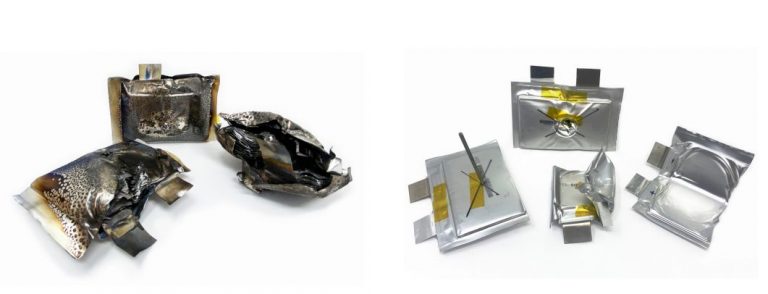
Cells after nail penetration test with standard separator (left) or with Soteria separator (right)
(Mit freundlicher Genehmigung/Courtesy of Soteria [Homepage])
The picture above compares the results of a nail penetration test involving conventional lithium-ion cells (left) and cells incorporating Soteria’s safety technology. The test illustrates the intended reduction in the risk of thermal runaway during an internal short circuit; results depend on the specific cell design and test conditions [2].
Sources
[1] https://soteriabig.com/ (Homepage, Access 27.11.2023)
[2] https://cdn-soteria.b-cdn.net/wp-content/uploads/2022/08/Website_whitepaper_2022.pdf (Access 27.11.2023)
[3] Soteria – Licensing of Rutgers current collector technology (25.06.2026)
[cs 27.11.2023, 11.10.2026]
South 8 Technologies [↑] [↓] [⇑] [⇓]
US start-up from San Diego that is developing a liquefied gas electrolyte for innovative lithium-ion cells. Investors and technology partners include LG, Lockheed Martin, Shell and Porsche [1].
Liquid electrolytes are the state of the art in Li-ion cells, but conventional organic electrolyte solvents are often flammable. Alternatively, many companies are working on solid electrolytes, although widespread commercial production remains challenging.
South 8 takes a different approach with its proprietary LiGas electrolyte, a mixture of gases kept in a liquefied state inside the battery cell. The company describes the gas components as non-toxic and non-corrosive. The technology is designed to improve safety and extend the operating temperature range while retaining a conventional separator between the electrodes.
- According to the manufacturer, LiGas can escape from a punctured or damaged cell, leaving substantially less flammable electrolyte behind and thereby reducing the risk of fire.
- Li-ion cells using LiGas are designed for a very wide operating temperature range, from -60°C to +60°C.
The LiGas electrolyte is designed to be compatible with a range of lithium-ion cell chemistries, although compatibility and performance must be validated for each specific cell design.
In cooperation with an unnamed vehicle manufacturer, South 8 produced cylindrical sample cells in the 18650 format with LNMO chemistry. These cells demonstrated largely unrestricted operation at temperatures as low as -40°C.
At the annual ARPA-E Energy Innovation Summit in 2024, South 8’s demonstrator was recognized by IEEE Spectrum magazine as one of the five coolest tech demos. It involved two flashlights placed in a bucket of dry ice at almost -80°C. The flashlight with standard Li-ion cells went out after just 15 minutes, while the one with South 8 cells remained lit for over 15 hours [2].
In December 2025, South 8 announced an additional USD 11 million financing round led by investment units of W. L. Gore & Associates and Lockheed Martin. The funds were intended to accelerate the commercialization and expansion of LiGas cell production, particularly for defense and aerospace applications [3].
In September 2026, South 8 announced the start of volume production of its extreme-cold lithium-ion cells for defense customers. A new semi-automated production line in San Diego manufactures cylindrical ARCTIC AE35 cells in the 18650 format using the LiGas electrolyte. The company expects an annual production capacity of approximately 5 MWh in 2027. This marks the transition from sample-cell development to commercial manufacturing for specialized applications, but not yet to large-scale automotive battery production [4].
In October 2026, South 8 also announced a three-year supply agreement with Galvion for batteries used in the Arctic SoloPack, a portable power solution designed for extreme cold. The agreement provides a concrete commercial application for South 8’s LiGas technology outside the automotive sector [5].
Sources
[1] https://www.south8.com/ (Homepage, Access 19.07.2024)
[2] https://www.south8.com/news/ieee-spectrum-five-cool-tech-demos-from-the-arpa-e-summit/ (Access 19.07.2024)
[3] South 8 – Additional USD 11 million funding (09.12.2025)
[4] South 8 – Volume production of extreme-cold lithium-ion batteries (24.09.2026)
[5] South 8 – Three-year supply agreement with Galvion (06.10.2026)
[cs 19.07.2024, 11.10.2026]
Israeli start-up founded in 2012 by Doron Myersdorf and others with the aim of developing fast-charging lithium–ion cells. Regarding this criteria, StoreDot is primarily in competition with the US start-up Enevate. The phrase “dot” in the company name refers to the nanoparticles (Nana-Dots) that StoreDot uses as part of the active material [1].
Investors and technology partners include Samsung (2013), Daimler and TDK (2017), EVE Energy (2018) and Vinfast (2021).
StoreDot works with an anode consisting of a nano-sized silicon material and other organic compounds. With this active material, it has been possible to significantly reduce the cell expansion typical of a silicon anode.
The currently developed cells make it possible to charge 100 miles (approx. 160 km) in 5 minutes. At the Future Battery Forum in Berlin in November 2023, Doron Myersdorf emphasized in his presentation that the StoreDot cells can be charged at maximum power up to an SoC of 85% at a 350 kW charging station without jeopardizing the SoH of the cell.
In contrast, the charging power of today’s commercially available vehicles with high charging power (Porsche, Hyundai, BMW, Mercedes-Benz) is reduced at 50% SoC at the latest [2].
In 2024, a first test vehicle with StoreDot cells was built in cooperation with Polestar; the technology carrier is a Polestar 5 [3].
In September 2024, StoreDot announced the production of the first prismatic cells, which are manufactured in cooperation with the US company Flex-N-Gate. The sample cells have a capacity of 80 Ah and can be charged from 10 to 80% in 10 minutes [4].
In March 2025, StoreDot announced a strategic partnership with South Korean battery manufacturer JR Energy Solution to accelerate the production and industrial scaling of its extreme fast-charging (XFC) cells. The agreement represents a further step towards commercial manufacturing, but does not by itself establish that large-scale series production has begun [5].
In November 2025, StoreDot reported that its silicon-dominant XFC battery technology had been validated by seven global automotive manufacturers. This marks progress in customer qualification and industrial readiness. However, validation by automakers should not be equated with confirmed mass-production contracts or regular deliveries of series-production cells [6].
Sources
[1] https://www.store-dot.com/ (Homepage, Access 29.11.2023)
[2] https://de.futurebattery.eu/ (Slides of Dr. Myersdorf, 29.11.2023)
[3] https://www.store-dot.com/press/storedot-and-polestar-showcase-worlds-first-electric-vehicle-10-minute-charge-with-si-dominant-cells (Access 12.09.2024)
[4] https://www.store-dot.com/press/storedot-accelerates-ev-adoption-10-minute-charging-of-large-prismatic-batteries-now-a-reality (Access 12.09.2024)
[5] StoreDot – Manufacturing partnership with JR Energy Solution (06.03.2025)
[6] StoreDot – XFC technology validated by seven global OEMs (06.11.2025)
[cs 29.11.2023, 12.09.2024, 11.10.2026]
Chinese start-up for lithium–ion cells, which was founded in Shenzen in 1997. Sunwoda produces cells for mobile devices (smartphones), EVs (BEV, PHEV) and ESS as well as other electronic products [1].
With 23.6 GWh, Sunwoda was not among the world’s top ten EV cell manufacturers in 2025, based on the volume of batteries installed in EVs (EV battery usage, Source: SNE Research).
Sunwoda’s customers include Xpeng as well as international automakers such as Nissan and Renault. In April 2026, Chinese media also reported that Sunwoda had entered Tesla’s global battery supply chain, supplying LFP cells for export vehicles manufactured in Shanghai. This supplier relationship has not been independently confirmed by Tesla [2].
In November 2022, VW announced that it had selected Sunwoda as a supplier of batteries for hybrid vehicles; since then, the partnership has been further expanded, and Sunwoda has now been integrated into Volkswagen’s BEV supplier network.
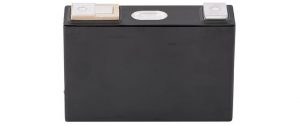
Prismatic cell from Sunwoda
(Mit freundlicher Genehmigung/Courtesy of Sunwoda Electronic Co., Ltd. [Homepage])

Modules from Sunwoda with prismatic, pouch and round cells.
(Mit freundlicher Genehmigung/Courtesy of Sunwoda Electronic Co., Ltd.[Homepage])
Sunwoda manufactures cells, battery management systems (BMS), modules, and complete battery packs. In the field of traction batteries, the current focus is on prismatic lithium-ion cells in aluminum casings, which are used primarily in BEVs and hybrid vehicles. Sunwoda supplies cells with NMC and LFP chemistries.
In addition, the company is expanding its portfolio to include large-format cylindrical cells (46xx). Specific series applications or customers in this segment have not yet been announced.
In addition to these cell formats, Sunwoda also offers lithium–polymer cells. These are lithium-ion cells with polymer-based electrolytes, typically designed in a flexible pouch configuration. This cell technology is currently used primarily in the consumer sector, for example in smartphones, laptops, and other portable electronic devices.
As part of its research activities, Sunwoda is working on solid–state batteries, with a particular focus on polymer–based and hybrid solid electrolytes that combine solid and liquid components. In its review of 2025 milestones, published in January 2026, the company reported the launch of polymer-based solid-state batteries. However, this announcement does not establish that all-solid-state traction batteries are already being mass-produced for automotive customers [3].
Sunwoda is listed on the Shenzen stock exchange, among others.
Sources
[1] https://en.sunwoda.com/ (Homepage, Access 01.12.2023)
[2] CnEVPost – Tesla reportedly adds Sunwoda to global battery supply chain (09.04.2026)
[3] Sunwoda – 2025 Milestones (09.01.2026)
[cs 01.12.2023, 02.04.2026, 11.10.2026]
SVOLT Energy Technology is a Chinese lithium–ion cell manufacturer that was spun off from the Great Wall Motor automotive group in 2018. The company is headquartered in Jintan District, Changzhou, in Jiangsu Province. SVOLT develops and manufactures battery cells, modules, packs, and energy storage systems; on its website, SVOLT currently lists 11 production sites worldwide, 5 R&D centers, and more than 10,000 patent applications.
In 2025, SVOLT was the world’s tenth-largest manufacturer of EV cells, based on the battery capacity installed in EVs (EV battery usage, Source: SNE Research).
Year EV Batt. Usage [GWh] Market Share Ranking YoY Growth
2025 28.5 2.4 % 10 74.8 %
2024 16.3 1.8 % 10 158.7 %
2023 6,3 0,9 % >10 57.5 %
2022 4.0 0,8 % 10 29.0 %
The table above shows that SVOLT has grown in tandem with the overall market in recent years (Source: SNE Research).
SVOLT supplies battery cells to both Great Wall Motor and external OEMs. A first major order was secured with Stellantis in 2021. In addition, the company has supply relationships or is participating in qualification programs with other automakers, including Geely and BMW MINI.
The plans to build three German production plants were canceld due to the reduced demand for BEVs in Germany. Originally, two plants were planned in Saarland and one in Brandenburg.
The plant in Brandenburg was taken over by wind turbine manufacturer Vestas in Lauchhammer, where lithium-ion cells with an annual volume of 12 GWh were to be produced from 2025. The cells were to be processed into modules and battery packs in Häusweiler in Saarland. A further cell factory was planned in Saarland, but this was postponed following protests from local residents.
The focus is therefore currently clearly on the production and development sites in Asia. SVOLT officially highlights its existing global manufacturing network and plans for further expansion in China and select international markets, such as Thailand.

Prismatic cells and modules from SVolt
(Mit freundlicher Genehmigung/Courtesy of SVOLT Energy Technology (Europe) GmbH [Mediatek])

Batterie-Pack from SVolt for Ora Funky Cat
(Mit freundlicher Genehmigung/Courtesy of SVOLT Energy Technology (Europe) GmbH [Mediatek])
SVolt produces cells in all common formats (prismatic, pouch, round) as well as modules and battery packs; NMC and LFP are used as the cell chemistry.
The company is also working on cobalt-free NMx cells, whose cathodes, according to the company, consist of 75 percent nickel and 25 percent manganese. In 2021, SVOLT announced 115 Ah and 226 Ah formats for this generation of cells and indicated that material costs would be lower than those of traditional NCM cells.
According to SVOLT, the current portfolio includes, among other things:
- Short-blade LFP cells with 5C fast charging, 10–80% state of charge in about 12 minutes, and more than 3,500 cycles,
- Short-blade NCM cells with 6C charging capability,
- an 800V PHEV NCM battery with up to 4C charging power and an energy density of 250 Wh/kg as stated by the company,
- as well as a semi-solid NCM battery with a stated energy density of 266 Wh/kg.
Sources
[1] https://www.svolt-eu.com/ (Homepage, Access 04.12.2023)
[cs 04.12.2023, 28.10.2024, 04.04.2026]
Talent New Energy [↑] [↓] [⇑] [⇓]
Chinese start-up for innovative lithium–ion cells founded in 2018. Talent claims to have achieved breakthroughs in key technologies for solid electrolyte cells, including an oxide-based composite solid-state electrolyte and an integrated casting process for production [1].
For the cathode, the company relies on high-capacity, lithium-rich manganese-based materials; in the anode, Talent uses a lithium metal-based composite material that is both very wide and ultra-thin and has high cycle stability.
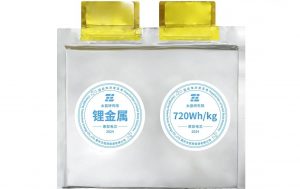
Sample pouch cell from Talent New Energy
(Mit freundlicher Genehmigung/Courtesy of Talent New Energy [Homepage])
Talent claims to have developed the world’s first sample cell with automotive-grade lithium metal technology with a cell capacity of 120 Ah and an energy density of 720 Wh/kg (see picture). This figure refers to an experimental all-solid-state cell and should not be confused with the performance of Talent’s commercially manufactured semi-solid-state batteries.
For comparison: NIO´s 150 kWh semi-solid-state battery pack uses WeLion cells with a specific energy of approximately 360 Wh/kg. Talent’s reported laboratory figure is therefore twice as high, although the two cells are at different stages of commercial maturity.
Since 2024, Talent has established partnerships for the commercialization of its battery technologies. In particular, the company is working with Changan Automobile on separator-free solid-state battery technology, with vehicle integration testing planned for 2026 and series production targeted for 2027 [3].
A significant commercial milestone followed in April 2026, when Talent and Chinese two-wheeler manufacturer Yadea introduced the Guanneng Xingjian II-200L electric motorcycle equipped with a mass-produced semi-solid-state battery. The battery system has a nominal rating of 72 V and 109 Ah. This marks a practical commercial application of Talent’s semi-solid-state technology, but not the mass production of its experimental 720 Wh/kg all-solid-state cell [4].
According to information published in July 2026, Talent’s semi-solid-state batteries are already being produced and supplied for applications including two-wheelers and energy storage. The company expects initial small-scale demonstration applications of its all-solid-state batteries in selected premium vehicles around 2027. Large-scale automotive commercialization remains a longer-term objective [5].
Sources
[1] https://cnevpost.com/2024/04/03/talent-unveils-battery-cell-ultra-high-energy-density/ (Access 22.07.2024)
[2] https://www.ctlne.com/ (Homepage, Access 22.07.2024)
[3] Shanghai Metals Market – Talent’s solid-state battery development and partnerships (05.11.2025)
[4] People’s Daily – Talent and Yadea launch electric motorcycle with semi-solid-state battery (02.04.2026)
[5] Chongqing Municipal Government – Battery industry development and Talent New Energy (17.07.2026)
[cs 22.07.2024, 11.10.2026]
Theion is a battery startup founded in Berlin in 2020 and built around chemist and co-founder Marek Slavik. The company is developing crystalline sulfur batteries as an alternative to today’s lithium–ion cells. Technologically, Theion relies on sulfur as the active cathode material, as well as its own processes and a proprietary lithium-metal anode.
Among the advantages over conventional lithium-ion batteries with NMC chemistry, Theion cites significantly lower material costs, higher gravimetric energy density, fast charging, and simpler, more resource-efficient production processes—for example, without slurry coating, solvents, water, or drying steps. The company cites a target energy density of up to 1,000 Wh/kg and positions its technology as a more cost-effective and climate-friendly alternative to today’s lithium-ion cells.
According to the company, Theion developed small button cells in the spring of 2025; the new capital from the Series A round is now to be invested in the development of larger pouch cells. Theion currently cites electric aviation, electric vehicles with longer ranges, and stationary energy storage as the most relevant future applications. According to CEO Ulrich Ehmes, the cells could theoretically be on the road in electric vehicles before the end of the decade.
In 2026, Theion also announced its participation in SPACEBOX, a research project for lightweight lithium-sulfur battery modules for satellites. Together with TU Berlin and Space Structures GmbH, the company aims to develop an integrated battery system with approximately 50% lower module weight than conventional solutions. The project is supported by German public research funding and remains at the development stage [2].
Sources
[1] https://www.theion.de/ (Homepage, Access 04.12.2023)
[2] Theion – SPACEBOX satellite battery development project (2026)
[cs 04.12.2023, 03.04.2026, 11.10.2026]
Verkor is a French lithium-ion cell startup founded in July 2020. Its shareholders and strategic partners include EIT InnoEnergy, Groupe IDEC, Schneider Electric, Capgemini, Renault Group, EQT Ventures, Arkema, Tokai COBEX, Demeter FMET, Plastic Omnium, and Sibanye-Stillwater.
The company’s headquarters and its research, development, and pilot center (Verkor Innovation Centre) are located in Grenoble. There, the company operates a pilot line and develops cell technologies and production processes for industrial scaling.
Verkor’s first gigafactory is located in Bourbourg near Dunkirk (northern France). The facility was inaugurated in December 2025 and is designed for an initial production capacity of approximately 16 GWh per year, with a long-term expansion target of about 50 GWh. Following the industrial ramp-up in early 2026, Verkor announced in August 2026 that its second production line had been commissioned and that the first batteries manufactured entirely at the Dunkirk site had been delivered. The factory is thus progressing from pre-series production towards larger-scale industrial manufacturing, while production volumes are being increased gradually [2].
Verkor develops lithium-ion cells in pouch and cylindrical formats with a focus on applications in electric mobility. The technology is centered on NMC cathode chemistry for high energy densities. To date, the company has published only limited detailed specifications regarding cell chemistry, instead emphasizing aspects such as fast-charging capability, performance, and reduced CO₂ intensity in production.
The Renault Group, including Alpine, is considered a key customer. In addition, Verkor is in the qualification phase with other automakers that have not yet been publicly named.
Sources
[1] https://www.verkor.com/ (Homepage, Access 19.06.2024)
[2] Verkor – News: Leadership changes and industrial production progress (04.08.2026)
[cs 19.06.2024, 03.04.2026, 11.10.2026]
US start-up founded in 2018, specialising in innovative drop-in materials for lithium-ion batteries. Unlike companies such as Group14 and Sila, which primarily develop new anode materials, Volexion focuses on the cathode. Its technology uses an extremely thin graphene-based coating to encapsulate individual particles of the cathode active material. The technology originated from research at Northwestern University and Argonne National Laboratory [1][2].
Graphene consists of a single layer of carbon atoms arranged in a hexagonal honeycomb structure. The physicists Andre Geim and Konstantin Novoselov first isolated and characterised graphene in 2004 and received the Nobel Prize in Physics in 2010 for their pioneering experiments. The theoretical foundations of graphene had already been investigated decades earlier.
Graphene combines excellent electrical and thermal conductivity with high mechanical strength and flexibility. An intact graphene sheet is also an exceptionally effective barrier to gases and liquids. In battery electrodes, these properties can help protect active material particles against undesirable reactions with the electrolyte while maintaining good electrical conductivity.
According to Volexion, its graphene encapsulation technology can significantly improve the cycle life, power capability and energy density of lithium-ion batteries. Research results reported by Northwestern University in 2023 included approximately 30% higher energy density, 40% higher power density and twice the cycle life compared with reference materials under the investigated conditions. These figures are development and test results, not universally applicable improvements for every commercial battery cell [2].
The protective graphene layer is intended to reduce degradation of the cathode material, improve stability at higher voltages and temperatures, and potentially contribute to greater battery safety. However, it does not eliminate the risk of thermal runaway. Volexion describes its material as a drop-in solution that can be integrated into established cathode and cell manufacturing processes without fundamental changes to production equipment [1][2].
Volexion is currently progressing towards commercialisation. In June 2025, battery industry executive Joseph X. Adiletta became CEO, with a focus on scaling production and expanding customer projects. In August 2025, the company announced the first shipments of graphene-coated cathode material samples to international battery manufacturers, automotive companies and specialised energy storage developers. In 2026, Volexion continued to report cooperation with international customers, including manufacturers of cells for stationary energy storage systems. The names of individual customers and confirmed large-scale series-production contracts have not been publicly disclosed [3][4][5].
Sources
[1] Volexion – Official company website and technology overview (accessed 11.10.2026)
[2] Northwestern University – Startup Volexion: Thinking Beyond the Holy Grail of Battery Power (2023)
[3] North American Clean Energy – Joseph X. Adiletta appointed CEO of Volexion (13.06.2025)
[4] American Coatings Association – Volexion delivers graphene-coated cathode material samples (28.08.2025)
[5] pv magazine – Graphene coatings for grid-scale battery storage (02.04.2026)
[cs 11.10.2026]
Chinese battery manufacturer founded in 2016 by three scientists in the Beijing region. WeLion (Beijing WeLion New Energy Technology Co., Ltd.) specialises in advanced lithium-ion batteries, particularly semi-solid-state and solid-state cell technologies. The company has close ties to the Institute of Physics of the Chinese Academy of Sciences and operates several production and development sites in China. According to its European corporate profile, WeLion employs around 1,300 people, approximately 31% of whom work in research and development [1][3].
WeLion manufactures semi-solid-state lithium-ion cells and is developing all-solid-state batteries. Its semi-solid-state technology combines solid electrolyte components with a remaining liquid electrolyte fraction; it is therefore not a completely solid-state battery. The company offers cells in various formats for electric vehicles, light electric vehicles and stationary energy storage systems. Its technology roadmap envisages further development of semi-solid-state cells in 2026 and fully solid-state technology from 2028, although these future milestones are not confirmed commercial production achievements [1][3].
WeLion became internationally known as the cell supplier for the 150 kWh battery pack of Chinese electric vehicle manufacturer NIO. The semi-solid-state cells were reported to achieve a specific energy of approximately 360 Wh/kg. The complete battery pack weighed around 676 kg and offered an energy density of approximately 260 Wh/kg at pack level. Series production of the battery packs began in 2024, with the batteries offered mainly through NIO’s battery-swapping and rental system [2][4].
However, in November 2025, NIO confirmed that production of the 150 kWh battery pack had been discontinued after only a few hundred units. According to NIO, the high cost of the battery and limited customer demand were the main reasons. The project demonstrated the technical feasibility of high-energy semi-solid-state cells in electric vehicles, but also the challenges of achieving competitive costs. At the same time, it highlighted the potential of battery-swapping technology, as NIO was able to make a new high-capacity battery available to existing vehicles without requiring customers to purchase a new car. [4]
WeLion continues to develop its cell technology and expand its industrial partnerships. In August 2025, BASF Shanshan Battery Materials announced the first deliveries of mass-produced cathode active materials for WeLion’s next generation of semi-solid-state batteries. The company is also active in the European market through partnerships for light electric vehicles and stationary energy storage applications [3][5].
Sources
[1] WeLion – Official company website (accessed 11.10.2026)
[2] CarNewsChina – NIO begins production of the 150 kWh semi-solid-state battery pack (03.04.2024)
[3] WeLion Energy Europe – Company profile and manufacturing facilities (accessed 11.10.2026); Technology and development roadmap (accessed 11.10.2026)
[4] electrive – NIO discontinues the 150 kWh semi-solid-state battery pack (17.11.2025)
[5] BASF – First deliveries of cathode active materials to WeLion (29.08.2025)
[cs 11.10.2026]
West Midlands Gigafactory [↑] [↓] [⇑] [⇓]
British joint venture that aims to build a gigafactory for lithium–ion cells near the city of Coventry. The investors include various industrial groups as well as state investors, with an envisaged annual volume of 60 GWh.
The consortium announced in October 2023 that it is in intensive negotiations with various Asian cell manufacturers. The topics of these talks are the structure of a technology partnership and financial participation. It was not disclosed whether the cell manufacturers are from China, Korea or Taiwan.
The joint venture has since renamed itself Green Power Park [2]. After negotiations with several Asian cell manufacturers initially failed to reach a conclusion, the project gained new momentum in 2026. The detailed plans for the industrial park were approved, and development of the site began. However, as of mid-2026, a final cell manufacturer to operate the Gigafactory had not yet been announced. In recent years, EVE Energy, among others, has been mentioned as a potential investor and technology partner.
Sources
[1] https://ukgigafactory.com/ (Homepage, Access 04.12.2023)
[2] https://greenpowerpark.co.uk/ (Homepage, Access 10.07.2026)
[cs 04.12.2023, 13.07.2026]
US battery technology company based in Houston, Texas, founded in 2014. Zeta Energy develops lithium-sulfur cells with high specific energy and the potential for fast charging. The company has previously reported development results of up to 450 Wh/kg, charging rates of up to 10C and ambitious cycle-life targets. These figures refer to particular development stages or test conditions and should not be regarded as verified specifications of currently available commercial cells [1][3].
According to its current technology roadmap, Zeta is supplying pilot cells with a capacity of 6.4 Ah and a specific energy of 350 Wh/kg in 2026. The company targets 450 Wh/kg in 2027 and 600 Wh/kg in 2028. These later figures are development objectives rather than confirmed production specifications. The cells are still at the pilot and pre-production development stage [1][4].
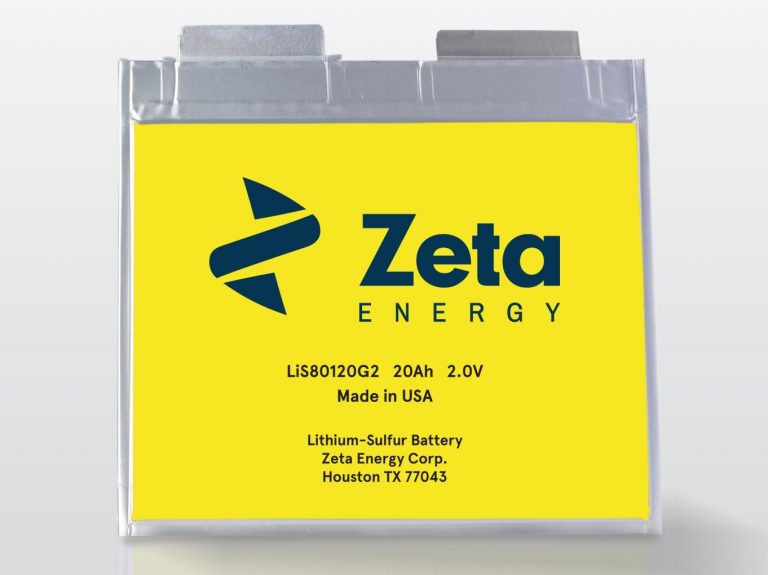
Pouch cell from Zeta Energy
(Mit freundlicher Genehmigung/Courtesy of Zeta Energy Corporation [Homepage])

Vertically aligned carbon nanotubes of the anode
(Mit freundlicher Genehmigung/Courtesy of Zeta Energy Corporation [Homepage])
The anode is based on a three-dimensional structure of vertically aligned carbon nanotubes containing metallic lithium (see illustration). The cathode uses a proprietary sulfurized-carbon material designed to suppress the polysulfide shuttle effect, a major cause of capacity loss in conventional lithium-sulfur batteries. According to Zeta, this approach enables high energy density without the use of nickel, cobalt, manganese or graphite [1][3].
Zeta Energy uses a liquid electrolyte and aims to manufacture its cells using equipment compatible with established lithium-ion battery production processes. Its sulfurized-carbon cathode material can be produced using industrial sulfur and carbon-containing feedstocks, potentially reducing material costs and supply-chain dependencies [1][2].
On 5 December 2024, Zeta Energy and the automotive group Stellantis announced a joint development agreement for lithium-sulfur batteries intended for electric vehicles. The cooperation covers cell development, pre-production work and planning for possible industrial production. The partners aim to introduce the technology into Stellantis electric vehicles by 2030, subject to successful development and industrialisation. This is a development programme, not an existing series-production supply agreement [2].
Zeta has established pilot production of sulfurized-carbon cathode material in Houston and is preparing pilot cell manufacturing activities with partners, including work at the University of Texas at Austin. The company is also exploring applications in aviation and defence. A large-scale commercial cell factory in Texas has not been confirmed as operational [1][4].
Sources
[1] Zeta Energy – Lithium-sulfur technology and cell development roadmap (accessed 11.10.2026)
[2] Stellantis – Joint development agreement with Zeta Energy (05.12.2024)
[3] Charged EVs – Interview on Zeta Energy’s lithium-sulfur cell technology (2025)
[4] DARPA – Zeta Energy presentation on pilot cells, manufacturing and technology targets (May 2026)
[5] Email communication with Zeta Energy (14.06.2024; historical information)
[cs 11.10.2026]